

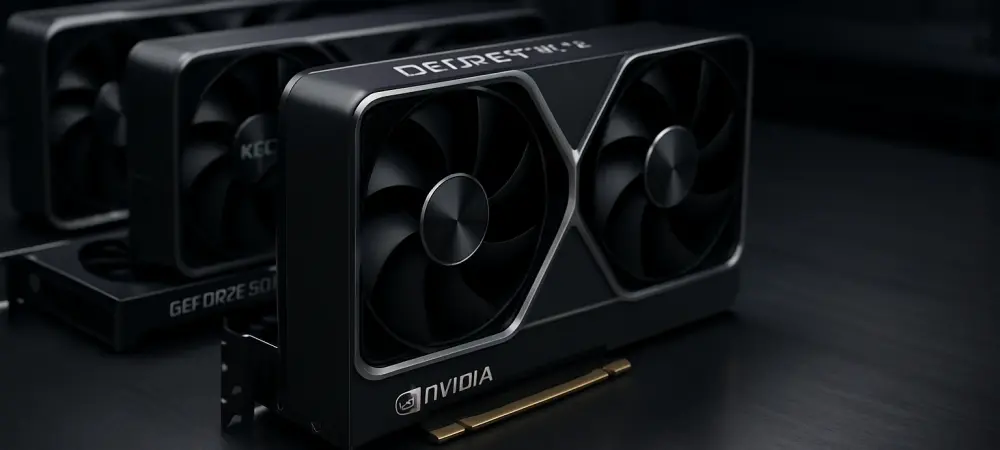
A seismic shift in technological priorities is quietly redrawing the roadmap for consumer hardware, with the immense gravity of the artificial intelligence boom pulling resources away from the once-unshakable world of PC gaming. The indefinite postponement of NVIDIA’s anticipated GeForce RTX 50 SUPER series marks a pivotal moment, signaling that the industry’s most powerful player is betting its future not on virtual worlds but on the digital brains that will build them. This decision, driven by a confluence of market forces, offers a clear window into the new economic reality governing high-performance computing, where the ravenous demand for AI processing power now dictates the flow of innovation and production.
The Dual Frontiers of GPU Technology Gaming and AI
The high-performance computing industry operates on two parallel fronts. One is the familiar landscape of consumer graphics, where NVIDIA’s GeForce line has long reigned supreme, powering immersive gaming experiences for millions. The other is the rapidly expanding domain of enterprise-level AI acceleration, a sector where specialized GPUs serve as the engines for machine learning, data science, and the development of large language models. These two segments, while technologically related, represent vastly different markets in terms of scale, profitability, and strategic importance.
At the intersection of these worlds stands NVIDIA, a company that has masterfully positioned itself to dominate both. While competitors like AMD and Intel also vie for market share, NVIDIA’s strategic foresight has allowed it to leverage its GPU architecture to capture the lion’s share of the lucrative AI and data center market. This dual dominance has created a unique internal dynamic where the needs of the enterprise now directly influence the product pipeline for the consumer, a reality that is becoming increasingly apparent.
Deciphering the Delay Key Market Catalysts and Projections
The AI Gold Rush Prioritizing Profit Over Pixels
The exponential growth of artificial intelligence has created an unprecedented demand for accelerator hardware. This AI gold rush is fueled by breakthroughs that require immense computational power, turning data centers into the most critical infrastructure of the modern era. For NVIDIA, this translates into a strategic imperative to prioritize its most profitable products. The profit margins on enterprise-grade AI accelerators far exceed those of consumer gaming cards, making the decision to reallocate resources a straightforward business calculation.
This strategic pivot is concretely demonstrated by the accelerated production of NVIDIA’s next-generation Rubin AI platform. Originally slated for a later launch, its advancement on the timeline confirms that the company is redirecting its manufacturing capacity to meet the surging enterprise demand. This reallocation means that consumer-focused product lines like GeForce are temporarily deprioritized, as the company funnels its finite resources toward the more lucrative AI sector.
Supply Chain Woes and a Missing Rival Market Data and Future Timelines
Compounding the internal shift in priorities are external market pressures, most notably within the memory supply chain. The high-performance GDDR6 and GDDR7 DRAM required for the RTX 50 series are experiencing both rising costs and significant supply shortages. This creates a logistical nightmare for a product refresh like the SUPER series, which was expected to feature increased VRAM capacity. The current market makes it not only more expensive to procure the necessary memory but also nearly impossible to secure it in the quantities required for a major consumer launch.
Furthermore, the competitive landscape has provided NVIDIA with an unexpected strategic advantage. With key rival AMD reportedly pushing its next-generation high-end consumer GPU architecture to 2027, the immediate pressure on NVIDIA has dissipated. Without a direct competitor challenging its top-tier products, the urgency to release an interim SUPER series to maintain a performance edge is significantly reduced. This lull allows NVIDIA to weather the volatile memory market and focus on its AI ambitions without sacrificing its leadership position in gaming.
A Perfect Storm The Three Pronged Challenge Forcing NVIDIA’s Hand
The decision to delay the RTX 50 SUPER series is not the result of a single factor but a perfect storm of converging challenges. The first prong is the overwhelming internal demand from NVIDIA’s own AI division, which consumes vast production resources. The second is the external pressure from a volatile memory market, where cost and availability make VRAM upgrades unfeasible. The third is the strategic opportunity afforded by a temporarily non-competitive high-end market, which removes the need for an iterative product refresh. Together, these three forces make the launch of a SUPER series both logistically complex and financially unnecessary at this time. Such a release would require NVIDIA to fight for scarce, expensive memory components to build a product for which there is no immediate competitive need, all while diverting resources from its most profitable business segment. In this context, the delay is less a setback and more a pragmatic response to an undeniable market reality.
Beyond Government Mandates How Market Forces Regulate the GPU Industry
In the absence of formal government oversight, the high-performance computing industry is being regulated by the sheer force of supply and demand. The immense profitability and resource requirements of the AI sector have created a new de facto regulatory landscape. In this environment, the market itself dictates production priorities, channeling finite resources like advanced silicon fabrication and high-bandwidth memory toward the applications that offer the greatest financial return.
This dynamic is reshaping industry practices far more effectively than any official mandate could. It forces companies to recalibrate their product roadmaps, delaying or canceling consumer-focused projects in favor of enterprise solutions. The result is a market-driven shift that directly impacts product availability for mainstream consumers, demonstrating that in the tech world, economic gravity can be the most powerful regulator of all.
The Reshaped Battlefield Projecting the Next Wave of GPU Innovation
For PC gamers and hardware enthusiasts, this strategic shift points toward a potential “GPU drought” in the high-end market. With the RTX 50 SUPER series shelved indefinitely and no major competing products on the immediate horizon, the industry may enter a quiet period lasting until 2027. This prolonged cycle between major performance upgrades will reshape consumer expectations and purchasing behaviors. The next significant wave of innovation is now projected for 2027, with the anticipated arrival of NVIDIA’s Rubin-based RTX 60 series and AMD’s next-generation architecture. This redrawn timeline focuses all eyes on a more distant horizon for a true generational leap in gaming performance. While Intel’s Big Battlemage remains a potential wildcard, its uncertain release schedule leaves it as a hopeful but unconfirmed player in the high-end space for the time being.
The Final Analysis Navigating the New Era of AI Driven Hardware
This analysis concluded that the postponement of the RTX 50 SUPER series was not a reaction to a single failure but a calculated, multi-faceted decision reflecting the new hierarchy in the semiconductor world. The convergence of insatiable AI demand, a strained memory supply chain, and a non-threatening competitive field created an environment where delaying a consumer product refresh became the most logical strategic path forward. The move underscored a fundamental power shift within the industry, where enterprise needs now set the pace of innovation.
The long-term implications for PC gamers are significant, heralding an era where consumer hardware development is secondary to the demands of artificial intelligence. This delay is a clear indicator of the evolving balance of power within NVIDIA and the industry at large. The unstoppable momentum of AI has created a new center of gravity, and for the foreseeable future, the world of consumer graphics will be orbiting it.