

The historical assumption that a handful of massive, general-purpose cloud providers would indefinitely monopolize the global compute market has been fundamentally dismantled by the arrival of specialized, high-performance neocloud ecosystems. This transformation marks a departure from the era of total abstraction, where developers were encouraged to ignore the underlying hardware in favor of convenient software interfaces. In the current landscape of 2026, the sheer intensity of artificial intelligence workloads has forced a return to the physical layer, prioritizing raw throughput and thermal management over the broad catalog of managed services that defined the previous decade. Neoclouds have emerged as the surgical response to this shift, offering a stripped-back, hardware-centric model that caters specifically to the requirements of large-scale model training and high-concurrency inference.
The emergence of these specialized providers is rooted in the “performance tax” inherent in traditional hyperscale clouds. For years, the major players focused on building vast, multi-tenant environments designed for general web applications, databases, and enterprise resource planning. While these environments are exceptionally reliable for standard business logic, they often struggle with the extreme data density and low-latency demands of modern neural networks. Neoclouds, by contrast, are built around the concept of “bare metal” efficiency, where the distance between the code and the silicon is minimized. This fundamental architecture allows researchers and engineers to extract maximum utility from every GPU cycle, a necessity when training costs for frontier models are measured in hundreds of millions of dollars.
Furthermore, the rise of neoclouds represents a cultural shift in how infrastructure is consumed. Rather than locking themselves into a proprietary ecosystem of serverless functions and proprietary databases, enterprises are increasingly viewing compute as a high-performance commodity. This shift allows for greater portability and forces providers to compete on the merits of their hardware configuration and network topology. As the industry moves toward 2027 and beyond, the neocloud model is not merely a niche alternative but a primary engine driving the next phase of the global digital economy.
The Evolution of Specialized Cloud Computing
The technological foundation of the neocloud is a deliberate rejection of the “jack-of-all-trades” approach. In the early days of cloud migration, the value proposition was based on the ability to scale up a fleet of virtual machines with a single API call. This worked because the primary bottleneck for most applications was CPU and RAM availability. However, the AI revolution changed the fundamental math of the data center. Training a generative transformer model requires a massive amount of parallel processing that traditional CPU-heavy architectures simply cannot provide efficiently. Neoclouds addressed this by designing data centers where the accelerator—the GPU or specialized ASIC—is the primary citizen, rather than an add-on peripheral.
This hardware-centric focus matters because it dictates every other component of the stack. In a traditional cloud, a virtual machine might share physical resources with hundreds of other tenants, leading to “noisy neighbor” effects that degrade performance. Neoclouds typically offer dedicated instances or entire clusters where the user has direct access to the hardware. This implementation is unique because it combines the elasticity of the cloud with the deterministic performance of on-premises supercomputers. It bridges the gap between the flexibility needed for rapid experimentation and the stability required for month-long training runs where a single second of downtime could invalidate significant progress.
Moreover, this evolution reflects a broader trend of technological decentralization. As data sovereignty laws become more stringent and the physical limits of power grids are tested, the ability to deploy specialized infrastructure in specific geographic regions becomes a strategic advantage. Neoclouds have been faster to adapt to these local realities than their hyperscale counterparts. By focusing on smaller, more efficient, and highly specialized footprints, these providers can operate in environments that might not support a massive, multi-service hyperscale campus. This agility has transformed them into the rapid-response units of the global infrastructure market.
Architecting the AI-First Environment
Accelerator-First Infrastructure
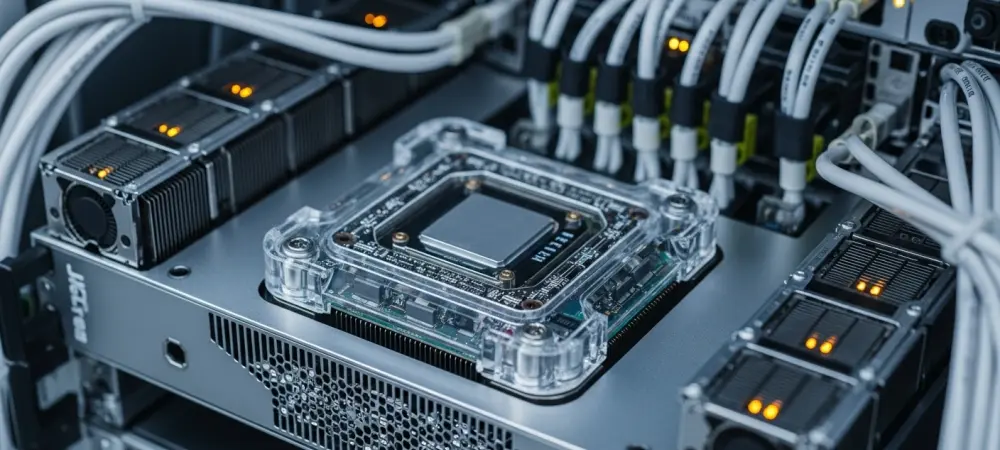
The heart of the neocloud is the high-density rack, a piece of engineering that looks fundamentally different from the server configurations of five years ago. Modern AI accelerators, such as those from the Nvidia Blackwell or AMD Instinct series, generate an immense amount of heat, often exceeding 1,000 watts per chip. Traditional air cooling is often insufficient for these densities, leading neoclouds to pioneer advanced liquid-to-chip cooling systems. These systems circulate coolant directly across the surface of the processor, allowing for much tighter packing of hardware. This density is not just about saving space; it is about reducing the physical distance data must travel, which directly impacts latency and performance.
Beyond the chips themselves, neocloud providers have reimagined power delivery. AI clusters require a massive surge of electricity that can fluctuate rapidly based on the workload. Neocloud architectures incorporate sophisticated power management units that can handle these spikes without tripping circuit breakers or damaging sensitive components. This implementation is unique because it treats the data center as a single, giant computer rather than a collection of individual servers. The result is an environment where hardware can be pushed to its theoretical limits for extended periods, providing a level of reliability that was previously only available to national research laboratories.
High-Performance Networking Fabrics
While the processors provide the “brainpower,” the networking fabric serves as the nervous system. In a neocloud environment, the interconnect is often more critical than the compute nodes themselves. When training a model across thousands of GPUs, the bottleneck is frequently the speed at which gradients can be synchronized between nodes. Neoclouds utilize high-performance fabrics like InfiniBand or specialized Ultra Ethernet configurations that offer hundreds of gigabits per second of throughput. These fabrics are configured in non-blocking topologies, ensuring that every node can communicate with every other node at full speed simultaneously.
This optimization is a significant departure from the standard Ethernet networks found in general-purpose clouds, which are designed for high-volume, low-priority traffic. In a neocloud, the network is deterministic, meaning that data packets arrive with predictable latency. This predictability is essential for the synchronous parallel processing used in deep learning. Without it, some GPUs would sit idle while waiting for others to finish their tasks, leading to massive inefficiencies. By prioritizing these specialized fabrics, neoclouds provide an environment where the scaling of performance is nearly linear, meaning that doubling the number of GPUs nearly doubles the training speed.
The Lean Software Stack
In contrast to the complex, multi-layered management consoles of traditional providers, neoclouds typically offer a lean software stack. This approach prioritizes direct access to orchestration tools like Kubernetes and Slurm, allowing engineers to manage their workloads using the same tools they would use on a local cluster. The lack of proprietary “middle-ware” reduces the overhead on the system, ensuring that more of the available memory and compute cycles are dedicated to the actual AI workload. This implementation matters for users who want complete control over their environment, from the driver version to the low-level library optimizations.
This lean approach also facilitates a faster deployment cycle. In a neocloud, an engineer can spin up a cluster of 512 GPUs and have them ready for a training job in minutes, rather than the hours or days it might take to navigate the provisioning hurdles of a larger provider. This speed is a competitive necessity in a market where the window of opportunity for a new AI model might only be a few months. By stripping away the administrative bloat, neoclouds have created a streamlined workflow that aligns perfectly with the iterative nature of modern AI development.
Key Drivers of the Neocloud Market
Several external forces have converged to accelerate the adoption of neocloud infrastructure. The most obvious is the ongoing demand for generative AI, which has created a perpetual shortage of high-end silicon. In this environment, neoclouds have functioned as the market’s pressure valve. Because they are often smaller and more focused, they have been able to secure allocations of the latest chips more quickly than the hyperscalers, who must manage global supply chains for millions of customers. This availability has made neoclouds the first choice for startups that need immediate access to the latest technology to survive in a hyper-competitive field.
Another critical driver is the physical constraint of the data center industry itself. In many global hubs, the power grid has reached its capacity, and building new, massive data centers can take several years. Neoclouds have bypassed some of these limitations by repurposing existing industrial spaces or building modular, high-efficiency sites that require a smaller overall footprint for the same amount of compute power. This flexibility is vital in a world where power availability has become a more significant constraint than capital. By optimizing for energy density, neoclouds are able to deliver more “intelligence per watt” than traditional providers.
Finally, the global semiconductor supply chain has become increasingly complex due to geopolitical tensions and trade restrictions. This has led to a diversification of hardware, with more companies looking toward alternatives to the dominant Nvidia platform. Neoclouds are often more willing to experiment with new silicon from companies like AMD, Intel, or even specialized AI startups. This openness provides a critical testing ground for the next generation of hardware, preventing a complete monopoly and ensuring that the market remains innovative. For the enterprise user, this means more choices and better long-term price stability as competition increases.
Real-World Applications and Deployment
The primary use case for neocloud infrastructure is the training of foundation models. These models, which can have trillions of parameters, require thousands of GPUs to work in perfect unison for weeks at a time. Research labs and large tech companies utilize neoclouds to run these massive jobs because the specialized networking and dedicated hardware minimize the risk of a “straggler” node slowing down the entire process. In this context, the neocloud is not just a hosting provider but a scientific instrument. The ability to monitor hardware telemetry at a granular level allows researchers to tune their models for maximum efficiency, a task that is nearly impossible in a highly abstracted virtualized environment.
Beyond training, large-scale inference tasks are also migrating to specialized clouds. As AI applications move from the lab to production, they must handle millions of requests per second with minimal latency. Neoclouds offer the high-throughput, low-latency infrastructure required to serve these models to a global audience. This is particularly relevant for applications involving real-time video processing, autonomous vehicle navigation, and complex financial modeling. In these scenarios, even a few milliseconds of delay can be the difference between a successful product and a failure. Neoclouds provide the predictable performance necessary to meet these strict requirements.
The regulated sectors of healthcare and finance represent another burgeoning market for neoclouds. These industries are often hesitant to move sensitive data to the public cloud due to concerns over data residency and security. Neoclouds address these concerns by offering regionalized infrastructure that can be customized to meet specific compliance standards. For example, a healthcare provider might use a neocloud to train a diagnostic model on patient data while ensuring that the data never leaves a specific jurisdiction. This combination of high-performance compute and localized control is a unique selling point that traditional, centralized hyperscalers often struggle to match.
Challenges and Adoption Barriers
Despite their rapid growth, neoclouds face significant challenges, the most daunting of which is capital expenditure. Building a state-of-the-art AI data center requires billions of dollars in upfront investment, largely to secure the necessary GPUs and power infrastructure. This creates a high barrier to entry and a risk of over-extension if demand for AI compute were to fluctuate. For the customer, this translates into a different kind of risk: the financial stability of the provider. While a hyperscaler has multiple revenue streams to weather a downturn, a neocloud is almost entirely dependent on the AI market.
Another barrier is the complexity of integration. Most large enterprises already have deeply entrenched identity management systems, security protocols, and data pipelines built around AWS, Azure, or GCP. Integrating a neocloud into this existing environment can be difficult, often requiring custom networking configurations and new security layers to ensure that data can move safely between the specialized AI environment and the core enterprise systems. While the emergence of federated management tools and multi-cloud orchestration platforms is beginning to mitigate these issues, the initial setup remains a significant hurdle for many IT departments.
There is also the challenge of the “talent gap.” Managing a specialized AI cluster requires a deep understanding of low-level systems programming, networking, and thermal dynamics. Many organizations have spent the last decade training their staff to manage software-defined infrastructure and may lack the expertise to handle the raw, hardware-centric model of the neocloud. This means that adopting a neocloud often requires hiring new specialists or partnering with external consultants, adding to the total cost of ownership. Overcoming this barrier will require the development of more intuitive management interfaces that can abstract away the complexity without sacrificing performance.
Future Outlook: The Federated Infrastructure Model
Looking ahead, the neocloud is likely to evolve from a standalone service into a critical component of a federated infrastructure model. In this scenario, the centralized hyperscale cloud acts as the primary orchestrator, managing general business logic and long-term storage, while specialized neoclouds are called upon as “compute engines” for intensive AI tasks. This hybrid approach allows enterprises to get the best of both worlds: the broad service ecosystem of the giants and the extreme performance of the specialists. Software layers are already being developed that can automatically route workloads to the most efficient provider based on cost, latency, and hardware requirements.
The next few years will also see an expansion in the diversity of hardware available in neoclouds. As the market moves toward 2028, we expect to see more specialized silicon designed for specific types of neural networks, such as graph-based models or edge-compatible inference. Neoclouds will be the primary gateway for these new technologies, offering users the ability to test and deploy alternative silicon without the risk of purchasing the hardware themselves. This will be particularly important for the development of autonomous systems, which require a mix of high-power training in the cloud and low-power inference at the edge.
Ultimately, the neocloud movement may lead to a more distributed and resilient internet. By placing high-performance compute closer to where data is generated—whether in urban centers, near renewable energy sources, or within specific regulatory zones—neoclouds are helping to break the centralization that has characterized the web for the last decade. This distributed model is not only more efficient for AI but also more resistant to large-scale outages and geopolitical disruptions. The neocloud is not just a temporary fix for the GPU shortage; it is the blueprint for a more specialized and robust digital backbone.
Final Assessment of Neocloud Infrastructure
The rise of neocloud infrastructure represented a pivotal moment in the history of computing, where the limits of physical hardware once again became the primary driver of architectural innovation. Throughout the mid-2020s, these specialized providers offered a necessary alternative to the increasingly bloated and general-purpose ecosystems of the traditional hyperscalers. By focusing on accelerator-first designs, high-performance networking, and lean software stacks, they solved the immediate crisis of the “GPU squeeze” and provided the foundation for the next generation of artificial intelligence. The success of these providers was not merely a result of silicon availability but a reflection of a deeper market need for efficiency and performance at scale.
In retrospect, the neocloud movement forced a healthy re-evaluation of the entire cloud industry. It demonstrated that while the convenience of a “one-stop-shop” provider is valuable, it often comes at the expense of peak performance. Large enterprises responded by moving toward a more nuanced infrastructure strategy, where workloads were carefully placed based on their specific requirements rather than a default commitment to a single vendor. This shift toward a multi-layered, federated model created a more competitive and innovative landscape, ensuring that the infrastructure could keep pace with the rapid advancements in AI research.
The long-term impact of neoclouds was the democratization of high-performance compute. By making supercomputer-grade resources available through an elastic, cloud-based model, they enabled a much broader range of companies to participate in the AI revolution. No longer was the training of foundation models restricted to the handful of companies with the capital to build their own private data centers. The neocloud provided the necessary bridge between raw silicon and transformative software, ensuring that the digital backbone of the global economy became as specialized and powerful as the algorithms it was designed to run.