

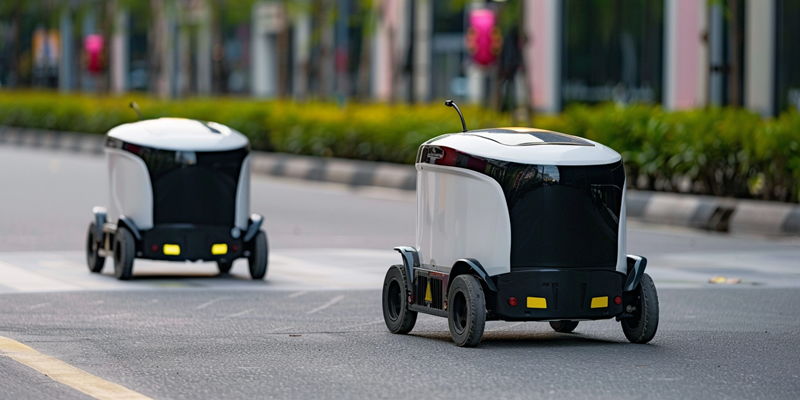
In the amalgam of robotics and artificial intelligence, a groundbreaking partnership has taken shape, set to redefine the realm of autonomous services. Naver Labs, illustrious for its forward-thinking approach in robotics, has joined forces with Adlink Technology, renowned for its proficiency in edge computing solutions. This alliance is set out to augment the abilities of “brainless” Autonomous Mobile Robots (AMRs), in particular, the cleverly designed Rookie Robots of Naver Labs’ lineup. These service robots, built for indoor applications, are on a mission to simplify delivery and distribution tasks, poised to transform workplaces by undertaking repetitive chores and unburdening human employees.
The Rookie robots boast an unconventional design that eschews traditional integrated processing units, opting instead for reliance on 5G connectivity with an external AI, Robot, Cloud (ARC) system for guidance and operation. This not only lightens their physical load but taps into the potential of centralized intelligence for navigation.
Enhancing the Brains behind the Brainless
The crux of this collaboration leans into the implementation of Adlink’s fanless embedded computers, specifically the MVP series, into Naver Labs’ Rookie robots. Armed with these computing powerhouses, the robots are set to witness an upsurge in their efficiency, precision in navigation, and overall safety in operation. Moreover, their navigational prowess within a range of industrial settings could see significant leaps in adaptability. Yet, the exact measure of improvement in computing performance and how these robots would fare without 5G connectivity remain under wraps, as these particulars were not disclosed in the recent briefing.
The vision fueling this endeavor targets not only the amplification of the robots’ functional capabilities but also envisions a seamless interaction with human workflow. The ultimate goal is to forge a future where machines and humans harmoniously share and optimize the workload.
Looking to a Robotics Revolution
In an exciting evolution of robotics and AI, a dynamic partnership emerges, poised to revolutionize autonomous services. Naver Labs, celebrated for its advanced robotics, has partnered with Adlink Technology, a leader in edge computing. This collaboration aims to enhance “brainless” Autonomous Mobile Robots (AMRs) capabilities, particularly Naver Labs’ ingeniously crafted Rookie Robots. Designed for indoor use, these service bots streamline delivery and distribution within workplaces, alleviating human workers of monotonous tasks.
Remarkably, the Rookie robots forgo built-in processors, instead leveraging 5G to connect with an external AI, Robot, Cloud (ARC) system for control and navigation. This innovative design reduces their weight and capitalizes on centralized intelligence for better maneuverability. The Naver-Adlink union signifies an ambitious step towards smart, interconnected workplaces, with robots offloading routine labor, freeing humans for more complex endeavors.