

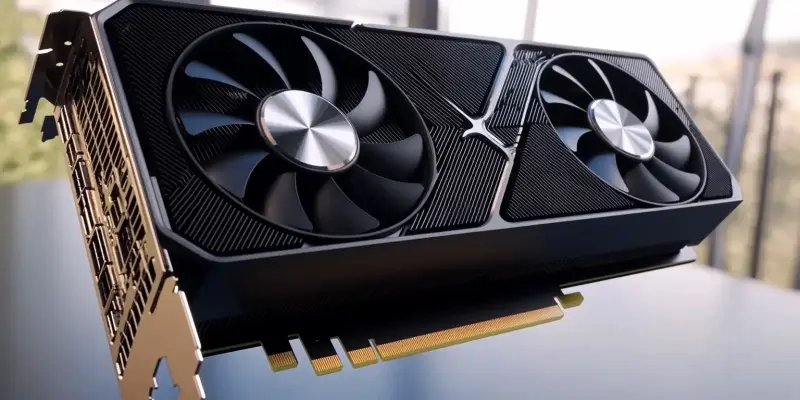
Nvidia’s new 50-series graphics cards mark a transformative shift in the gaming industry, with the MSI GeForce RTX 5070 Ti Vanguard SOC Launch Edition standing out as a notable entrant. This upgrade, particularly aimed at 4K gamers, exemplifies Nvidia’s new direction from sheer raw performance to emphasizing AI-assisted frame generation through DLSS4. Bolstered by the latest Blackwell architecture, this card promises advanced AI-driven functionalities, greatly enhancing the overall gaming experience.
AI-Powered Performance
A Leap in Gaming Capabilities
The MSI GeForce RTX 5070 Ti Vanguard offers significant enhancements beyond the baseline RTX 5070 Ti. Equipped with a boost clock of 2,588MHz in Gaming Mode and peaking at 2,602MHz in Extreme Performance, it surpasses the standard 2,520MHz typically seen in its counterparts. Central to its success is the AI Multi-Frame Generation technology embedded within Nvidia’s Blackwell architecture. This breakthrough enables up to four AI-boosted frames for each actual frame rendered, providing a smoother and more immersive gaming experience. As a result, gamers can expect unprecedented fluidity and responsiveness in visually demanding and fast-paced games.
The performance of the RTX 5070 Ti Vanguard was thoroughly tested on a high-end system featuring an Intel Core i7 14700K, 32GB of DDR5 RAM, and MSI’s Z790 Tomahawk Max WiFi motherboard. It demonstrated exceptional capabilities in several graphically intensive games. Cyberpunk 2077, with Ray Tracing Overdrive enabled, ran at an impressive 78 fps without DLSS, while activating DLSS4 nearly doubled the frame rate to 150 fps. This performance enhancement was consistently observed across other titles as well. For instance, Indiana Jones and the Great Circle and Diablo IV operated at high frame rates, and Monster Hunter Wilds managed a consistent 107 fps at 4K settings, underscoring the card’s potential to handle the most demanding games with ease.
Enhanced User Experience
A standout element of the MSI GeForce RTX 5070 Ti Vanguard is its thermal management. MSI’s inclusion of the Hyper Frozr cooling system, armed with STORMFORCE fans, ensures optimal cooling even under intense loads, keeping temperatures below 50°C. Furthermore, the quiet switch feature provides a quieter operational mode by reducing fan noise without sacrificing performance excessively. Yet, for gamers seeking to push their hardware to the max, operating in Gaming Mode is advised to strike the perfect balance between performance and noise levels.
It is worth noting the significant power consumption associated with Nvidia’s new series. Despite the robust performance, the RTX 5070 Ti demands careful consideration of power requirements, drawing approximately 300W under full load. To comfortably manage this, an 800W power supply unit (PSU) is recommended to ensure adequate power headroom and system stability during peak performance moments. This higher power draw underscores the need for a capable PSU to fully leverage the card’s capabilities without encountering power-related issues.
Market Position and Affordability
Value for High-End Gaming
With a retail price exceeding $1,100, the MSI GeForce RTX 5070 Ti Vanguard targets serious gamers, particularly those upgrading from the 30-series cards, providing a valuable proposition for 4K gaming enthusiasts. This price point, while on the higher end, reflects the advanced technology and significant performance improvements the card brings to the table. The out-of-the-box overclocking capabilities, paired with MSI’s superior cooling solutions, create a compelling package for gamers who prioritize exceptional gaming performance without the need for extensive manual tweaking.
The superior cooling mechanism and AI-driven enhancements in the RTX 5070 Ti Vanguard SOC Launch Edition elevate it above the competition, ensuring consistent, high-quality performance in the most demanding games. This card is a perfect fit for users looking to invest in a future-proof graphics solution that can handle current and upcoming game releases. Prospective buyers should weigh their need for 4K gaming against the associated costs and power requirements, but for those who demand top-tier performance, this card stands out as a solid choice.
Conclusion
Nvidia’s latest 50-series graphics cards represent a groundbreaking shift in the gaming industry, epitomized by the MSI GeForce RTX 5070 Ti Vanguard SOC Launch Edition. This graphics card specifically targets 4K gamers, highlighting Nvidia’s new focus on AI-assisted frame generation via DLSS4, rather than relying solely on raw performance. Enhanced by the cutting-edge Blackwell architecture, this card promises significant advancements in AI-driven functionalities, ensuring a superior and immersive gaming experience. The RTX 5070 Ti Vanguard SOC Launch Edition not only provides stunning visuals but also enhances game fluidity and responsiveness, creating a more enjoyable and compelling gaming environment. This innovative approach by Nvidia signifies a move towards leveraging AI to elevate gaming standards, demonstrating a commitment to evolving technology that meets the needs of modern gamers. With these advancements, the gaming experience is set to become more dynamic and engaging, showcasing the potential of AI in the next generation of gaming hardware.