

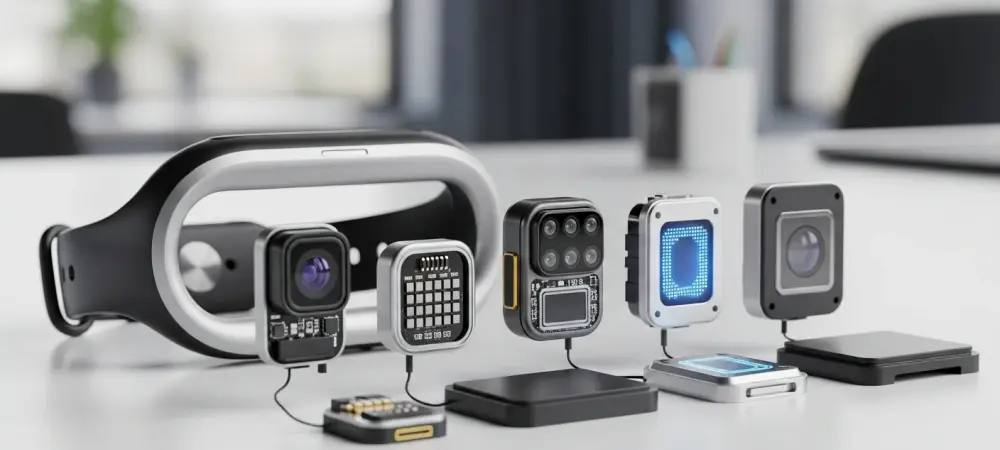
The rapidly expanding ecosystem of artificial intelligence wearables is currently navigating a pivotal transition from specialized technological novelties into indispensable tools for modern professional and personal productivity. This shift signifies a departure from the era of experimental prototypes toward a landscape dominated by integrated consumer electronics. Today, the market has bifurcated into distinct segments, including smartglasses, audio-enabled pendants, biometric pins, and sophisticated health-monitoring devices that track more than just steps.
Major industry players and independent innovators are now locked in a race to define the technological standards of this new category. While early adopters prioritized raw computational power, current development cycles emphasize the aesthetic and ergonomic requirements of all-day wearability. For a device to achieve mainstream success, it must transcend the status of a peripheral gadget and become a seamless extension of the user. This transformation requires a delicate balance between high-performance hardware and the unobtrusive design needed for social acceptance.
The Evolution of AI Wearables from Niche Gadgets to Daily Essentials
The current wearable market is defined by a rapid diversification of form factors that cater to specific user lifestyles. Smartglasses have emerged as a frontrunner due to their ability to provide heads-up information, while discreet pendants and pins offer hands-free interaction without the need for a screen. These devices are increasingly being viewed as essential companions that augment human capability through real-time language translation, contextual reminders, and advanced fitness coaching.
As independent firms challenge established tech giants, the focus has shifted toward refining the user experience. Manufacturers recognize that technical specifications mean little if a device is too heavy or unsightly for public use. Consequently, the industry is witnessing a trend where high-performance sensors are packed into frames that look identical to traditional eyewear. This push for “invisibility” is a primary driver behind current commercial strategies and design philosophies.
Shifting Paradigms and Economic Growth in Intelligent Hardware
Emerging Trends Toward Privacy-Centric Hardware Design
A significant shift is occurring in how companies monetize intelligent hardware, moving away from data-driven revenue models toward hardware-first strategies. Consumers are becoming increasingly wary of “always-on” surveillance and the monetization of their digital footprints. This skepticism has forced developers to rethink how devices capture and process information, leading to the rise of edge computing where data remains on the device rather than being uploaded to the cloud. The introduction of modularity serves as a direct response to the social scrutiny found in professional and private environments. By allowing users to physically alter their devices, manufacturers are giving individuals the power to opt-out of digital visibility without losing the primary function of their hardware. This trend reflects a broader move toward user-controlled privacy, where the hardware itself acts as a verifiable guarantee of security.
Market Projections and the Road to a $300 Billion Industry
Financial analysts are closely monitoring growth indicators that suggest the AI hardware sector is on a trajectory to reach a $300 billion valuation by 2033. Performance metrics for AI-specific shipments have already begun to outpace traditional consumer electronics like tablets and standard smartwatches. This surge is fueled by the integration of advanced generative models into hardware that provides immediate, tangible value to the end user.
The integration of prescription lenses has been identified as a critical factor for long term market penetration. Since a significant portion of the global population requires vision correction, smartglasses that can accommodate prescription needs have a much higher ceiling for adoption. By merging medical necessity with digital utility, the industry is effectively tapping into a pre-existing market of eyewear users who are ready for an upgrade.
Navigating the Friction Between Technological Capability and Social Stigma
The “Privacy Paradox” remains one of the most significant hurdles for the industry, as wearables face much higher scrutiny than smartphones despite having similar capabilities. While most people are comfortable with a phone in a meeting, a pair of glasses with a camera often triggers immediate discomfort. This friction creates logistical challenges for those who rely on smartglasses for vision but work in restricted zones like gyms, secure offices, or sensitive healthcare environments. To overcome this lack of trust, the industry is moving toward visible and verifiable hardware disconnects. Relying on software toggles or “do not disturb” modes is no longer sufficient for skeptical observers. Manufacturers are finding that the most effective way to reduce interpersonal etiquette friction is to provide a physical way to show that a device is “offline.” This transparency is essential for normalizing the presence of AI in shared social spaces.
Establishing New Standards for Security and User Compliance
Physical modularity is becoming a cornerstone for meeting diverse regional and corporate privacy policies. In an era where data regulations vary wildly between jurisdictions, hardware that can be physically adapted offers a universal solution. For example, a user might use a fully functional AI temple arm in a public park but switch to a non-electronic “dummy” component before entering a secure corporate briefing. This move toward mechanical solutions rather than software-based privacy settings represents a fundamental change in hardware transparency. When the electronic components are physically removed, there is no ambiguity about whether the device is recording. Such hardware-level assurance significantly boosts consumer confidence and simplifies the path to regulatory approval in strictly controlled sectors.
The Next Frontier of Intelligent Vision and User Autonomy
The future of the industry lies in the standardization of modular components, such as interchangeable temples and sensor modules. This approach allows for a convergence of high-fashion aesthetics with sophisticated technology, enabling users to customize their look while retaining advanced AI functionality. Potential disruptors in the eyewear space are already prioritizing this level of user autonomy, recognizing that style and control are just as important as processing speed.
Global economic conditions will continue to dictate the pace of innovation, but the demand for smarter tools remains resilient. As the technology matures, we can expect to see modularity become the industry standard rather than a niche feature. This evolution will likely lead to a marketplace where the “smart” elements of a device are treated as detachable upgrades, allowing the core hardware to remain relevant for years.
Concluding Perspectives on Unlocking the Mass Market
The report demonstrated how modular hardware effectively dismantled the cultural and logistical barriers that previously hindered the adoption of AI wearables. By prioritizing physical transparency over complex software settings, manufacturers successfully addressed the deep-seated privacy concerns of a global audience. It was observed that the transition from controversial gadgets to seamless vision solutions depended on giving users total control over their digital presence. Investors who focused on trust-based technology and friction-less experiences found themselves at the forefront of a historical market shift. Ultimately, the industry proved that the path to mass-market success required a commitment to both high-tech utility and fundamental human privacy.