

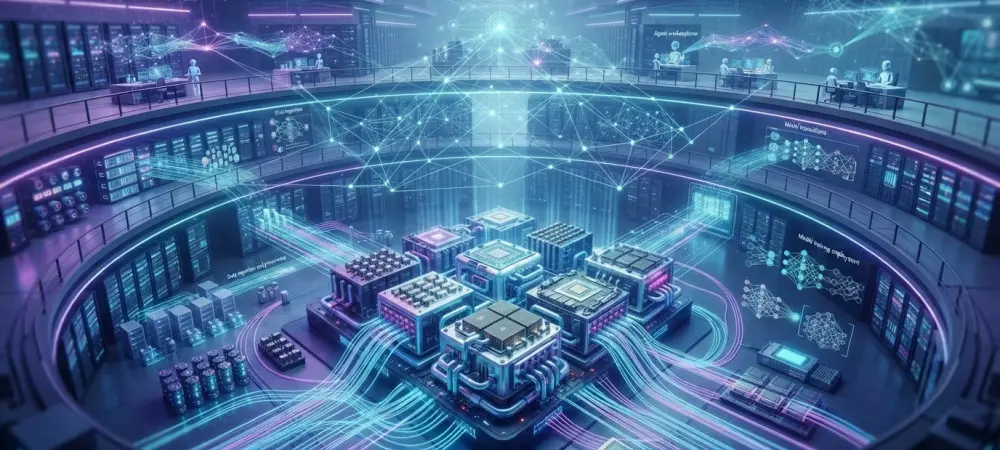
The transition from static language models that merely respond to prompts toward dynamic systems that autonomously navigate complex enterprise environments is redefining the fundamental requirements of modern cloud architecture. This evolution requires more than just better reasoning; it demands a radical overhaul of how compute is allocated and how security is enforced across distributed environments. Organizations are looking for ways to move beyond simple automation toward ecosystems where agents act as persistent digital employees.
The Paradigm Shift to Agentic Workflows
This infrastructure represents a strategic pivot, shifting the focus from the intelligence of a single model to the reliability of an entire ecosystem. As enterprises scale these agents, they encounter significant hurdles related to state management and resource utilization. Traditional cloud functions are too ephemeral for these tasks, while standard virtual machines are often too heavy, creating a technical gap that new architectural standards are currently filling.
The emergence of agentic workflows has necessitated a move from transient interactions to long-running, stateful processes. This shift implies that the infrastructure must now support agents that can “think” over hours or days, rather than seconds. Consequently, the industry is seeing a convergence of container orchestration and specialized AI runtimes to manage these sophisticated lifecycles.
Core Pillars of the Agentic Infrastructure
High-Density Managed Compute: The Agent Compute Engine
Central to this infrastructure is a compute environment designed for the erratic lifecycle of an autonomous agent. Modern engines utilize micro-virtual machine architectures to provide isolated environments that can be “frozen” without losing the crucial context required for long-term tasks.
By implementing snapshot-based pause-and-resume capabilities, these systems eliminate the cost of idle processing while maintaining near-instant responsiveness. This architectural choice is a necessity for financial viability when deploying agents at an industrial scale. Hardware-level isolation ensures that each agent operates within a cryptographically verified sandbox, protecting sensitive enterprise data from potential cross-session leaks.
Open Runtimes and Portability: The Agent Substrate
The introduction of open runtimes like the Agent Substrate has provided a standard for execution within Kubernetes environments. This runtime effectively separates agent logic from underlying hardware management, allowing for massive compute density that was previously unattainable. In modern stress tests, these systems demonstrated the ability to handle thousands of concurrent agents with minimal latency, proving the substrate can support global operations.
This move toward open standards allows developers to avoid vendor lock-in while leveraging familiar orchestration tools. By supporting diverse sandboxing technologies, the infrastructure accommodates various frameworks and coding environments. The ability to return hardware resources to a shared pool when an agent is idle significantly lowers the barrier to entry for resource-intensive applications.
Emerging Trends in Autonomous AI Orchestration
Orchestration is evolving toward complex, multi-agent coordination where specialized entities collaborate on single objectives. Recent industry shifts show a move toward decentralized systems where agents interact to solve multifaceted problems without constant human intervention. This trend is driven by the realization that a single, massive model is often less efficient than a swarm of specialized agents working within a well-defined execution layer.
Furthermore, there is a growing emphasis on long-term memory and persistent state within these orchestrated environments. Modern frameworks are now incorporating vector-based memory buffers that allow agents to remember past interactions across different sessions. This capability transforms agents from simple task-executors into knowledgeable partners that understand the historical context of the business processes they manage.
Real-World Implementations and Enterprise Adoption
Real-world implementations in sectors like beauty technology and research demonstrate how these frameworks deliver immediate value. Large corporations have integrated agentic governance to unify identity across global runtimes, enabling faster innovation without compromising security.