

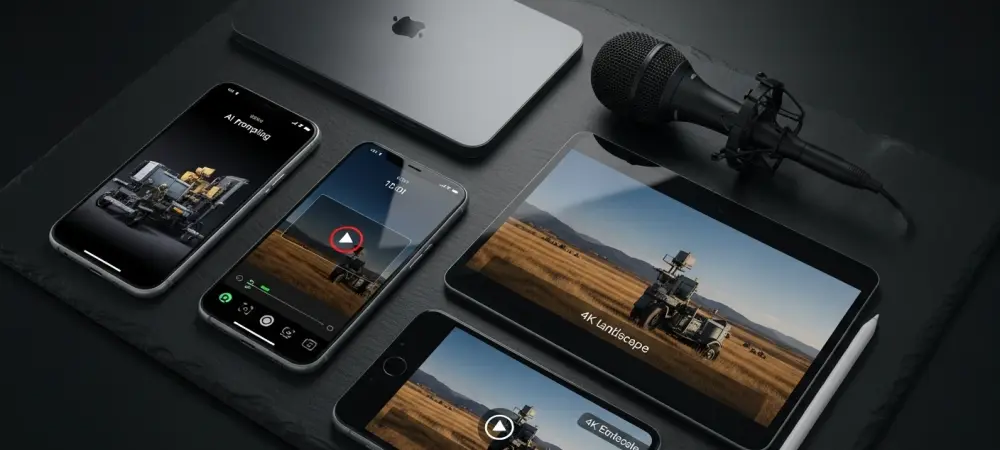
A professional-quality cinematic sequence that once required a fleet of expensive equipment and a dozen specialists can now be rendered in under sixty seconds by an individual holding a standard smartphone. This seismic shift characterizes the current state of mobile AI video generators, which have transitioned from rudimentary toys to essential components of the modern digital economy. By integrating sophisticated diffusion models with localized hardware acceleration, these tools have fundamentally altered how visual stories are told, bypassing traditional bottlenecks of post-production. The democratization of high-fidelity cinematography is no longer a distant theoretical concept; it is a functional reality that is currently reshaping the competitive landscape for independent creators and multinational brands alike.
The rise of the mobile AI video generator represents more than just a software update; it signifies the total decentralization of the production studio. In the current market, the barrier to entry for producing high-definition, narratively coherent video content has been effectively dismantled. While the technology relies heavily on complex back-end architectures, the user experience has been distilled into intuitive, prompt-driven interactions that prioritize speed without sacrificing visual integrity. This review examines the underlying mechanisms of these tools, their practical utility in the 2026 creator economy, and the technical hurdles that still define the boundaries of generative media.
The Evolution of Mobile-First AI Video Generation
The journey of mobile-first AI video generation has been defined by the transition from heavy, desktop-dependent rendering to agile, mobile-native workflows. In the earlier stages of development, generative video was plagued by significant temporal instability, where objects would warp or flicker between frames, making the output unsuitable for professional use. The introduction of temporal stability layers within diffusion models solved this by ensuring that the AI maintains a consistent understanding of spatial geometry across the entire duration of a clip. This advancement allowed developers to port these capabilities to mobile environments, where the focus shifted toward optimizing the balance between on-device processing and cloud-based rendering.
Modern mobile AI video tools, such as the Visionary platform, utilize a hybrid infrastructure that leverages the specialized neural engines found in contemporary smartphone silicon. This localized processing handles the initial interpretation of user intent and low-resolution previews, while the heavy lifting of 4K rendering is often offloaded to distributed GPU clusters in the cloud. This dual-layer approach is significant because it provides the responsiveness of a local app with the raw power of a high-end workstation. For the independent creator, this means the ability to iterate on complex visual ideas in real time while sitting in a coffee shop or commuting, a degree of flexibility that was previously inconceivable.
The democratization of these workflows has also been fueled by the widespread adoption of standardized cinematic styles within the AI models themselves. By training on vast datasets of professionally shot footage, these generators can automatically apply principles of lighting, framing, and color grading that once took years of study to master. This has leveled the playing field, allowing a solo marketer to produce content that mirrors the aesthetic quality of a high-budget commercial. Consequently, the technology has moved beyond its origins as a novelty and has become a core production accelerant that defines the current pace of content consumption across global digital platforms.
Technical Capabilities and Core Features
Text to Video AI Synthesis: From Language to Motion
The primary engine driving the current surge in mobile content creation is text to video AI synthesis, a feature that translates natural language descriptions into fluid cinematic sequences. This technology functions by mapping linguistic tokens to specific visual attributes and motion vectors, allowing the model to “understand” the physical laws of a scene. When a user prompts the system for a drone shot over a rainy cityscape, the AI does not simply pull from a database of existing clips; it constructs a three-dimensional environment from scratch, calculating how light should reflect off wet asphalt and how camera movement should influence the parallax of the buildings.
The uniqueness of this implementation lies in its ability to produce physically plausible motion that respects the constraints of the real world. Unlike earlier iterations that often produced “dream-like” or surreal distortions, current models prioritize structural coherence and environmental consistency. This matters because it enables creators to use AI-generated footage as a legitimate substitute for B-roll or location shots. By reducing the need for physical travel and expensive camera rigs, text to video synthesis has transformed the creative process from one of logistical management to one of pure conceptual ideation, where the only limit is the clarity of the user’s prompt.
Moreover, the integration of advanced Large Language Models (LLMs) as the interface for these generators allows for nuanced control over the final output. Users can specify camera lenses, lighting conditions, and even the emotional tone of a scene through descriptive text. This level of granularity ensures that the AI serves as a collaborative partner rather than a randomized generator. As these models continue to refine their understanding of complex physics, such as fluid dynamics and human anatomy, the gap between AI-generated sequences and traditionally captured footage continues to shrink, making the technology indispensable for high-volume publication strategies.
Image to Video Animation and Enhancement
Image to video animation has emerged as a critical bridge between static graphic design and dynamic video storytelling. This technical capability allows users to upload a single photograph or an AI-generated still and instruct the model to breathe life into it. The process involves sophisticated depth estimation, where the AI identifies the foreground, middle ground, and background of an image to create a sense of three-dimensional space. Once the spatial map is established, the model applies environmental effects—such as swaying trees, moving clouds, or realistic character gestures—to transform the static asset into a vivid cinematic moment.
This feature is particularly valuable for brand consistency and personal branding, as it allows creators to repurpose existing high-quality imagery into fresh video content without starting from zero. In the context of product marketing, a still photo of a watch can be transformed into a dynamic advertisement where light glints off the crystal and the hands move with precision. The performance characteristics of these animations are now so refined that they can maintain the exact details of the original image, preventing the “hallucination” of new, unwanted artifacts. This reliability is what separates professional-grade mobile tools from experimental software.
The technical complexity of maintaining fidelity during animation cannot be overstated. It requires the AI to understand the texture of materials and the way shadows should shift as the virtual camera moves. For the mobile user, this means that a single successful image generation can yield dozens of different video variations, significantly extending the life cycle of a creative asset. This efficiency is a primary driver for solo marketers who must maintain a constant presence on visual-heavy platforms while operating with limited time and resources.
Professional Output and Monetization Standards
The shift toward no-watermark 4K exports has become the gold standard for mobile AI video generators, marking a definitive break from the era of “freemium” tools that cluttered content with branding. In the current digital landscape, the ability to produce clean, high-resolution output is a functional requirement for monetization. Major platforms such as TikTok, YouTube Shorts, and Instagram Reels have updated their algorithms to favor original, high-quality content while often deprioritizing videos that carry visible watermarks from third-party editing apps. Therefore, a professional tool must offer a path to clean exports to be considered viable for serious creators.
High-resolution 4K output is equally vital, as it ensures that the content remains crisp across a variety of screen sizes, from mobile devices to desktop monitors and smart televisions. This technical standard allows AI-generated content to be integrated seamlessly with traditional footage in professional editing timelines. Furthermore, the absence of watermarks enables creators to secure brand deals and sponsorships, as corporate partners require their advertisements to be free of competing logos. By providing these professional standards, mobile AI tools have effectively removed the “AI look” from the equation, allowing the quality of the content to stand on its own merit.
Beyond resolution, the monetization standards of the current year demand that AI tools provide consistent frame rates and standard color profiles. This technical alignment ensures that exported files are ready for immediate publication or further post-processing in professional suites. The monetization of “faceless” content channels, which rely entirely on AI-generated visuals, is now a multi-million dollar industry. These channels depend on the reliability of mobile apps to produce massive quantities of high-tier video that meets the rigorous quality checks of platform-specific partner programs.
Emerging Trends in Generative Content
The current landscape of generative content is dominated by the rise of high-volume publication strategies, where the speed of AI production allows creators to dominate niche markets through sheer frequency. This trend has led to the proliferation of “faceless” channels—content hubs where the creator remains anonymous, and the entire visual narrative is constructed via AI. These channels focus on storytelling, educational content, and news synthesis, using the efficiency of mobile video generators to stay ahead of the traditional news cycle. The shift toward this model is a direct result of the reduced cost of production, which allows for experimentation across multiple niches simultaneously.
Furthermore, the intersection of video generation and search engine dynamics has given birth to the disciplines of Generative Engine Optimization (GEO) and AI Search Engine Optimization (AISEO). As more users turn to AI-powered search tools to discover content, creators are tailoring their video metadata and prompts to be more “readable” by these algorithms. This involves using specific keywords and structural data that help AI agents categorize and recommend their videos. The result is a new form of digital marketing where the success of a video depends as much on its algorithmic compatibility as its visual appeal.
Another significant trend is the move toward hyper-personalization. Creators are using AI to generate multiple versions of the same video, each tailored to a different demographic or aesthetic preference. A travel influencer might generate one version of a video with a lo-fi, nostalgic filter for one audience and a high-contrast, cinematic version for another. This level of customization, once the domain of major advertising agencies with massive budgets, is now a standard feature in mobile AI suites. It represents a shift toward a more fragmented and targeted media environment where content is no longer “one size fits all.”
Real-World Applications and Industry Deployment
In the e-commerce sector, the deployment of mobile AI video tools has fundamentally changed how products are showcased to consumers. Small business owners no longer need to hire professional videographers to create compelling social media ads; instead, they use image-to-video tools to animate their inventory. This has drastically lowered the cost of customer acquisition, as high-converting video ads can be produced and tested in a matter of minutes. The ability to quickly iterate on different visual hooks allows marketers to find the most effective way to engage their audience without a significant upfront investment.
The digital art and NFT markets have also integrated AI video as a primary medium for creative expression. Artists are leveraging text-to-video synthesis to create complex, evolving visual pieces that would be impossible to animate by hand. These assets are then minted as unique digital collectibles, often featuring temporal loops or generative elements that react to external data. This application highlights the role of AI not just as a tool for efficiency, but as a new medium for artistic exploration that challenges traditional definitions of authorship and craft.
Additionally, solo marketers and social media managers are using these tools to compress their entire content pipeline. By generating b-roll, transitions, and even background elements on the fly, a single individual can manage the social media presence of multiple brands with the output quality of a full agency. This compression of the production cycle is particularly evident in the rapid-response marketing of trending topics, where being the first to post high-quality video can lead to exponential growth in engagement. The integration of AI into these workflows has turned the “production studio” into an app that fits in a pocket.
Technical Hurdles and Market Obstacles
Despite the rapid progress in the field, several technical hurdles remain that prevent mobile AI video generation from reaching total parity with traditional cinematography. The most persistent of these is maintaining absolute temporal consistency across long-form content. While short clips of five to ten seconds are now remarkably stable, longer sequences still face issues with “character drift,” where a person’s features or clothing might subtly change from one shot to the next. Solving this requires massive amounts of memory and computational power, which can be difficult to manage on mobile devices without causing thermal throttling or excessive battery drain.
Regulatory and ethical obstacles also represent a significant challenge for the industry. As AI-generated content becomes indistinguishable from reality, platform-specific disclosure requirements have become more stringent. Creators are often required to tag their content as AI-generated, which can sometimes impact viewer trust or algorithmic reach. Moreover, the competitive landscape is shifting toward credit-based pricing models that can be expensive for high-volume users. Balancing the cost of high-end GPU time with a subscription model that remains accessible to independent creators is a delicate act that many developers are still trying to perfect.
The high computational demand of on-device AI inference is another physical limitation. While mobile chips are becoming incredibly powerful, the heat generated by intensive AI tasks can limit the duration of a creative session. Developers are forced to find clever ways to optimize their code, often relying on “quantization”—a process that reduces the precision of the AI model to make it run faster on mobile hardware. However, this can sometimes lead to a slight degradation in visual quality compared to full-scale cloud models. Navigating these trade-offs between speed, heat, and quality remains a primary focus for the next generation of mobile app development.
Future Outlook and Technological Trajectory
Looking ahead, the trajectory of mobile AI video generation is moving toward real-time interactivity and seamless hardware integration. We are approaching a point where the distinction between “editing” a video and “generating” one will vanish. Future updates to mobile silicon will likely include even more dedicated AI cores, allowing for real-time style transfer and object manipulation during a live recording. This would allow a creator to film a scene in their backyard and instantly transform the environment into a sci-fi landscape or a historical setting through their viewfinder, effectively merging augmented reality with generative video.
The long-term impact on the professional film industry will be profound, as the lowering barrier to entry redefines the very concept of a production studio. Traditional roles in lighting, set design, and even location scouting may be supplemented or replaced by “prompt engineering” and AI curation. However, this does not signify the end of human creativity; rather, it shifts the focus toward high-level direction and storytelling. The most successful creators will be those who can harness these tools to execute complex visions that were previously limited by budget or technical expertise.
Integration with the broader Internet of Things (IoT) and wearable technology also presents an interesting path for development. As smart glasses and other peripherals become more common, the ability to generate and overlay AI video content in a hands-free environment will open up new avenues for immersive storytelling. The shift toward “spatial computing” will require AI video tools to generate content that is not just a flat rectangle on a screen, but a 3D asset that can be interacted with in physical space. This evolution will further cement the role of generative AI as the foundational technology of the next era of digital media.
Final Assessment of Mobile AI Video Tools
The transition from AI as a curious novelty to a core production accelerant was completed as the technology integrated deeply into the mobile creator’s daily life. It was observed that the most successful platforms were those that prioritized a balance between raw generative power and practical, clean output for professional use. The evolution of tools like Visionary demonstrated that mobile-first design could compete directly with desktop software by leveraging the unique strengths of portable hardware and cloud-based scalability. This shift allowed for a more democratic creative environment where the quality of an idea became the primary differentiator rather than the size of a production budget.
Reflecting on the impact of these generators, it was clear that they functioned as a massive force multiplier for the global creator economy. The ability to animate static images, generate cinematic b-roll from text, and export 4K files without watermarks provided a comprehensive toolkit for the modern entrepreneur. While technical challenges like temporal consistency and high power consumption persisted, the rapid pace of iteration suggested that these limitations were temporary hurdles rather than permanent barriers. The market responded by rewarding tools that offered transparency, ease of use, and professional-grade fidelity, setting a high bar for future developers.
Ultimately, the rise of mobile AI video generation redefined the relationship between the creator and the medium. It replaced the mechanical labor of traditional editing with a more fluid, conceptual process that favored vision and narrative strategy. As the technology matured, it became an invisible but essential layer of the digital landscape, powering everything from viral social media clips to professional advertising campaigns. The legacy of this era was the permanent expansion of human creative capacity, proving that when the technical barriers to production were removed, the diversity and volume of global storytelling could reach unprecedented heights.