

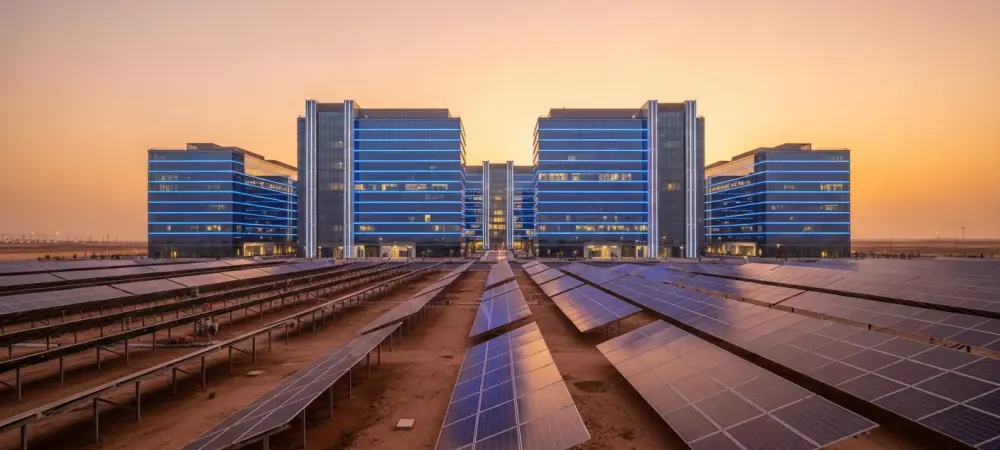
The silent hum of high-performance servers is rapidly replacing the traditional sounds of industry across the Middle East as the region undergoes a tectonic shift in its economic identity. This profound technological metamorphosis is transitioning nations historically defined by energy exports into global leaders in digital infrastructure. At the heart of this shift is the explosive growth of the datacentre market, which is projected to triple its capacity by the end of the decade. As government-led visions, surging demand for cloud computing, and the rapid advancement of artificial intelligence converge, the United Arab Emirates, Saudi Arabia, and Qatar are positioning themselves as vital digital gateways. This transformation is not merely a regional trend but a strategic realignment that connects the technological ecosystems of Asia, Africa, and Europe, setting the stage for a new era of global connectivity.
Foundations of the Regional Digital Infrastructure
A primary driver behind this expansion is the region’s unique geographic position. Acting as a bridge between three continents, the Middle East serves as a critical landing point for numerous submarine cables originating from major hubs like Singapore, India, and various African nations. This connectivity is essential for low-latency data transmission between global markets. Historically, the region relied on its role as a transit point, but recent shifts have seen it evolve into a destination for data storage and processing. This evolution reflects a broader trend toward decentralizing the internet’s core and moving processing power closer to emerging consumer markets.
Furthermore, the region’s abundant access to energy provides a significant competitive advantage that few other global hubs can match. Large-scale datacentre operations are notoriously energy-intensive, and the Middle East’s ability to provide massive energy generation capacity at competitive costs makes it an attractive destination for global tech giants. These foundational pillars—geographic advantage and energy security—are the bedrock upon which the current infrastructure boom is built. By leveraging these natural and infrastructural gifts, the region is successfully mitigating the high operational costs that often hinder growth in European or North American markets.
Strategic Drivers and Market Evolution
Governmental Vision: A Catalyst for Growth
Unlike many other markets where growth is primarily driven by private enterprise, the Middle East’s digital evolution is heavily steered by proactive government policy. National strategies, such as Saudi Arabia’s Vision 2030 and the UAE’s National Strategy for Artificial Intelligence, are central to this momentum. These frameworks are designed to diversify national economies away from oil and gas by fostering a high-tech ecosystem. The commitment to these goals is visible in the rapid implementation of digital-first policies that encourage both foreign investment and local entrepreneurship.
In Saudi Arabia, digitalization is integrated into every facet of governance and civic life through platforms like the Seha Virtual Hospital and unified digital identity systems. These top-down initiatives create a stable and predictable environment for investors, ensuring that the necessary regulatory frameworks and digital literacy are in place to support massive infrastructure projects. Moreover, the integration of technology into the public sector provides a guaranteed base level of demand for datacentre services, reducing the risks typically associated with large-scale capital expenditures in emerging markets.
The Surge: Hyperscale and Cloud Demand
The scale of this infrastructure boom is reflected in recent market forecasts. The Middle East datacentre construction market is expected to reach an estimated valuation of nearly $7 billion by 2030. In terms of technical capacity, existing third-party infrastructure has already moved beyond the early stages of development and is entering a phase of exponential expansion. A robust pipeline of upcoming projects is set to propel total capacity to 1.5 gigawatts by the end of the decade. This growth is fueled by changing consumer behaviors, including the rapid rise of e-commerce, digital payment systems, and high-definition streaming across a young and tech-savvy population.
The pressure on existing infrastructure has reached a point where both hyperscale datacentres for global cloud providers and colocation facilities for diverse business needs have become essential for economic stability. As regional enterprises move away from on-premise hardware toward more flexible cloud-based models, the requirement for localized, high-speed data processing has never been higher. This transition is not just about storage; it is about providing the computational power necessary to run the complex algorithms that define modern business operations.
Regional Compliance: Local Infrastructure Leaders
The strategic importance of the Middle East has attracted the world’s most prominent technology companies, such as Amazon Web Services and Microsoft Azure. However, the narrative is not solely about international giants. Local providers are playing a crucial role in meeting regional needs, particularly regarding data localization laws. These regulations often require that sensitive data remain within national borders, making local datacentres a necessity for government agencies and financial institutions.
Companies like Khazna Data Centers have emerged as leaders, scaling their capacity to meet the surge in demand triggered by the ongoing digital acceleration. These local entities provide the secure, energy-efficient, and scalable facilities that governments and regional enterprises require to stay compliant with local laws while navigating regional market complexities. Their success demonstrates that local expertise in cooling technologies and regional grid management is just as valuable as global brand recognition when it comes to infrastructure reliability.
Future Innovations: Energy and Technology
As the region builds out its digital future, sustainability and emerging technologies are shaping the next phase of development. Modern datacentres are increasingly being designed with “green tech” in mind to mitigate the environmental impact of high power consumption. Innovations in cooling infrastructure—crucial for the hot Middle Eastern climate—and water-smart technologies are being integrated into new builds. Furthermore, the development of “smart cities” like Neom will require unprecedented levels of edge computing and AI integration to manage everything from autonomous transport to automated energy grids.
We can expect to see a shift toward modular datacentre designs and increased investment in renewable energy sources, such as solar power, to feed these massive data hubs. By integrating large-scale solar arrays directly with datacentre campuses, providers are beginning to create a closed-loop energy system that reduces reliance on the traditional grid. This move toward sustainability is not just an environmental choice but a strategic one, as it ensures long-term price stability for energy—the single largest operational expense for any data facility.
Strategic Recommendations: Navigating the Boom
For businesses and investors looking to capitalize on this tripling capacity, several actionable strategies are essential. First, organizations should prioritize partnerships with local providers who understand the specific regulatory and data residency requirements of each nation. Second, enterprises must invest in scalable cloud architectures today to ensure they are ready for the massive capacity increase coming over the next few years. For professionals in the tech sector, developing expertise in AI-driven infrastructure management and sustainable cooling technologies will be vital for staying competitive in an evolving labor market.
Finally, consumers and businesses alike should stay informed about the evolving digital services offered by regional governments, as these platforms will continue to be the primary drivers of digital adoption and data demand. Monitoring the progress of regional fiber-optic expansion and 5G deployment will also be necessary, as these technologies complement datacentre growth by ensuring that the “last mile” of connectivity is as robust as the backend infrastructure.
A Unified Vision for the Digital Era
The transformation of the Middle East into a global digital hub resulted from a rare alignment between visionary government policy and surging market demand. By tripling its datacentre capacity, the region secured its place as a critical node in the world’s data network. The interplay between massive capital investments from global hyperscalers and the agility of local providers created a diverse and resilient digital ecosystem. Ultimately, the Middle East moved beyond being a participant in the global digital economy to setting the pace for innovation and infrastructure development. Moving forward, stakeholders should prioritize the integration of localized AI models and explore the potential of sovereign cloud solutions to further enhance data security and national autonomy. Developing a robust regional talent pipeline in specialized fields like liquid cooling engineering and cybersecurity will be the next necessary step to maintain this momentum and ensure that the physical infrastructure is supported by a world-class workforce.