

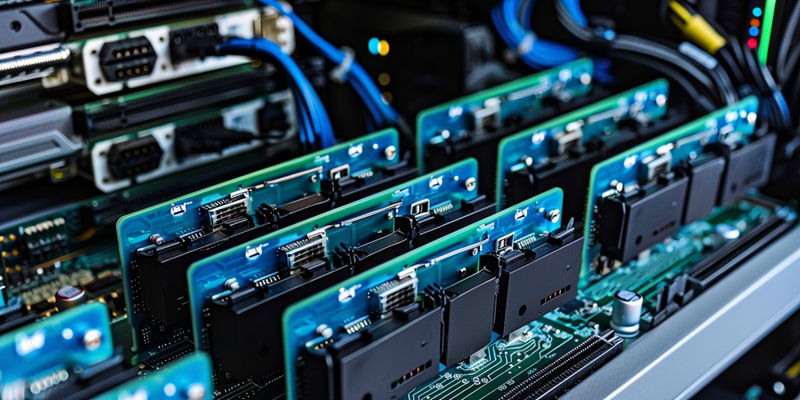
Micron Technology, Inc. is redefining the server memory landscape with the advent of its groundbreaking 128GB DDR5 RDIMM modules. Tailored for AI data center applications, these modules harness the power of a monolithic 32Gb DRAM die and are crafted using Micron’s cutting-edge 1-beta (1β) manufacturing technology. Their debut signals a new era in memory performance, providing the bandwidth and capacity essential for advanced computing applications.
Advancements in Memory Technology
Doubling Down on Speed and Capacity
Micron’s latest DDR5 memory modules represent a significant milestone in server memory technology. They offer unprecedented levels of performance, achieving speeds up to 5,600 MT/s in existing server platforms with potential future enhancements guiding them to 8,000 MT/s. This remarkable boost is not just about raw speed; it’s about enabling servers to process ever-growing volumes of data with greater efficiency. With AI and machine learning workloads expanding exponentially, the demand for memory that can keep pace is critical. These modules fulfill that need, contributing to a more agile and capable server infrastructure.
The 128GB DDR5 RDIMMs from Micron are replete with innovation, offering benefits that other current technologies simply cannot match. These include significant improvements in bit density, which is around 45% higher than that of preceding generations, as well as an impressive 22% enhancement in energy efficiency over comparative 3DS TSV products. The decrease in latency by up to 16% is particularly beneficial for processing real-time data, where every millisecond matters. By building these modules with a steadfast focus on progression, Micron delivers a solution that excels in the realms of capacity, power conservation, and responsiveness.
Empowering AI and High-Performance Computing
The deployment of Micron’s 128GB DDR5 RDIMM modules is expected to energize AI and high-performance computing operations substantially. Serving memory-intensive applications with higher efficiency and bandwidth, they lay the groundwork for sophisticated computing tasks that form the foundation of AI research and data analytics. With such powerful memory at their core, servers can handle complex algorithms, large datasets, and intricate simulations with remarkable dexterity.
For data centers, the ability to process vast amounts of information quickly and reliably is paramount, and that’s where these DDR5 RDIMMs truly shine. Their enhanced performance metrics mean that tasks such as pattern recognition, natural language processing, and predictive modeling can be executed with greater precision and speed—advancing the field of AI and opening new avenues for exploration.
Partnership with Industry Leaders
Collaboration for Enhanced Compatibility
Micron has solidified its leadership in memory technology not merely through innovation but also through strategic partnerships. The company has collaborated closely with industry heavyweights including AMD, HPE, Intel, and Supermicro to ensure its DDR5 memory modules perform seamlessly with a wide range of server CPUs. Such teamwork ensures that customers can integrate the new memory technology without compatibility concerns, allowing for a smoother transition to the enhanced capabilities of DDR5.
These partnerships are indicative of the industry’s acknowledgement of DDR5 as the next standard in server memory technology, signaling a collective move towards a future imbued with higher performance thresholds. Micron’s RDIMMs are thus perfectly positioned to become integral components within sophisticated server ecosystems across various sectors.
By fostering compatibility with diverse server architectures, Micron’s 128GB DDR5 modules are set to be a cornerstone in the advancement of AI and HPC workloads. The cooperation among technology titans ensures that these modules will serve a broad spectrum of data-intensive applications, undeniably shaping the progression of computational capacity in data centers worldwide.
Availability and Future Prospects
Micron Technology, Inc. is pioneering a transformation in server memory for AI data centers with its innovative 128GB DDR5 RDIMM modules. These powerful modules utilize a single 32Gb DRAM die and are produced through Micron’s advanced 1-beta (1β) process technology. This launch marks a significant milestone for memory capacity and bandwidth, crucial for next-gen computing demands.
The 128GB DDR5 RDIMMs by Micron are specifically engineered to meet the high-performance requirements of artificial intelligence workloads in data centers. By integrating the large density of a 32Gb DRAM die, Micron maximizes the memory module’s capacity, thereby enabling servers to process and analyze vast amounts of data at greater speeds. This is vital for AI applications where prompt data processing is key.
Furthermore, Micron’s utilization of its state-of-the-art 1-beta manufacturing technology not only enhances the modules’ density but also improves energy efficiency—a critical factor in reducing operational costs and environmental impact for data centers. Ultimately, these modules represent a leap forward in server memory technology, offering unmatched performance that will likely set new industry standards for AI and advanced computing applications.