

A Calculated Leap into the AI Infrastructure Revolution
In a bold and decisive move that signals a fundamental shift in data center architecture, Marvell Technology has committed nearly $3.8 billion to acquire Celestial AI and XConn Technologies. This massive investment is far more than a simple expansion; it is a calculated bet on a future where the relentless demands of artificial intelligence can no longer be met by traditional copper-based infrastructure. As AI models grow to unprecedented scale, the physical limitations of electrical interconnects—in power, distance, and bandwidth—have become the primary bottleneck to progress. This article will deconstruct Marvell’s strategic acquisitions, analyzing how the company is assembling a comprehensive platform to solve these challenges and position itself as the dominant force in the next generation of AI hardware, where light, not electricity, will connect the brains of the world’s most powerful systems.
The Inevitable End of the Copper Era in AI Data Centers
For decades, copper wiring has been the reliable workhorse connecting components within the data center. However, the exponential growth of large-scale AI has pushed this legacy technology to its breaking point. Training and running massive AI models requires thousands of specialized processors, or accelerators, to operate in perfect concert as a single, cohesive unit. Over the distances required to link these processors across multiple server racks, copper’s inherent weaknesses become insurmountable barriers. Signal integrity degrades rapidly, necessitating power-hungry repeater chips, and the sheer volume of thick copper cabling creates a thermal and logistical nightmare.
With AI accelerators themselves consuming kilowatts of power, the industry can no longer afford the exorbitant power and cooling overhead imposed by an inefficient copper fabric. The power consumption of copper interconnects is approximately double that of emerging optical alternatives, making it an economically and environmentally unsustainable choice for future build-outs. This has led to an architectural inflection point: the rise of “scale-up fabrics,” where processors are distributed but function as one logical supercomputer, a design that demands a fundamentally new interconnect technology capable of delivering massive bandwidth over longer distances with a fraction of the power draw.
Forging an Integrated Connectivity Platform
The Three Pillars of Marvell’s Connectivity Strategy
Marvell’s acquisitions of XConn and Celestial AI are not isolated plays but are the cornerstones of a cohesive, three-layered strategy designed to control the entire AI connectivity stack. The first pillar, enabled by XConn, addresses the “memory wall” using Compute Express Link (CXL) technology. By providing a best-in-class CXL switching solution, Marvell allows hyperscalers to disaggregate memory from individual servers, creating vast, shareable pools that dramatically improve utilization and cut costs by allowing the reuse of older, depreciated memory hardware. This transforms memory from a fixed, per-server cost into a flexible, on-demand resource.
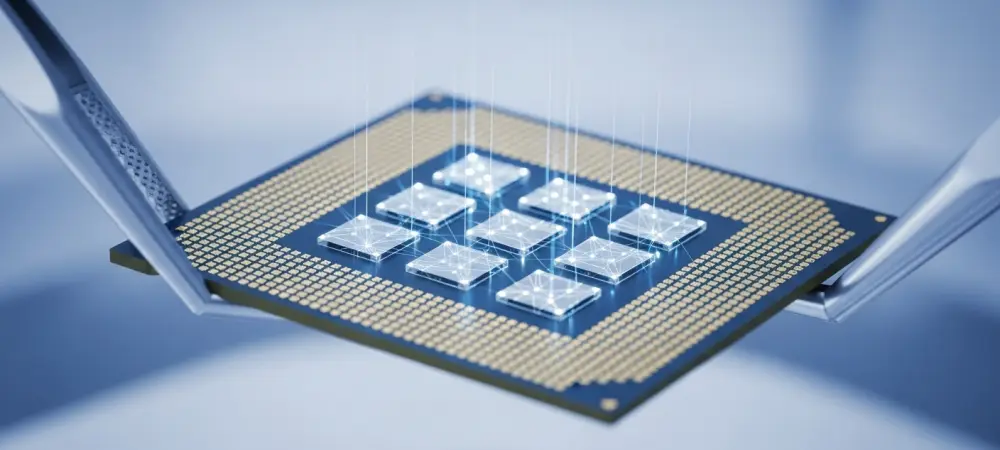
The second, and most revolutionary, pillar comes from Celestial AI’s Photonic Fabric. This technology integrates optical chiplets directly into the processor package, delivering an astonishing 16 terabits per second of bandwidth—a tenfold leap over current solutions—and eliminating power-hungry copper from the critical scale-up links between racks. A crucial advantage of Celestial’s platform is its thermal stability, allowing it to operate reliably alongside processors generating several kilowatts of heat. The final pillar is the adoption of the Ultra Accelerator Link (UALink), an open communication standard that ensures all components in this new fabric can speak the same high-speed, low-latency language, enabling a distributed cluster of accelerators to perform as a single, unified system.
Reshaping the Competitive Silicon Landscape
This integrated strategy has fundamentally altered the competitive dynamics of the AI silicon market. Broadcom, the incumbent leader in custom silicon for hyperscalers, suddenly finds itself with a critical gap in its portfolio: it lacks an in-house, co-packaged optical solution, putting it at a disadvantage for next-generation designs that will mandate this technology. To stay competitive, Broadcom may be forced into a costly acquisition of its own, ceding a significant first-mover advantage to Marvell. This move effectively raises the table stakes for participating in the high-end custom AI accelerator market.
Meanwhile, aspiring challengers like MediaTek, which lack deep data center relationships and a comprehensive connectivity portfolio, now face a substantially wider technology gap. Marvell’s move also sidesteps traditional optical vendors like Cisco and Lumentum, whose expertise in long-reach networking is ill-suited for the short-reach, high-density, on-package optical interconnects that define this new market segment. Their technology is designed for connecting data centers across a campus, not for the millimeter-scale connections inside a server rack, leaving the field largely uncontested for Marvell.
The Financials and the Creation of a New Market
The financial structure of the acquisitions underscores both the immense potential and the calculated risk. While XConn is expected to contribute a modest $100 million in revenue by fiscal 2028, the targets for Celestial AI are far more ambitious, projecting a $1 billion annualized revenue run rate by late fiscal 2029. To mitigate risk, the Celestial deal includes a performance-based earnout, aligning the interests of both parties and protecting Marvell if market adoption proves slower than anticipated. This structure demonstrates confidence while prudently managing a substantial investment. More importantly, this investment is not about capturing existing market share but about creating an entirely new, high-value semiconductor category. By moving optical connectivity from the network edge directly into the processor package, Marvell is poised to capture a significant silicon opportunity that simply did not exist before. This strategy redefines the value of the AI interconnect, transforming it from a peripheral networking component into a core part of the computational system itself, thereby commanding higher margins and deeper integration with customer roadmaps.
The Dawn of the Optically-Connected Supercomputer
Marvell’s strategy is accelerating the industry toward a future where entire data center racks, and eventually rows of racks, function as a single, optically-wired supercomputer. The public endorsement from cloud giant AWS and active engagement with other hyperscalers provide powerful market validation that this architectural shift is not a distant vision but an imminent reality. This technological leap will remove the physical constraints that currently limit the size and complexity of AI models, potentially unlocking new capabilities in artificial intelligence that are unattainable with current hardware configurations.
As Marvell solidifies its lead, the pressure on competitors will intensify, likely triggering an M&A race as others scramble to acquire the optical and memory-interconnect technologies needed to remain relevant in the AI era. This dynamic will reshape the supplier landscape, favoring companies that can offer holistic, integrated solutions over those providing single-point products. The battle for the future of the data center will be fought not just on processing power, but on the speed and efficiency of the light-based fabric that connects it all together.
Strategic Takeaways for the AI Ecosystem
The analysis of Marvell’s bold move revealed several clear insights. First, the era of copper as a viable interconnect for large-scale AI was definitively over. The physics of signal degradation and power consumption had created an insurmountable barrier that only a fundamental shift in technology could overcome. This transition was no longer a matter of choice but of necessity for any organization building next-generation AI infrastructure at scale. Second, leadership in the AI silicon market was shown to now be defined by the ability to offer a complete, integrated platform—combining CXL for memory, optics for data transport, and open standards for communication—rather than selling disparate components. For technology buyers and enterprise IT leaders, the primary consideration was no longer if this transition would happen, but when and how to prepare for it. The analysis highlighted that investing in server architectures not designed for this optical future risked creating costly, stranded assets.
Marvell’s Vision: Lighting the Path for Artificial Intelligence
Marvell’s $3.8 billion investment was revealed as a prescient and defining move that looked beyond current industry roadmaps to the fundamental physics of building next-generation AI. The company’s strategy was predicated on the bet that to overcome the immense challenges of power consumption and data throughput, the industry must transition from moving electrons over copper to moving photons through silicon.
This was more than just a bet on faster networking; it was a strategic play to build the central nervous system for a new class of AI that is currently impossible to construct. The acquisitions were not merely additive but synergistic, creating a comprehensive toolkit to solve the most pressing bottlenecks in AI scalability. By acquiring the technologies to weave light into the very heart of the processor, Marvell’s strategy was shown not just to be connecting chips—it laid the foundational groundwork for the future of artificial intelligence itself.