

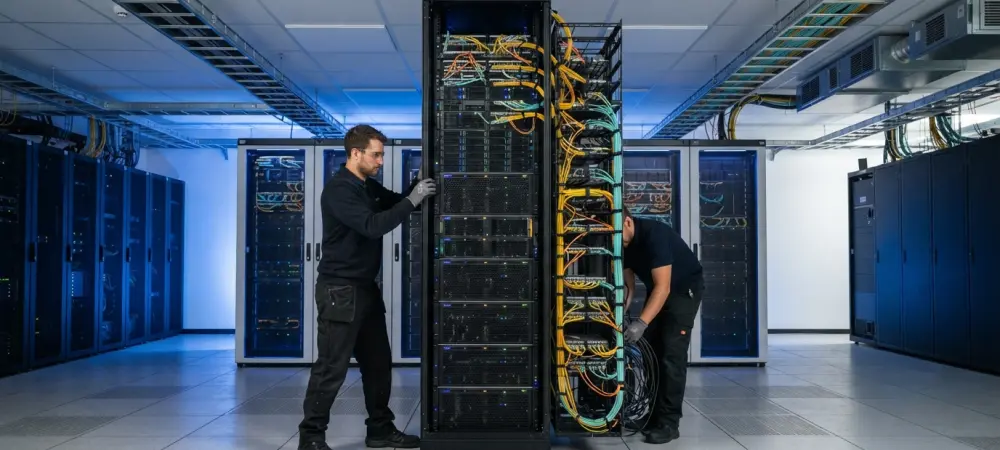
The rapid shift from experimental laboratory artificial intelligence to robust production-grade systems has created a sudden and intense demand for infrastructure that balances open-source flexibility with enterprise-grade reliability. Managed compute frameworks bridge this divide, offering a paradigm where inference is treated as an integrated engineering challenge rather than a simple compute cost. This review explores how the current landscape has redefined the way enterprises host and scale sophisticated models, moving from basic API consumption toward a more nuanced, managed-service approach that addresses the complexities of modern machine learning.
Evolution: AI Production Inference
The emergence of managed open model infrastructure marks the professionalization of the open-source AI movement. In the early stages of model deployment, organizations were often forced to choose between the simplicity of closed-source APIs and the extreme complexity of building a private cloud from the ground up. Today, technology has evolved to provide a middle ground that treats the entire serving stack—from the GPU kernel to the model container—as a unified product.
This evolution is driven by the realization that model weights alone do not constitute a production system. High-performance inference requires deep synchronization between software runtimes and the underlying silicon. As organizations move toward 2026 and 2027, the focus is shifting away from mere model hosting and toward “production inference,” which accounts for the intricate nuances of memory bandwidth, tensor parallelism, and specialized hardware kernels. This transition ensures that open models can compete with proprietary alternatives in terms of both latency and reliability.
Core Pillars: Managed Compute Infrastructure
The foundation of a managed environment rests on its ability to abstract the physical hardware while maintaining the performance characteristics of bare-metal systems. Unlike traditional cloud virtual machines, which provide generic compute power, managed open model infrastructure is built specifically for the high-memory requirements of large language models. The architecture is designed to handle the massive data throughput required for real-time applications, ensuring that the bottleneck remains the model’s complexity rather than the infrastructure’s limitations.
Furthermore, this infrastructure is characterized by its high degree of observability and specialized support. In a production environment, the ability to monitor GPU health, memory pressure, and request concurrency in real time is vital. Managed platforms provide these insights out of the box, allowing technical teams to focus on model fine-tuning and application logic rather than debugging hardware drivers or network partitions. This structural integrity is what allows a research project to transform into a mission-critical business service.
Flexible Deployment Frameworks
Technical teams now utilize a dual-pathway approach to deployment that scales according to their specific workload profiles. The first pathway involves a pay-per-token model, which is highly effective for applications with unpredictable or bursty traffic patterns. This serverless-style consumption allows for rapid experimentation without the overhead of committed hardware. However, it often lacks the strict performance guarantees required for high-tier enterprise service-level agreements.
In contrast, dedicated capacity offers a more robust solution for organizations with sustained, high-volume needs. By securing dedicated accelerators, such as the AMD Instinct MI300X, enterprises can ensure that their applications have consistent access to the necessary compute power. This deployment framework is particularly beneficial when using custom-tuned models or specialized runtimes that require a stable environment to maintain low latency. The flexibility to switch between these two modes ensures that infrastructure costs remain aligned with actual business value.
Performance-Based Engineering Metrics
In the current landscape, the metrics used to evaluate AI infrastructure have matured beyond simple cost-per-token calculations. Engineers now prioritize “Operating Points,” which represent the equilibrium between Time to First Token and total throughput. For interactive applications like customer support bots, low latency is the dominant requirement. For batch processes such as document analysis, high throughput is the goal to maximize the utility of every provisioned GPU hour.
Effective utilization is the secondary critical metric that defines success in a managed environment. It is no longer enough to simply have access to GPUs; those resources must be performing work as efficiently as possible. This involves optimizing the batch size and concurrency to ensure that hardware is not sitting idle during periods of low demand. By interpreting these metrics, organizations can determine the most cost-effective way to scale their operations without sacrificing the user experience.
Emerging Trends: Managed Infrastructure
The industry is currently moving toward a more distinct “management boundary” that separates the duties of the platform provider from those of the developer. This trend is essential because it allows platform providers to handle the heavy lifting of security patching, runtime updates, and hardware maintenance. Meanwhile, the customer retains complete authority over model selection and the configuration of the inference container. This separation of concerns reduces the “operational friction” that typically stalls AI projects during the transition to production.
Another significant trend is the rise of workload-centric benchmarking. Rather than relying on generic hardware performance scores, organizations are now evaluating infrastructure based on how it handles specific model architectures and context windows. This shift acknowledges that a GPU configuration that excels at short-form chat might struggle with long-context retrieval or complex reasoning tasks. As we progress from 2026 toward 2028, this granular approach to benchmarking will become the standard for infrastructure procurement.
Real-World Applications: Sector Impact
Managed infrastructure is proving its worth in sectors that require massive data processing capabilities with high levels of reliability. Telecommunications and large-scale data firms have been early adopters, utilizing these systems to automate complex internal workflows. By deploying hundreds of high-performance GPUs in a managed environment, these organizations can process billions of tokens per day, a feat that would be nearly impossible to manage with traditional self-hosted setups without a massive dedicated engineering team.
High-Scale Synthetic Data Generation
One of the most transformative applications of managed compute is the generation of synthetic data for training and testing purposes. Companies like AT&T have utilized hundreds of specialized GPUs to generate hundreds of billions of tokens monthly using models like Phi-4. This scale of operation requires a highly stable environment where hardware failure or software glitches are handled automatically by the provider. The ability to sustain such high throughput over long periods demonstrates the maturity of the managed approach.
Optimizing Large-Scale Parameter Models
The deployment of massive models, such as the GLM 320-billion-parameter architecture, highlights the necessity of architectural optimization. These heavyweight models require complex tensor and expert parallelism to function efficiently. Managed infrastructure allows for these configurations to be deployed across multi-GPU nodes with minimal manual intervention. By leveraging high-memory configurations, organizations have seen significant improvements in output throughput, proving that managed solutions are capable of handling even the most demanding open-source models available today.
Technical Challenges: Operational Hurdles
Despite the clear benefits, navigating managed open model infrastructure is not without its difficulties. A primary hurdle is the requirement for advanced capacity forecasting. Because dedicated GPUs are reserved for specific customers, a failure to accurately predict demand can lead to either costly over-provisioning or performance bottlenecks during peak times. Developing the internal expertise to balance these needs remains a challenge for many growing organizations.
Furthermore, the performance of these systems is often tethered to the maturity of the underlying open-source software stack. Utilizing hardware like the AMD Instinct MI300X requires deep integration with ecosystems like ROCm. While these stacks have seen massive improvements, they still require a level of technical sophistication to optimize fully. Issues such as inter-GPU communication bottlenecks and memory fragmentation can still arise, requiring a collaborative effort between the infrastructure provider and the customer’s engineering team to resolve.
Future Outlook: Technological Trajectory
The trajectory for the next few years suggests a deeper synergy between hardware design and model architecture. We can expect significant advancements in High Bandwidth Memory and specialized interconnects that will allow even the largest models to run with unprecedented speed. In the period from 2026 to 2028, the democratization of high-tier AI capabilities will likely continue, as smaller organizations gain access to the same specialized hardware used by global tech giants.
Long-term, the focus will likely shift toward “serverless” dedicated capacity, where the benefits of reserved hardware are combined with the ease of automatic scaling. This would allow an infrastructure to expand or contract its GPU footprint in real time based on actual inference demand while maintaining the security and performance of a dedicated environment. As software runtimes become more intelligent, the manual tuning of hardware kernels may become a relic of the past, fully replaced by automated optimization layers.
Summary: Final Assessment
The evaluation of managed open model infrastructure confirmed that this technology has become a cornerstone of professional AI deployment. The infrastructure demonstrated a remarkable ability to balance the freedom of open models with the rigorous demands of enterprise production. During the review, it became clear that the most successful implementations were those that moved away from generic metrics and instead focused on workload-specific optimization and efficient GPU utilization. Organizations determined that delegating the maintenance of the underlying stack to a managed provider allowed their internal teams to innovate at a much faster pace. While challenges in capacity planning and software maturity persisted, the overall reliability and performance of the systems exceeded previous industry standards. The assessment indicated that managed compute is no longer just an alternative to self-hosting; it is the superior strategic choice for any organization aiming to scale open-source artificial intelligence in a competitive market. Moving forward, the adoption of high-memory accelerators and specialized runtimes will likely serve as the benchmark for operational excellence in the field.