

Physical contaminants like graded silica particulate produce high-frequency broadband energy that traditional maintenance thresholds often fail to isolate accurately. In the sophisticated industrial landscapes of 2026, where precision and uptime are the primary drivers of global profitability, the reliance on oversimplified vibration metrics has become a significant liability for heavy manufacturing. Equipment such as conveyor drives, cooling fans, and high-speed machine tool spindles are typically arranged in series, meaning a single bearing failure or a slight shaft misalignment can trigger a costly chain reaction of downtime. While established international standards like ISO 20816-1 offer a baseline for identifying excessive vibration, they generally lack the granularity required to distinguish between different types of mechanical distress. Recent advancements in the Industrial Internet of Things (IIoT) have paved the way for automated machine learning pipelines that not only detect anomalies but also classify specific fault types and their severity with unprecedented precision, bridging the gap between basic monitoring and intelligent diagnostics.
The Physical Laboratory: Engineering Faults for Robust Data
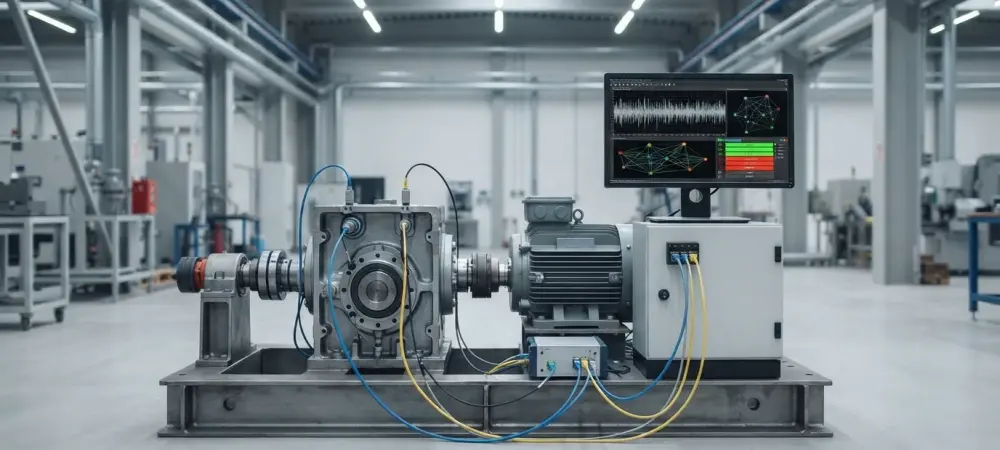
The foundation of modern mechanical diagnostic research relies on the creation of high-fidelity data that reflects the messy realities of the factory floor. To achieve this, researchers utilized a precision-engineered laboratory test bench consisting of a 0.37-kilowatt induction motor driving a 20-millimeter-diameter carbon steel shaft. This shaft was supported by deep-groove ball bearings mounted in pillow blocks on a rigid, welded steel frame. To capture the full spectrum of mechanical signatures, the sensing suite included a single-axis piezoelectric accelerometer mounted on the motor and a tri-axial MEMS accelerometer situated on the bearing housing. By utilizing a 24-bit data acquisition module sampling at 25.6 kilohertz per channel, the system maintained an alias-free bandwidth of 11.5 kilohertz. This setup was critical for capturing both the low-frequency rotational dynamics associated with imbalance and the high-frequency impact signatures caused by microscopic bearing degradation. The use of multiple sensor types ensured that the machine learning models had access to a multidimensional view of the machine’s dynamic state during operation.
A pivotal aspect of the experimental design involved the physical seeding of three primary failure modes to ensure the machine learning models were trained on authentic mechanical signatures rather than idealized simulations. Researchers introduced bearing contamination by packing the internal raceways with graded silica particulate in precise increments of two, four, and six grams. Mass imbalance was simulated by attaching calibrated steel weights to a rotor disk, while shaft misalignment was created by inserting precision shims beneath the bearing pedestal to generate angular offsets. Interestingly, the study revealed that “healthy” baseline vibrations could vary by as much as sevenfold between different assemblies due to minor variations in mounting torque and residual alignment. This discovery underscored a major flaw in traditional maintenance strategies: a fixed vibration threshold that works for one machine might lead to a false alarm or a missed failure on an identical machine in the same facility. This variability necessitated a more nuanced approach that looks at the relationship between multiple spectral and axial features rather than relying on a single amplitude value.
The Algorithmic Architecture: Developing the Machine Learning Pipeline
The data processing workflow was meticulously structured to ensure that the resulting diagnostic tool remained computationally efficient enough for real-time industrial deployment. Raw acceleration data was first converted to velocity through numerical integration, preceded by a third-order high-pass Butterworth filter to eliminate low-frequency drift. The recordings were then partitioned into one-second temporal windows with a 50% overlap, providing a large dataset for training and validation. Feature engineering played a decisive role in the pipeline’s success, with the researchers extracting 60 candidate descriptors across the time and frequency domains. To optimize the model and prevent the inclusion of redundant data, a combination of Analysis of Variance ranking and Recursive Feature Elimination was used to distill the list down to the 18 most impactful features, the majority of which originated from the tri-axial bearing sensor. To determine the most effective classifier, the research team benchmarked six distinct architectures, ranging from k-Nearest Neighbors to deep learning models. While a One-Dimensional Convolutional Neural Network achieved the highest raw accuracy at 99.1%, the study ultimately favored the Gradient-Boosted Tree (GBT) model for industrial implementation. This decision was driven by the GBT’s superior inference speed, which was nearly seven times faster than the neural network, making it ideal for edge computing devices with limited processing power. Furthermore, the GBT model offered greater interpretability, allowing plant operators to see exactly which physical features, such as a specific frequency peak or an increase in axial vibration, were contributing to a fault diagnosis. This “glass-box” approach is highly valued in industrial settings where maintenance managers need to justify repair decisions to stakeholders. The resulting pipeline demonstrated that it was possible to maintain extremely high accuracy without sacrificing the speed and transparency required for day-to-day operations.
Precision Performance: Analyzing Diagnostic and Severity Accuracy
The effectiveness of the deployed Gradient-Boosted Tree model was validated through a rigorous evaluation process that demonstrated near-perfect diagnostic capabilities. When the model analyzed held-out test recordings, it achieved a 100% correct classification rate for identifying the presence and type of mechanical faults. On a more granular level, the model showed exceptional sensitivity to shaft misalignment, reaching a 99.2% sensitivity rate. This high performance was attributed to the distinct and high-amplitude dynamic responses that misalignment produces, which are easily distinguished from other mechanical stressors. While bearing contamination and mass imbalance were also classified with high precision, the few errors that did occur were concentrated at the lowest severity levels, where the mechanical signatures are most similar to healthy operation. Despite these minor overlaps, the model maintained a macro-averaged F1 score of 0.988, proving that it could reliably operate even in the early stages of component degradation when manual detection would be impossible. Beyond the simple classification of faults, the researchers successfully integrated regression models to estimate the specific severity of each mechanical issue. This capability is a cornerstone of advanced predictive maintenance, as it allows facilities to track the progression of wear and tear over time. The system was able to predict the mass of contaminants in a bearing with a mean absolute error of only 0.31 grams and estimate shaft misalignment within 0.19 millimeters. By quantifying the severity of a fault, the tool moves beyond being a simple alarm system and becomes a strategic asset for maintenance planning. Instead of reacting to a sudden failure, plant managers can use these severity metrics to determine the remaining useful life of a component. This data-driven approach allows for the scheduling of repairs during planned shutdowns, preventing the catastrophic financial losses associated with unexpected equipment failure and ensuring that replacement parts are ordered only when they are truly necessary.
Standards Comparison: Benchmarking Against Traditional Methods
A critical component of the research involved a direct comparison between the multidimensional machine learning pipeline and traditional univariate vibration standards, such as ISO 10816-1. The results of this comparison were striking, revealing the inherent limitations of relying on single-value thresholds for complex machinery. The traditional root-mean-square velocity threshold rule achieved an accuracy of only 33.3% for the “healthy” class. This poor performance was due to its inability to account for the natural baseline variations that occur between different machine assemblies. In many cases, a perfectly healthy machine was flagged as faulty simply because its mounting torque resulted in a vibration level slightly above the arbitrary global standard. In contrast, the machine learning model successfully navigated these variations by analyzing the intricate relationships between multiple spectral and axial features. This allowed the system to recognize that a machine was healthy even if its total vibration amplitude was higher than average, provided the characteristic signatures of a fault were absent.
The shift from univariate monitoring to a multidimensional machine learning approach represents a significant evolution in industrial maintenance philosophy. Traditional standards often focus on the total energy of a vibration signal, which can be influenced by many non-critical factors. However, the machine learning pipeline analyzed frequency-domain descriptors that isolate specific mechanical behaviors. For example, mass imbalance typically manifests at the fundamental rotational frequency, while misalignment creates elevated second-harmonic responses. By focusing on these specific spectral peaks and their relationship to axial vibrations, the ML model avoided the false positives that plague simpler systems. This increased reliability is essential for modern manufacturing environments where false alarms can lead to unnecessary shutdowns and a loss of confidence in monitoring technology. The study proved that advanced algorithms are not just a luxury but a necessity for achieving reliable diagnostics in environments where “normal” operation is not a static or universal value.
Industrial Deployment: Optimizing Edge Computing and IoT
To demonstrate the practical feasibility of the system, the researchers performed extensive edge profiling to ensure the pipeline could operate on standard industrial hardware. The entire process, from the initial data acquisition and filtering to the final inference, averaged only 11.3 milliseconds per analysis window. This remarkable efficiency meant that the diagnostic tool used less than 3% of the available processing budget on a typical industrial gateway. This low computational footprint is vital for factories that need to monitor dozens or hundreds of machines simultaneously without investing in expensive, high-performance server clusters. The ability to perform high-frequency data processing at the “edge”—directly on the factory floor—reduces the need for bandwidth-heavy data transfers to the cloud and ensures that critical alerts are generated with minimal latency. This immediate feedback loop allows for real-time intervention, potentially stopping a machine before a minor fault escalates into a catastrophic failure.
The final phase of the project involved the seamless integration of the diagnostic model with a cloud-based dashboard via HTTP telemetry. This setup provided plant operators with a centralized digital interface where they could monitor the health of their machinery from anywhere in the world. The communication logging showed that the system maintained 99.4% live availability, with robust buffering mechanisms designed to prevent data loss during wireless reconnection events. This end-to-end demonstration confirmed that the transition from a laboratory-scale proof-of-concept to a production-ready Industrial IoT solution was entirely achievable. By combining high-performance machine learning with accessible cloud-based visualization, the researchers provided a clear roadmap for the future of smart manufacturing. The system offers a scalable, cost-effective way to implement predictive maintenance, giving facilities the tools they need to optimize their operations and maintain a competitive edge in an increasingly automated global market.
Strategic Outcomes: Directions for Future Predictive Maintenance
The research successfully demonstrated a robust framework for automated mechanical diagnostics that surpassed traditional industry standards in both accuracy and reliability. By utilizing an ensemble of gradient-boosted decision trees and a refined set of spectral features, the study provided a definitive method for identifying and quantifying faults in rotating machinery. The implementation of this technology showed that machine learning could effectively handle the natural variability of industrial equipment, significantly reducing the frequency of false alarms that have historically hindered the adoption of automated monitoring systems. The integration of these models into edge computing devices further proved that sophisticated diagnostics do not require prohibitive computational resources, making the technology accessible to a wide range of manufacturing sectors. This transition from reactive to predictive maintenance was supported by the system’s ability to provide actionable data regarding the severity of mechanical degradation.
As industrial facilities looked toward broader implementation, several strategic insights emerged from the final stages of the study. The researchers concluded that while the current model was highly effective for the specific machine type tested, future progress would depend on the development of transfer learning techniques. These techniques allowed models trained on one type of equipment to be adapted for different machine architectures and varying operational states without requiring extensive new datasets. Additionally, the study suggested that hardware and software requirements must be more closely aligned to ensure that sensors are capable of capturing the high-frequency features that the algorithms find most useful. By establishing these clear pathways for future development, the research provided a foundation for the next generation of intelligent manufacturing. The move toward automated, self-diagnostic machinery was confirmed as a critical step in reducing operational risks and maximizing the efficiency of the global industrial infrastructure.