

The rapid migration of data-center-grade compute power from remote, chilled server rooms to the immediate vicinity of a developer’s desk marks a fundamental shift in how modern enterprises approach artificial intelligence. While the initial wave of AI adoption was defined by a heavy reliance on massive cloud clusters, the current landscape is being reshaped by the “deskside data center” concept. This evolution is driven by a necessity to bypass the latency, recurring costs, and privacy vulnerabilities inherent in third-party hosted environments. By localizing high-performance execution, organizations are gaining a level of autonomy that was previously reserved only for hyperscale tech giants, effectively decentralizing the core engine of the digital economy.
This transition is not merely about convenience; it represents a strategic pivot toward edge-based high-performance execution. As models grow in complexity, the “round-trip” to the cloud becomes a bottleneck for real-time iteration. Localized infrastructure addresses this by placing trillion-parameter capabilities directly into a desktop chassis. This context of evolution highlights a broader trend where the “edge” is no longer just a collection of low-power sensors, but a robust frontier where heavy-duty training and inference occur.
Evolution of Deskside Data-Center Computing
The emergence of localized AI infrastructure is the result of a multi-year effort to shrink enterprise-grade components without sacrificing their inherent power. Historically, a workstation was a tool for design or CAD, while the “heavy lifting” of AI training was offloaded to massive GPU clusters in the cloud. However, as organizations realized that the most sensitive parts of their development cycle—proprietary data and experimental architectures—were being exposed to external networks, the demand for a “private cloud in a box” intensified. This shift has moved the industry away from the “thin client” model of the past decade toward a “thick edge” philosophy.
This technological maturation matters because it democratizes high-parameter execution. It is no longer a requirement to have a multi-million-dollar server contract to fine-tune a specialized model. Instead, the localized infrastructure acts as a bridge, offering the same software stacks and hardware acceleration found in global data centers but within a form factor that fits under a desk. This context is vital for understanding why the current market is moving toward hardware that prioritizes local throughput over remote connectivity.
Key Components of High-Performance Localized AI
Nvidia Grace Blackwell Ultra GB300 Superchip
Central to this hardware revolution is the Nvidia Grace Blackwell Ultra GB300, a component that redefines the ceiling of local computation. Unlike consumer-grade cards, the GB300 is an integrated superchip that combines specialized CPU and GPU architectures to eliminate the traditional bottlenecks found in standard PCIe lanes. With 252GB of HBM3e memory, this chip provides the massive memory bandwidth required to keep the processors fed during the execution of trillion-parameter models. This implementation is unique because it allows for the residence of entire large models within local memory, avoiding the performance degradation that occurs when data must be swapped to slower storage.
The significance of the GB300 extends beyond raw speed; it enables a type of “model-in-memory” workflow that was previously impossible outside of a server rack. For developers, this means the ability to run high-fidelity simulations or complex neural networks with instantaneous feedback. By providing such a massive memory buffer, the technology ensures that the hardware does not become the limiting factor in the creative process, allowing for more ambitious AI architectures to be tested in a controlled, local environment.
High-Wattage Thermal and Power Architecture
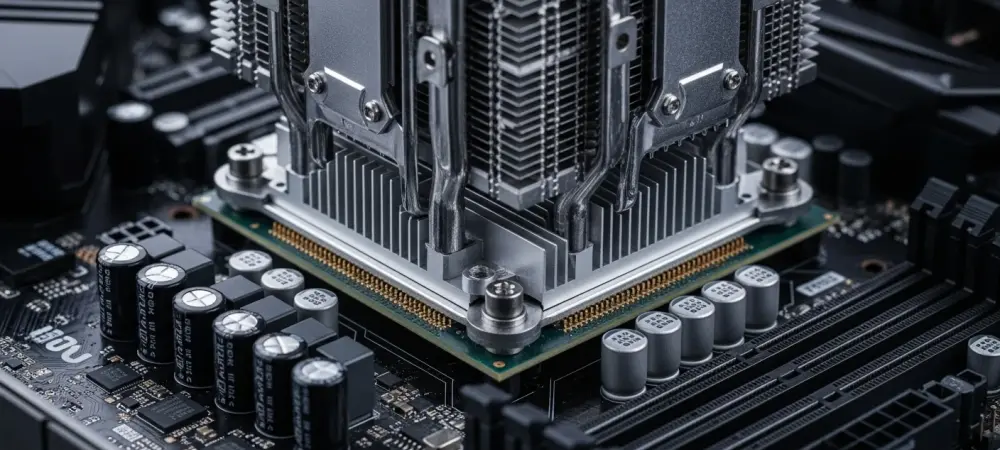
Sustaining data-center class workloads in a desktop chassis requires a radical departure from standard PC power delivery. The adoption of 1600-watt power architectures is a technical necessity to prevent thermal throttling during prolonged compute sessions. This high-wattage delivery system must be paired with sophisticated cooling solutions—often involving liquid-to-air heat exchangers—to manage the intense caloric output of the Blackwell chips. Without this robust infrastructure, the hardware would be unable to maintain the clock speeds required for consistent AI inference and training.
This power demand creates a unique engineering challenge: the hardware must be quiet enough for an office environment while being powerful enough to mimic a server. The unique implementation of specialized power phases and high-density capacitors ensures that the energy delivery remains stable even during the massive current spikes typical of AI workloads. This performance characteristic is what differentiates a true localized AI system from a high-end gaming PC, as it is built for 24/7 reliability under maximum load.
Emerging Trends in Tokenomics and Hybrid Cloud
The economic landscape of AI is undergoing a shift from operational expenditure (OpEx) to capital expenditure (CapEx). Under the cloud-hosted model, every “token” generated by an AI model incurs a marginal cost, which can become prohibitively expensive as an enterprise scales its autonomous systems. Localized hardware allows a firm to pay a high upfront cost to effectively “own” their token generation. This concept of “tokenomics” suggests that for high-volume users, the return on investment for a localized system can be realized within a few months of heavy usage.
Moreover, the industry is gravitating toward a hybrid AI environment. In this setup, the cloud is utilized for massive, general-purpose scaling and global distribution, while the edge is reserved for specialized, high-security, or low-latency tasks. This coexistence allows enterprises to optimize their budgets and security protocols simultaneously. The trend reflects a growing realization that the cloud is not a universal solution, but rather one component of a broader, tiered compute strategy that prioritizes the location of the data and the sensitivity of the mission.
Real-World Applications of Localized AI Systems
Agentic Workflows and Autonomous Development
Developers are increasingly utilizing local infrastructure to support “agentic workflows,” where AI agents operate autonomously over long durations to solve complex problems. These “missions” often require constant coordination and reasoning steps that would be delayed by the latency of a round-trip to a cloud server. By running these agents locally, developers can achieve a tighter feedback loop, allowing for “on-the-fly” adjustments to the agent’s logic. This is particularly useful in software engineering and automated research, where the AI must interact with local file systems and private repositories in real-time.
These agentic systems thrive in an environment where compute is “free” after the initial hardware purchase. Without the ticking clock of a cloud billing cycle, researchers can afford to let an agent explore non-linear solutions or conduct exhaustive brute-force testing. This implementation is unique because it encourages a more exploratory, less constrained approach to AI development, leading to breakthroughs that might have been skipped due to the cost constraints of metered cloud services.
Secure Sandbox Environments for Proprietary Data
In sectors like finance, healthcare, and defense, the primary barrier to AI adoption has always been data privacy. Localized AI infrastructure provides a “secure sandbox” where proprietary datasets can be processed without ever touching the public internet. This eliminates the risk of data leakage or the use of sensitive information to train a third-party’s base model. By keeping the compute local, organizations maintain a clear “air-gap” or at least a strictly controlled perimeter, fulfilling stringent regulatory requirements while still leveraging the latest AI advancements.
This application is fundamentally different from using a “private cloud” instance, as the physical hardware is under the direct control of the organization’s IT department. There is no shared tenancy and no reliance on a provider’s security patches. This level of sovereignty is the ultimate value proposition for many enterprises, transforming AI from a potential liability into a protected internal asset.
Challenges and Technical Hurdles
Despite the clear benefits, the transition to localized high-performance compute is not without significant friction. The high initial acquisition cost, often reaching into the high five figures, represents a formidable barrier for smaller organizations. Furthermore, the 1600-watt power draw is not just an electrical challenge; it is an environmental one. The energy consumption of a single localized AI unit can rival that of several standard office suites, necessitating specialized electrical circuits and contributing to a higher carbon footprint per local node.
Ongoing development efforts are focusing on mitigating these limitations through the optimization of small language models (SLMs) and more efficient cooling technologies. However, the trade-off remains: to achieve data-center performance at the desk, one must accept the physical and financial realities of data-center-grade power. While hardware-software integration is improving, the requirement for specialized technical staff to maintain and optimize these local systems adds another layer of complexity to the total cost of ownership.
The Future of Edge-Based Enterprise Computing
Looking forward, the maturation of the “super-desktop” category will likely lead to more accessible versions of this technology, potentially merging with the broader “AI PC” movement. As hardware becomes more efficient, we can expect a future where the distinction between a workstation and a server continues to blur. The long-term impact will be a leveling of the playing field, where small to mid-sized enterprises can compete with tech giants by leveraging their own private, high-performance AI clusters to iterate faster and more securely than those relying solely on generic cloud APIs.
Breakthroughs in hardware-software co-design will eventually allow for even higher parameter models to run on even lower power envelopes. This will lead to a world where “intelligence” is a localized utility, as common as electricity or high-speed internet. The decentralization of this power will fundamentally change the competitive dynamics of the tech industry, placing the tools of innovation directly into the hands of the individual developer.
Assessment of the Localized AI Landscape
The move toward localized AI infrastructure represented a decisive rejection of the “cloud-only” narrative that dominated the early part of the decade. By integrating components like the GB300 into the desktop environment, the industry successfully proved that high-parameter model execution did not require a sprawling server farm. This decentralization of compute power provided a necessary balance to the market, offering a path for organizations that prioritized data sovereignty and long-term cost predictability over the convenience of managed services.
The technology effectively democratized access to high-end AI development, allowing for more secure and creative workflows through agentic systems and private sandboxes. While the hurdles of energy consumption and initial cost were significant, the benefits of local autonomy and reduced “tokenomics” expenses offered a compelling alternative. Ultimately, the shift toward localized infrastructure matured into a hybrid reality, where the desktop became the primary engine for refined, proprietary innovation while the cloud served as the secondary layer for global distribution.