

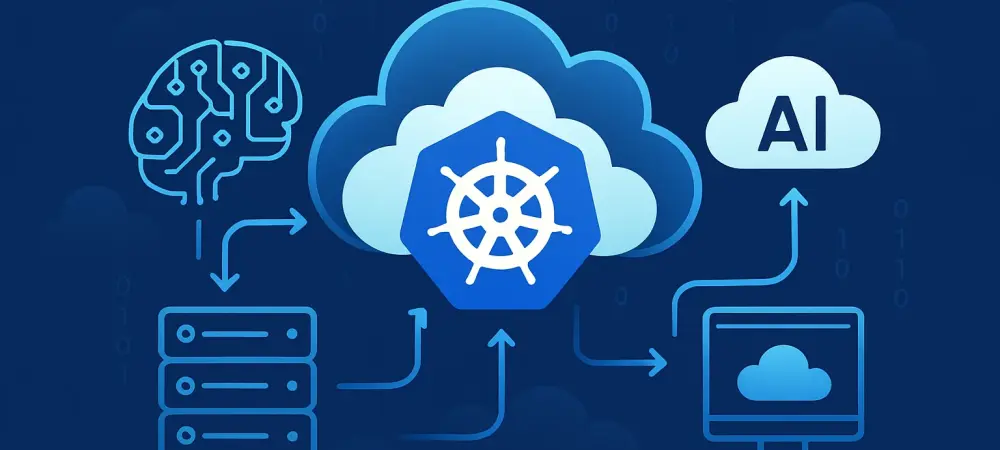
Imagine a world where cloud systems not only scale effortlessly to meet demand but also predict and adapt to challenges before they arise, saving millions in resources and downtime. This is no longer a distant vision but a reality being shaped by the powerful synergy of Kubernetes and artificial intelligence (AI). As cloud-native environments become the backbone of modern enterprises, the integration of these technologies is revolutionizing how workloads are managed and optimized. This review delves into the profound impact of their convergence, exploring key features, real-world applications, and the challenges that lie ahead in this dynamic landscape.
Core Components and Features of Kubernetes and AI Synergy
Kubernetes as a Scalable Orchestration Platform
Kubernetes has emerged as a cornerstone for managing containerized workloads, providing a robust framework for scaling applications in response to fluctuating demands. Its ability to orchestrate resources dynamically ensures that AI-driven applications, which often require significant computational power, can operate seamlessly across distributed environments. This scalability is critical for deploying complex machine learning models that need rapid adjustments to processing capacity based on real-time data inputs.
Beyond scalability, Kubernetes offers precise resource allocation, minimizing waste and enhancing cost efficiency in cloud ecosystems. Its architecture supports automated load balancing and fault tolerance, which are essential for maintaining the uptime of AI systems that power predictive analytics or autonomous decision-making. This orchestration capability positions Kubernetes as an indispensable tool for organizations aiming to leverage AI at scale.
The performance benefits of Kubernetes extend to its facilitation of continuous integration and deployment pipelines, enabling faster iterations of AI models. By streamlining updates and rollbacks, it ensures that AI applications remain agile, adapting to new data patterns or business needs without disruption. Such efficiency underscores its role as a foundational platform in modern cloud strategies.
AI and Agentic Systems in Cloud Environments
AI, particularly through agentic systems that operate with a degree of autonomy, is transforming cloud infrastructures by automating complex tasks and enhancing decision-making. These systems can independently monitor environments, detect anomalies, and optimize workflows, reducing the need for human intervention in Kubernetes-managed setups. Their integration allows for smarter resource management, where AI predicts peak loads and adjusts allocations proactively.
From a technical perspective, agentic AI systems excel in processing vast datasets to uncover insights that improve system performance. When paired with Kubernetes, they enable real-time responses to operational challenges, such as rerouting traffic during network congestion or scaling resources during unexpected demand spikes. This synergy results in cloud environments that are not only reactive but also predictive, a significant leap forward in operational intelligence.
Real-world usage of these AI systems within Kubernetes frameworks demonstrates their value in industries requiring high automation, such as logistics or e-commerce. For instance, they streamline inventory management by forecasting demand trends and adjusting supply chain operations accordingly. This practical application highlights how AI enhances the adaptability and efficiency of cloud-native systems, paving the way for broader adoption.
Recent Developments in Kubernetes and AI Integration
The landscape of Kubernetes and AI convergence has seen remarkable advancements, with innovations like AIOps gaining traction for their ability to automate IT operations using machine learning. AIOps tools analyze system logs and metrics to identify potential issues before they escalate, significantly reducing downtime in Kubernetes clusters. This proactive approach is becoming a standard for enterprises managing large-scale cloud infrastructures.
Real-time observability tools have also emerged as a critical trend, offering deeper insights into system performance and AI model behavior. These tools enable engineers to monitor Kubernetes environments with granular detail, ensuring that AI-driven processes operate within expected parameters. Events like CloudCon Sydney this year have spotlighted such technologies, emphasizing their role in enhancing transparency and control over complex cloud setups.
Industry behavior is shifting toward greater adoption of AI for platform engineering, where it aids in designing and maintaining robust cloud architectures. Discussions at recent conferences reveal a consensus on the need to integrate AI more deeply into Kubernetes release cycles and traffic management strategies to curb inefficiencies. This trend signals a maturing ecosystem where strategic foresight and technical innovation go hand in hand to address evolving demands.
Real-World Applications and Industry Impact
Across diverse sectors, the integration of Kubernetes and AI is driving transformative outcomes, particularly in financial institutions where it powers fraud detection systems. By leveraging AI algorithms within Kubernetes-orchestrated environments, banks can analyze transaction patterns in real time, identifying suspicious activities with unprecedented accuracy. This application not only enhances security but also builds customer trust through reliable service delivery.
In technology providers and large enterprises, this synergy facilitates application modernization and multi-cloud strategies, allowing seamless migration of legacy systems to cloud-native platforms. Kubernetes ensures consistent performance across hybrid environments, while AI optimizes workload distribution, reducing operational costs. Such implementations demonstrate the tangible business value of combining these technologies for agility and innovation.
Government agencies and startups are also harnessing this integration for AI-driven analytics to inform policy decisions or accelerate product development. For instance, startups use Kubernetes to scale AI models for market analysis, enabling rapid pivots based on consumer trends. These use cases, often highlighted at industry summits, illustrate how the convergence fosters data-driven decision-making, reshaping operational paradigms across the board.
Challenges and Limitations in Adoption
Despite its promise, the adoption of Kubernetes and AI integration faces significant technical hurdles, such as the “idle Kubernetes crisis,” where substantial compute resources remain underutilized. Reports suggest that a considerable portion of allocated capacity goes to waste due to inefficient workload scheduling, posing a financial burden on organizations. Addressing this inefficiency requires refined algorithms and better integration of AI for predictive resource management.
Security vulnerabilities present another critical challenge, especially as AI and machine learning systems become prime targets for cyber threats. Ensuring robust protection in Kubernetes environments involves safeguarding data pipelines and model outputs against breaches, a task complicated by the dynamic nature of cloud setups. Compliance with regulatory standards further adds layers of complexity, demanding continuous updates to security frameworks.
Market obstacles, including a lack of skilled professionals to manage these integrated systems, also hinder widespread adoption. While development efforts focus on creating user-friendly tools and training programs, the gap in expertise remains a barrier. Overcoming these limitations necessitates collaborative initiatives between industry stakeholders and educational bodies to build a workforce capable of navigating this intricate technological terrain.
Future Outlook for Kubernetes and AI Convergence
Looking ahead, the trajectory of Kubernetes and AI integration points toward groundbreaking advancements in scalability and observability. Emerging tools are expected to offer even finer control over resource distribution, potentially resolving inefficiencies like idle compute capacity over the next few years, from 2025 onward. Such progress could redefine how enterprises approach cloud cost management and operational resilience.
Potential breakthroughs in AI algorithms may further enhance autonomous decision-making within Kubernetes environments, enabling systems to self-optimize without human oversight. This evolution promises to streamline platform engineering, making cloud architectures more adaptive to diverse workloads. The long-term impact could see cloud computing become a cornerstone of digital transformation across industries, from healthcare to manufacturing.
The societal implications are equally profound, as this convergence could democratize access to advanced technologies for smaller organizations, fostering innovation at a grassroots level. As scalability improves and costs decrease, the barriers to entry for leveraging AI in cloud setups may lower, empowering a broader range of businesses. This future vision underscores the transformative potential of sustained investment and research in these fields.
Final Thoughts on a Game-Changing Integration
Reflecting on the journey of Kubernetes and AI integration, it becomes evident that this pairing has already redefined cloud computing by enhancing scalability, automation, and operational intelligence. The detailed exploration of their features and applications reveals a technology duo that tackles real-world challenges with remarkable efficiency. Industry events held this year further illuminate the path taken, showcasing both achievements and hurdles through shared experiences. As a next step, stakeholders should prioritize collaborative efforts to address persistent issues like resource waste and security risks, investing in training programs to build expertise. Exploring open-source contributions and community-driven innovations could accelerate solutions, ensuring broader accessibility. By focusing on these actionable strategies, the tech community can sustain momentum, pushing the boundaries of what cloud environments achieve in this transformative era.