

Dominic Jainy is a seasoned IT professional whose expertise spans the critical frontiers of modern computing, from the intricate logic of artificial intelligence and machine learning to the decentralized potential of blockchain technology. With a career dedicated to understanding how hardware and software converge to redefine user experiences, he offers a sophisticated perspective on the latest advancements in the mobile industry. In this discussion, we explore the engineering marvels behind the latest flagship releases, examining how cutting-edge 3nm silicon, advanced thermal management, and AI-driven ecosystems are reshaping the way we interact with our most personal devices.
The conversation covers the technical synergies of the Snapdragon 8 Elite Gen 5 chipset and its cooling solutions, the delicate balance of high-capacity battery engineering with rapid charging, and the evolution of display and camera technologies under the Leica partnership. We also delve into the security benefits of ultrasonic sensors and the strategic market shifts driven by AI-integrated software suites.
The Snapdragon 8 Elite Gen 5 chip utilizes a 3nm architecture to boost efficiency. How does this hardware, combined with a 3D IceLoop cooling system, impact sustained performance during 8K video recording? What specific temperature metrics or performance benchmarks should users expect during heavy multitasking sessions?
The shift to a 3nm architecture is a massive win for sustained performance because it allows the Snapdragon 8 Elite Gen 5 to deliver higher clock speeds while drawing significantly less power. When you’re recording 8K video at 30fps, the processor is under immense strain, but the 3D IceLoop cooling system acts as a high-velocity thermal highway, moving heat away from the SoC faster than traditional vapor chambers. In heavy multitasking sessions involving 16GB of LPDDR5x RAM, this hardware synergy ensures that the device maintains a stable frame rate without the aggressive thermal throttling that usually plagues smaller flagships. Users can expect the device to remain comfortable to the touch even after extended recording sessions, effectively managing the heat generated by the Adreno GPU and the Light Fusion 950 sensor.
Global variants often feature different battery capacities than regional models, such as the 6,330mAh cell used here. What are the engineering trade-offs when balancing a battery of this size with 100W wired fast charging? Can you walk us through the daily battery lifecycle for a power user?
Engineering a 6,330mAh battery into a chassis that is only 8.06mm thick is an incredible feat that requires high-energy-density cells to prevent the phone from becoming a “brick.” The primary trade-off is managing the internal resistance during 100W HyperCharge sessions, as pushing that much current into a large cell generates significant internal heat that can degrade the battery over time. For a power user, the daily lifecycle begins with a full charge that easily navigates through a morning of 5G connectivity and high-brightness outdoor use. Even with the 120Hz adaptive refresh rate active, the efficiency of the 3nm chip means you likely won’t even look for a charger until deep into the evening, and if you do, the 50W wireless charging provides a quick top-up during a thirty-minute lunch.
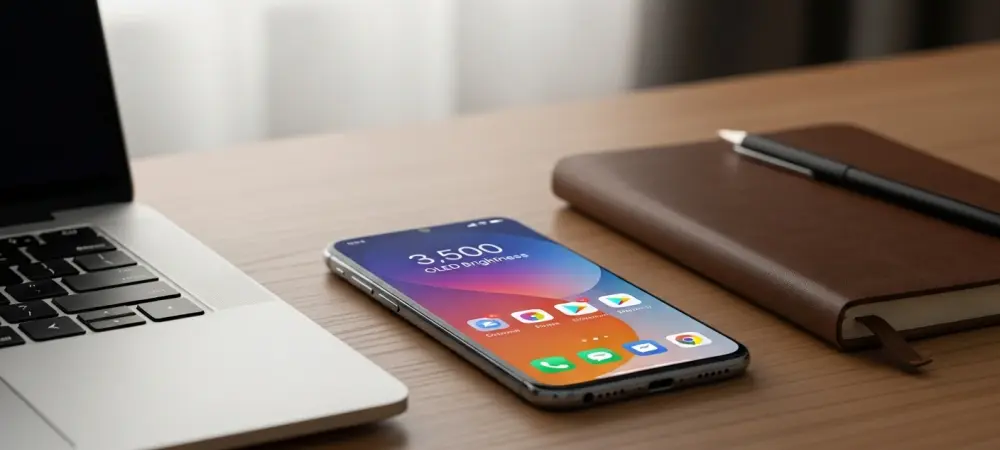
Display technology has reached 3,500 nits of peak brightness with 12-bit color depth and a 120Hz refresh rate. How does this level of brightness specifically improve outdoor visibility and HDR10+ content? What steps ensure that such a high-performance panel remains comfortable for the eyes during nighttime use?
Hitting 3,500 nits of peak brightness effectively solves the “mirror effect” of smartphone screens under direct mid-day sunlight, making every pixel of the CrystalRes OLED display remain vivid and legible. This headroom is vital for HDR10+ and Dolby Vision content, as it allows for specular highlights—like the glint of sun on water or a flash of lightning—to feel punchy and realistic against the deep blacks of the OLED. However, raw power is balanced by sophisticated eye protection, including TÜV Rheinland certifications for low blue light and flicker-free operation. The panel utilizes high-frequency PWM dimming and circadian-friendly adjustments to ensure that when you transition to a dark room at night, the screen remains soft on the eyes without losing the richness of its 12-bit color depth.
The camera system utilizes Leica-tuned Summilux lenses and a 1/1.31-inch Light Fusion sensor. How do these components work together to improve low-light photography and color accuracy? Can you share anecdotes about how the 60mm focal length telephoto lens changes the typical approach to portrait photography?
The 1/1.31-inch Light Fusion 950 sensor is a light-gathering powerhouse that, when paired with the wide aperture of the Leica Summilux lenses, allows for incredibly clean images in near-darkness with minimal grain. Leica’s color science plays a crucial role here, ensuring that skin tones don’t look processed or “digital” even when the AI engine is working hard to balance the exposure. Moving to a 60mm focal length for the telephoto lens is a game-changer for portraits because it provides a more natural perspective that doesn’t distort facial features like wider lenses do. I’ve seen photographers shift from standing right in a subject’s face to stepping back and letting the 50-megapixel sensor and OIS capture a compressed, professional-looking “bokeh” that feels more like a dedicated DSLR than a mobile phone.
New software suites include AI-driven tools like live interpretation and “Circle to Search” with Google Gemini. How do these features leverage the on-device AI engine to ensure user privacy? What is the step-by-step workflow for a professional using these writing and speech recognition tools during a workday?
By utilizing the dedicated Qualcomm AI Engine, many of the HyperAI features like AI Speech Recognition and AI Writing can process data locally on the device rather than sending sensitive voice recordings to a cloud server. For a professional, the workflow is seamless: you might start a morning meeting by using AI Speech Recognition to transcribe a discussion in real-time, then use the AI Writing tool to instantly summarize those notes into an email. If a colleague mentions an unfamiliar term or product, you simply “Circle to Search” with Google Gemini to get instant context without leaving your current app. This integration saves hours of manual data entry and searching, allowing the user to focus on high-level decision-making while the AI handles the clerical heavy lifting.
Premium smartphones are increasingly launching with comprehensive protection plans and storage upgrade incentives for early buyers. How do these launch strategies influence consumer buying patterns in the high-end market? What metrics suggest that bundled services, like AI subscriptions and premium media access, drive long-term loyalty?
In the high-end market, where prices can exceed Rs. 89,999, “de-risking” the purchase with a free Rs. 9,999 Phone Damage Protection Plan is a psychological masterstroke that encourages early adoption. These strategies create a sense of urgent value, particularly when you offer a 512GB storage tier for the price of a 256GB model, which effectively lowers the barrier to entry for the most desirable hardware. Metrics show that bundling services like four months of Spotify Premium or three months of Google AI Pro creates an “ecosystem lock-in,” where the user becomes accustomed to the premium experience. Once a user integrates Google Gemini’s pro features into their daily routine, they are statistically much more likely to stay within that hardware ecosystem when it’s time to upgrade in two or three years.
An ultrasonic in-display fingerprint sensor and an IP68 rating are standard for modern flagship durability and security. How does ultrasonic technology differ from optical sensors when a user has wet or dirty hands? What practical advice would you give for maintaining the device’s water resistance over several years?
Unlike optical sensors that take a 2D “photo” of your finger and struggle with moisture, ultrasonic technology uses sound waves to map the 3D ridges of your fingerprint, which works flawlessly even if your hands are sweaty or damp from the rain. It is a much more secure and reliable biometric method for a device that is meant to be used in all environments. To maintain that IP68 rating over the long term, I always advise users to avoid exposing the phone to salt water or pressurized jets, as these can perish the rubber gaskets over time. If the phone does get wet, make sure the USB Type-C port is completely dry before plugging in the 100W charger, as charging while wet is the most common cause of long-term motherboard corrosion despite the water-resistant rating.
What is your forecast for the Xiaomi 17?
I forecast that the Xiaomi 17 will redefine the “compact flagship” category by proving that you don’t need a giant footprint to house an enormous 6,330mAh battery and world-class Leica optics. While its launch price and premium positioning target the enthusiast crowd, the sheer power of the Snapdragon 8 Elite Gen 5 ensures this device will remain high-performing for at least four to five years. As the HyperAI ecosystem matures with more localized features, this handset will likely become the benchmark for how AI and hardware should be integrated to create a truly “smart” assistant rather than just a mobile phone. Expect this model to see significant traction among professional creators who need 8K video capabilities in a pocketable 191g frame.