

The USB 3.0 interface on the WD Elements series provides a theoretical data transfer rate of up to 5Gbps while maintaining backward compatibility with legacy USB 2.0 hardware. This foundational connectivity ensures that as digital ecosystems evolve in 2026, users can still bridge the gap between contemporary high-speed workstations and the aging infrastructure often found in home offices or secondary studios. In an environment where the average consumer generates more data in a month than they once did in a year, the introduction of a 20TB single-drive solution feels less like a luxury and more like a tactical necessity for long-term data preservation. The ballooning size of high-bitrate video assets, complex software development environments, and expansive digital archives has created a storage crisis that conventional internal drives can no longer manage effectively. Western Digital has addressed this persistent demand by positioning its Elements Desktop series as a massive, centralized repository, recently lowering the barrier to entry with a significant price adjustment to $549.99 on Amazon. This 38% discount represents a strategic shift, moving the device from the realm of professional data centers into the hands of enthusiast photographers, hardcore gamers, and digital archivists who require immense scale without the administrative complexity of networked server configurations. By offering a straightforward plug-and-play experience, the drive aims to eliminate the frustration of managing a disorganized collection of smaller external disks, replacing them with a singular, high-capacity anchor for an entire digital existence.
Technical Capabilities and Hardware Details
Speed and Connectivity Standards
While the raw 20TB capacity is the primary feature, the underlying data transfer standards determine the day-to-day utility of such a large volume. The USB 3.0 interface is the workhorse of this device, providing the bandwidth needed to move large files without the long wait times associated with older standards. In practical terms, although the theoretical 5Gbps limit is rarely reached due to the physical constraints of spinning platters, the drive maintains a consistent throughput sufficient for streaming high-resolution media directly from the disk. This performance profile makes it an ideal candidate for offloading finished projects or hosting a vast library of installation files that do not require the near-instantaneous seek times of a solid-state drive. Furthermore, the decision to retain compatibility with USB 2.0 ensures that the drive remains a versatile tool for those who occasionally need to interface with older diagnostic equipment or legacy laptops that have not yet been phased out.
The architecture of the drive is designed to prioritize stability and sustained write speeds, which is a critical consideration when moving terabytes of data during an initial backup. Unlike portable drives that may throttle performance due to heat buildup in smaller enclosures, the desktop-class housing of the 20TB Elements drive allows for better thermal management. This ensures that during a massive data migration, the drive can maintain its operational speed without the risk of overheating. For professionals who are syncing large databases or backing up entire server partitions, this consistency is more valuable than short bursts of extreme speed. The drive functions as a reliable bridge, ensuring that data can flow from a primary workstation to a secondary archive with minimal supervision. This level of reliability in connectivity standards solidifies the device as a cornerstone of a modern storage strategy, providing a balance between high capacity and functional accessibility for a wide range of hardware environments.
Operating System Compatibility
Right out of the box, the WD 20TB Elements drive is formatted with the NTFS file system, which is the native standard for the Windows ecosystem. This choice allows for an immediate, hassle-free setup for users running Windows 10 or the more recent Windows 11 and Windows 12 versions. Once the USB cable is connected, the operating system recognizes the massive partition instantly, enabling users to begin moving files with a simple drag-and-drop action. This seamless integration is particularly beneficial for those who are not tech-savvy or who simply want a solution that works without the need for driver installations or software configurations. The drive essentially acts as a massive extension of the internal storage, appearing as a local volume that can be indexed, searched, and used by any standard Windows application or backup utility.
However, the experience differs slightly for those in the Apple ecosystem, as macOS does not natively support writing to NTFS partitions without third-party software. Consequently, Mac users must manually reformat the drive using Disk Utility, typically choosing between APFS and HFS+, depending on their hardware and macOS version. While this is standard for almost any high-capacity hard drive intended for cross-platform use, it remains a critical step that requires users to configure the device before it becomes fully functional for data backup. Once reformatted, the drive performs excellently as a Time Machine destination or as a general storage pool for creative assets. This initial friction is a small price to pay for 20TB of storage, but it is a necessary consideration for those who work in mixed-OS environments and need a drive that can be moved between different machines without compatibility hurdles.
Physical Design and Power
The WD Elements 20TB is a 3.5-inch desktop-class unit, a form factor that explicitly dictates its role as a stationary fixture rather than a mobile accessory. Its physical design focuses on providing a stable environment for the high-density platters required to store 20 terabytes of data. Due to the power demands inherent in spinning these massive disks at the speeds necessary for reliable data retrieval, the drive cannot rely solely on the power delivered via a USB port. Instead, it requires a dedicated AC power adapter, which is included in the box. This requirement for a wall outlet anchors the drive to a desk or server rack, making it the polar opposite of a “pocket-sized” portable drive. This design trade-off is intentional, as larger 3.5-inch drives generally offer higher capacities and better long-term durability for archival purposes than the 2.5-inch counterparts found in portable models.
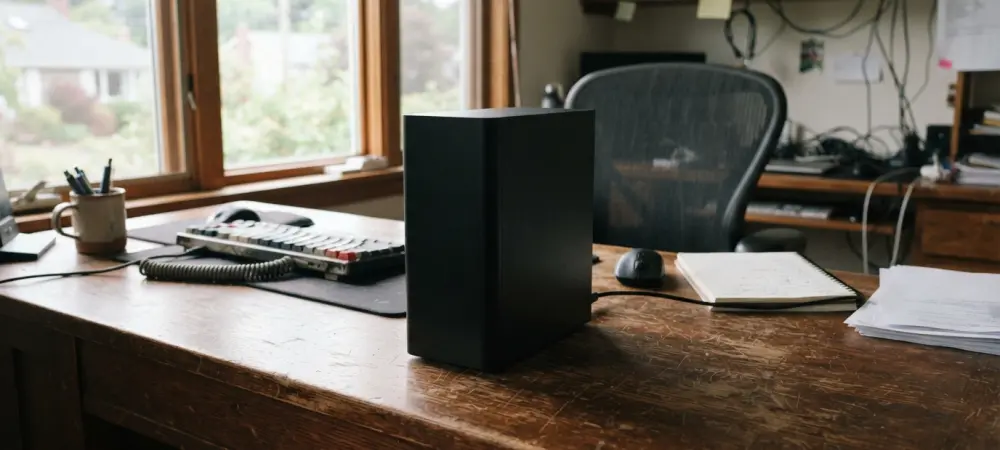
The housing itself is minimalist, featuring a sleek, dark finish that blends into most office environments without drawing unnecessary attention. Ventilation is integrated into the chassis to ensure that internal components remain within safe operating temperatures during long periods of activity. This stationary design makes the drive an excellent candidate for a “set it and forget it” backup strategy. It is not intended to be tossed into a backpack for a commute; rather, it is designed to sit quietly next to a workstation, serving as a silent guardian for years of accumulated digital content. The physical presence of the drive provides a sense of permanence, signaling its role as the primary vault for a user’s most important files. By sacrificing portability, Western Digital has been able to pack an extraordinary amount of data into a relatively small desktop footprint, providing a level of storage density that was unthinkable just a few years ago.
Meeting the Demands of Modern Users
High-Resolution Media Storage
The ongoing transition from standard high-definition to 4K and even 8K video production has drastically shifted the storage landscape for content creators. In 2026, a single hour of high-bitrate raw footage can easily consume hundreds of gigabytes, making even a one-terabyte internal drive feel claustrophobic within a single afternoon of shooting. The 20TB Elements drive addresses this “data bloat” by providing enough headroom to house entire project libraries in one location. This centralization is a significant workflow improvement, as it eliminates the need to search through multiple smaller disks to find specific clips or project files. For videographers and photographers, having all their assets on a single, high-capacity volume reduces the risk of data fragmentation and simplifies the process of creating redundant backups, which is essential for professional security.
Beyond professional use, the rise of personal media collections has also contributed to the need for massive storage solutions. Families who have digitized decades of home movies, or enthusiasts who maintain extensive libraries of high-fidelity music and movies, find that 20TB provides a comfortable cushion for future growth. Instead of constantly monitoring disk space and deleting older files to make room for new ones, users can simply archive everything. This “keep everything” mentality is supported by the drive’s ability to act as a primary media server for home entertainment systems. By connecting the drive to a router or a dedicated media PC, an entire household can access a centralized library of content, turning a simple external hard drive into the backbone of a sophisticated home theater setup. This versatility ensures that the drive remains relevant regardless of whether it is being used for creative professional work or personal leisure.
Solutions for Gamers and Archivists
The gaming industry has reached a point where “AAA” titles frequently exceed 100GB to 200GB in size, especially when factoring in high-resolution textures and expansive post-launch updates. For gamers who enjoy maintaining a large library of titles for instant access, internal solid-state drives can fill up after installing only a handful of games. The WD 20TB Elements drive serves as a perfect “overflow” tank for these massive libraries. While it may not offer the load speeds of an internal NVMe drive, it is an excellent location to store games that are not currently being played but that the user wants to keep on hand to avoid lengthy re-downloads. This strategy allows gamers to shuffle their active titles onto faster storage while keeping their entire collection safely stored on the high-capacity external unit.
For digital archivists, the appeal of a 20TB drive lies in its role as a permanent, stationary home for historical records and family legacies. In an age where physical photos and documents are increasingly being replaced by digital scans, the need for a reliable, long-term storage solution has never been higher. This drive provides a secure location for decades of correspondence, legal documents, and digital memories. Archivists often prefer these stationary desktop units because they are less prone to the physical shocks and accidental drops that can plague portable drives. By keeping the drive in a controlled environment on a desk, the risk of mechanical failure is minimized. The sheer capacity also means that archivists can use a portion of the drive for versioned backups, ensuring they can recover earlier versions of files if a mistake is made during the organization process.
Market Volatility and Availability
The current retail landscape for high-capacity storage is often defined by aggressive sales cycles and fluctuating inventory levels, particularly on platforms like Amazon. The significant price drop to $549.99 is a clear indicator of the competitive nature of the market in late 2026. However, these steep discounts often come with the caveat of unstable stock availability. Analysis of recent shopping trends shows that the 20TB Elements drive frequently disappears from digital shelves during high-demand periods, only to reappear a few days later at a different price point. This volatility suggests that consumer demand for 20TB units is at an all-time high, driven by the increasing affordability of what was once considered enterprise-grade capacity. For those monitoring the market, the current 38% discount represents a prime opportunity to acquire massive storage at a historically low cost per terabyte.
This market dynamic necessitates quick decision-making for those who are serious about expanding their storage capabilities. Waiting for a “better deal” in a fluctuating market can often lead to missing out entirely when stock runs out or when prices revert to their original MSRP. The consensus among tech analysts is that while prices generally trend downward over long periods, the specific windows for holiday-tier discounts are narrow and unpredictable. Therefore, if the drive is in stock at the $549.99 price point, it is widely considered one of the most cost-effective ways to secure a massive amount of name-brand storage. Consumers must weigh the urgency of their storage needs against the potential for future price drops, but for many, the immediate relief of having 20TB of space outweighs the prospect of saving a few additional dollars months down the line.
Reliability and Final Considerations
Manufacturer Warranty and Security
Entrusting 20TB of data—potentially a user’s entire digital life—to a single piece of hardware requires a high degree of confidence in the manufacturer. Western Digital backs the Elements Desktop drive with a two-year limited warranty, which serves as a foundational layer of security for the purchaser. This warranty covers defects in materials and workmanship, providing a path for replacement should the drive experience a mechanical failure within the first two years of operation. While no warranty can replace the value of the data itself, the presence of this manufacturer support indicates a level of confidence in the drive’s build quality and longevity. For many users, Western Digital’s brand reputation acts as a deciding factor, as the company has a long history of producing some of the most reliable hard drives in the consumer and professional markets.
Beyond the warranty, users are encouraged to implement their own security and redundancy measures, as a single drive should never be the only location for mission-critical data. The 20TB Elements drive is often used as the “primary backup” in a 3-2-1 storage strategy, where three copies of data are kept on two different media types, with one copy stored off-site. Because of its massive size, it can easily hold backups from multiple laptops, tablets, and phones, making it a central node in a comprehensive security plan. The reliability of the Elements line is rooted in its simplicity; by avoiding complex internal software or unnecessary features, Western Digital has minimized potential points of failure. This straightforward approach to storage hardware has earned the drive a reputation for being a dependable workhorse that performs its task without drama or complication.
Summary of Performance Factors
The assessment of the WD 20TB Elements drive revealed a clear set of trade-offs that defined its place in the 2026 technology market. It offered an unparalleled amount of capacity for a consumer-grade device, yet it required a stationary environment and a dedicated power source. While limited by the physical nature of hard disk technology, the speed remained consistent enough for most archival and media consumption tasks. The drive’s primary strength was its simplicity; it was designed for users who wanted to plug in a cable and immediately double or triple their available storage. The analysis showed that while it lacked the extreme performance of an SSD or the networking features of a NAS, it provided the best value for those who simply needed a “bucket” for an overwhelming amount of data.
The physical design considerations and the requirement for reformatting on macOS were noted as minor hurdles that did not significantly detract from the drive’s overall value. The consensus among those who integrated the drive into their workflows was that the peace of mind provided by 20TB of space far outweighed the inconvenience of a dedicated power brick. It was categorized as a “minimalist” solution for a “maximalist” problem. By stripping away the bells and whistles, Western Digital created a product that focused entirely on the core requirement of the modern digital era: the need for reliable, high-capacity storage that did not require a degree in network engineering to operate. For users who had outgrown their internal drives and were tired of juggling a “stack” of smaller external disks, this 20TB unit stood out as the most efficient way to reclaim control over their digital archives.
Choosing the Right Storage Path
The analysis of the Western Digital 20TB Elements drive suggested that the device was a premier choice for those facing a critical storage shortage. The review highlighted that the 38% price reduction made it a highly accessible tool for a broad demographic, ranging from creative professionals to casual users with massive media collections. The drive was evaluated based on its ability to centralize data, and the results indicated that it successfully simplified file management by replacing multiple smaller drives with a single, high-capacity repository. The study further noted that while the desktop form factor limited portability, it enhanced the drive’s role as a permanent, reliable anchor for a home office. This stationary nature was viewed as an acceptable trade-off for the sheer volume of data it could safeguard, providing a level of organizational clarity that was previously difficult to achieve without expensive server hardware.
Looking forward, the acquisition of such a large storage volume was identified as a strategic move to future-proof one’s digital life against the inevitable growth of file sizes. The report concluded that for users who prioritize ease of use and cost-effectiveness, the WD Elements 20TB offered a straightforward path to digital organization. The recommended next step for potential buyers involves assessing their current and projected data needs to determine if the 20TB capacity will provide the necessary longevity. For those who decide to proceed, the analysis suggests that immediate action is prudent given the fluctuating stock levels on major retail platforms. By integrating this drive into a consistent backup routine and accounting for the initial setup requirements, users can effectively resolve their storage crisis and ensure that their digital legacy remains accessible for years to come.