

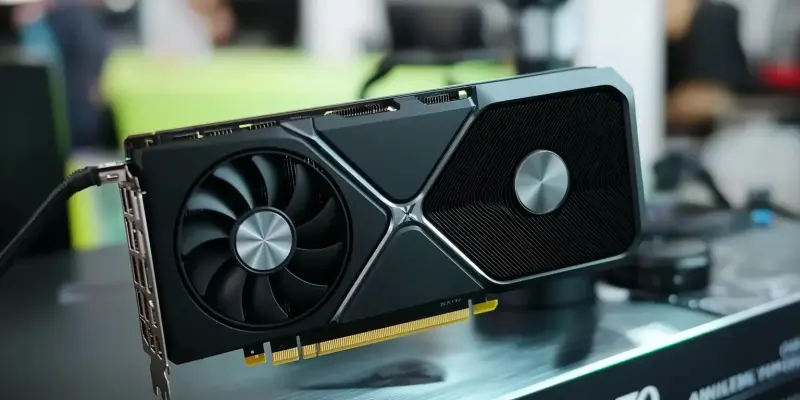
NVIDIA has packed its latest mid-range graphics card, the GeForce RTX 5070, with an impressive array of features and advancements. The performance benchmarks for the GeForce RTX 5070 have been eagerly anticipated, with initial results indicating a notable improvement over the RTX 4070. In a series of rigorous OpenCL and Vulkan tests, the RTX 5070 exhibited scores of 187,414 and 188,712 respectively. These figures represent an impressive up to 20% improvement compared to the RTX 4070, which recorded scores of 167,924 for OpenCL and 156,601 for Vulkan. Such enhancements highlight the capabilities of the RTX 5070’s architecture and the overall efficiency adjustments NVIDIA has made.
Particularly significant is the RTX 5070’s potential to handle demanding applications and gaming scenarios with greater ease. The increased performance in both OpenCL and Vulkan tests further establishes the card’s versatility and resilience in handling varied workloads.
Comparison with the RTX 4070 Ti reveals that while the RTX 5070 has a strong showing, there are specific areas where the previous generation card still holds an edge. In Vulkan performance, the RTX 5070 manages to match the RTX 4070 Ti, showcasing its competency in this domain. However, when it comes to OpenCL tests, the RTX 4070 Ti slightly outperforms the new contender, demonstrating the subtle differences in their processing abilities. This nuanced comparison provides valuable insights for potential buyers deliberating between these two models.
Furthermore, the RTX 4070 Ti SUPER, another variant in the 4070 line, surpasses the RTX 5070 by offering more Video RAM (VRAM) – a notable 16 GB as opposed to the 12 GB available in the RTX 5070. For users whose tasks are VRAM-intensive, such as high-resolution video editing or advanced gaming with extensive texture packs, these extra gigabytes could make a significant difference.
When it comes to market strategy, NVIDIA seems to have hit a sweet spot with the pricing of the RTX 5070. Announced with a Manufacturer’s Suggested Retail Price (MSRP) of $549 USD, the RTX 5070 is positioned $50 lower than the initial launch price of the RTX 4070. This makes the RTX 5070 not only more affordable at launch but also a potentially more attractive option for users looking to get the most bang for their buck.
Another critical aspect favoring the RTX 5070 is NVIDIA’s strategy concerning stock and supply. The introduction of the Blackwell GB205 chip appears to promise more stability and availability for the new graphics card. By prioritizing stable stock levels, NVIDIA not only ensures a smoother roll-out but also builds trust with consumers who have become wary of launch day scarcity.
The combat between NVIDIA and AMD is set to escalate with the impending release of the AMD Radeon RX 9070 series, based on the innovative RDNA 4 architecture. AMD’s new series is expected to match the RTX 5070 in terms of price and performance, making the mid-range GPU segment a fierce battleground. As AMD aims to captivate gamers with its latest offerings, NVIDIA’s continuous software innovation, specifically through features like DLSS (Deep Learning Super Sampling), has the potential to be a game-changer in differentiating the RTX 5070.
However, it’s crucial to acknowledge that while the RTX 5070 boasts significant improvements, it does not aim to rival NVIDIA’s flagship RTX 4090. The performance gap between mid-range and high-end models remains clear, and the leap to achieve top-tier performance levels, including advancements like DLSS 4 (Multi-Frame Generation), will require future iterations and enhancements. NVIDIA’s tactical approach to serve diverse market needs through distinguishable performance tiers is evident, positioning the RTX 5070 strategically within a highly competitive market landscape.
NVIDIA’s latest mid-range graphics card, the GeForce RTX 5070, comes packed with an impressive array of features and advancements. With rumors and benchmarks beginning to emerge, gamers and tech enthusiasts are keen to assess if this new addition to NVIDIA’s lineup will dominate the mid-range GPU market. However, the appeal of the RTX 5070 seems to lie in the significant upgrades it brings over its predecessor, the RTX 4070.
The RTX 5070 is expected to deliver enhanced performance, thanks to its improved architecture, higher clock speeds, and increased memory bandwidth. Additionally, the card reportedly offers better ray tracing capabilities and support for the latest AI-driven technologies, making it an attractive option for those looking to future-proof their gaming rigs. As the release date approaches, the battle for supremacy in the mid-range GPU market heats up, but the RTX 5070’s advancements give NVIDIA a strong edge in this highly competitive arena.