

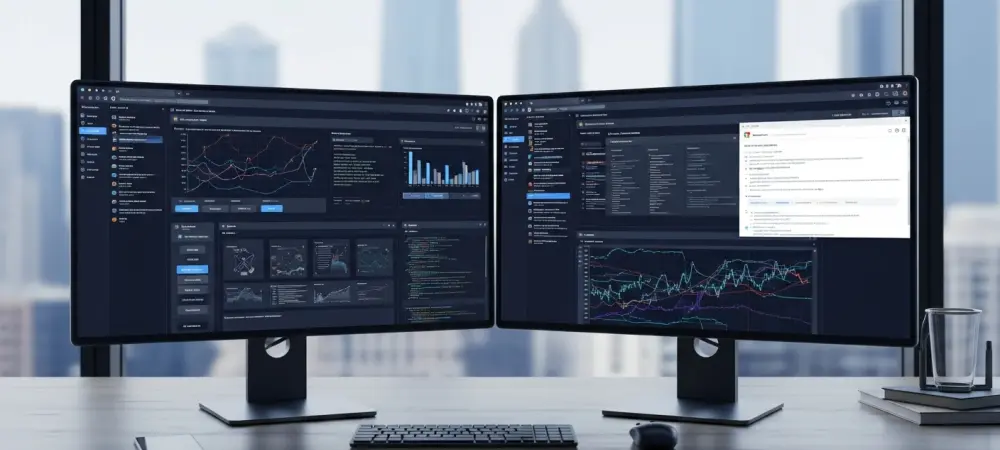
The digital landscape is currently witnessing a tectonic shift as the era of the isolated, text-based chatbot rapidly concludes to make way for the age of the integrated enterprise ecosystem. In the present market, the novelty of generating creative poems or casual email drafts has been eclipsed by a relentless demand for high-compute utility and measurable professional ROI. Major industry players are no longer content with providing a simple interface for conversation; instead, they are racing to consolidate fragmented toolsets into unified environments that handle everything from complex coding to autonomous web navigation. This evolution marks a strategic pivot from consumer-facing curiosities toward a professional infrastructure where AI is not just an assistant, but the very foundation of the modern workplace.
The Shift from Conversational Chatbots to Integrated Enterprise Ecosystems
The artificial intelligence industry is currently undergoing a massive transformation, moving away from simple text-based interactions toward comprehensive, multi-functional platforms. While the initial wave of AI adoption was driven by consumer curiosity and casual use, the focus has rapidly pivoted toward high-compute utility and professional productivity. Organizations now demand systems that can do more than just talk; they require environments that can act, reason, and integrate with existing corporate software. This consolidation is not just a technical upgrade but a strategic necessity as companies seek to move beyond experimental side projects and deliver tangible value through specialized enterprise solutions and agentic workflows.
As the industry matures, the distinction between general-purpose models and professional-grade platforms has become increasingly stark. Developers and knowledge workers are moving away from browser-based tabs and toward dedicated desktop applications that offer deeper access to system resources and smoother performance. By merging previously separate tools like large language models, coding assistants, and autonomous research browsers into a single superapp, providers are attempting to capture the entire lifecycle of a professional task. This shift suggests that the future of the market will be defined by the ability to offer a seamless, all-in-one environment that reduces the friction of switching between disparate applications.
The Rise of Agentic AI and Professional Workflows
The Evolution of Autonomy and Hyper-Productivity
One of the most significant trends reshaping the industry is the transition from reactive chatbots to proactive agentic AI. This shift represents a move toward systems capable of autonomous execution, where the AI can write and debug code, conduct deep research via integrated browsers, and manage multi-step professional tasks without constant human prompting. Consumer behavior is following suit, as power users increasingly demand tools that integrate directly into their desktop environments. They are trading the fragmented experience of using multiple disparate apps for a single, high-performance superapp that understands context across different work streams.
This new level of autonomy allows the AI to function more like a digital colleague than a software tool. For instance, a researcher can now delegate an entire project to an agent that navigates the web, synthesizes data, and prepares a technical report, all within a singular interface. This hyper-productivity is becoming the standard for the high-compute demographic, which prioritizes speed and depth of execution over simple conversational fluency. As these agentic capabilities become more refined, the traditional prompt-and-response loop is being replaced by long-running processes that require minimal oversight, fundamentally changing how professionals interact with their machines.
Market Projections and the Enterprise Adoption Curve
Current market data suggests a narrowing window for AI dominance as competition intensifies among the top-tier providers. While some early movers historically led the market, recent data indicates that agile competitors are capturing a significant share of enterprise spending, with some reports showing a jump from minimal usage to nearly a quarter of the business market in a very short span. Projections indicate that the future of AI profitability lies in capturing the high-compute user—the developers and data scientists who require deep integration. The industry is forecasted to move toward a winner-takes-all scenario where the platform that successfully merges conversational AI with autonomous utility becomes the standard layer for modern work.
The adoption curve is also being influenced by the shift toward paid enterprise seats over individual consumer subscriptions. Businesses are looking for stability and scale, favoring platforms that can demonstrate a clear path toward automating complex internal processes. As we move from 2026 toward 2028, the market will likely consolidate around two or three dominant superapps that act as the primary operating system for knowledge work. Companies that fail to integrate their services or provide autonomous agency risk being relegated to niche plugins, losing their direct relationship with the professional user base.
Complexity Risks and the Challenge of Feature Dilution
The drive toward a superapp introduces significant obstacles, primarily the risk of product dilution and user experience friction. By merging diverse tools like advanced coding platforms and autonomous browsers into a single interface, there is a danger of alienating casual users who value simplicity. A product that tries to be a universal tool can easily become cluttered, making it difficult for users to find the specific functions they need. This tension between power and usability remains a primary hurdle for developers aiming to build an all-in-one desktop ecosystem without sacrificing the intuitive nature of the original chatbot.
Furthermore, the technical complexity of managing autonomous agents that can navigate the web and execute code creates new points of technical failure. When an AI agent operates across multiple software layers, the potential for errors increases exponentially, leading to reliability issues that can be catastrophic in a professional setting. Balancing the needs of a global consumer base with the rigorous demands of enterprise-grade stability is a delicate act. Developers must ensure that as they add more features, the core performance of the system does not degrade, which would drive professional users back to more specialized, lightweight alternatives.
The Governance Gap and the Search for Security Standards
As AI transitions into a desktop superapp with agentic capabilities, it encounters a rigorous regulatory and security landscape. Existing identity management systems and audit trails are largely designed for human operators, leaving a governance gap regarding how autonomous agents interact with sensitive corporate data. For an IT administrator, the thought of an AI agent independently browsing the web or modifying codebases without a clear trail of accountability is a significant concern. Compliance with global data protection standards becomes exponentially more difficult when AI agents operate independently across different software layers and cloud environments.
This regulatory pressure favors established tech giants who already possess mature administrative control planes and deep relationships with corporate compliance departments. New superapp developers are being forced to build robust security frameworks from the ground up to gain the trust of enterprise legal teams. Without a standardized way to govern AI agency, many corporations may hesitate to fully deploy these powerful tools. The search for a universal security standard for AI agents is currently one of the most critical challenges in the industry, as the ability to prove safety and accountability is becoming as important as the intelligence of the model itself.
The Future Frontier of Autonomous Work Environments
The industry is heading toward an era where the distinction between a tool and a colleague becomes increasingly blurred. Emerging technologies point toward even deeper integration where the AI superapp functions as an operating system for productivity, anticipating user needs and managing entire project lifecycles autonomously. Potential market disruptors will likely focus on specialized, industry-specific agents that can outperform general-purpose models in niche sectors like legal research, medical diagnostics, or high-end financial modeling. Global economic conditions and the ongoing demand for high-end compute resources will dictate the pace of this innovation, but the trajectory is clearly toward integrated, professional-grade systems.
In this future environment, the value of an AI provider will be measured by its ability to orchestrate complex workflows rather than its ability to generate text. We are likely to see the emergence of specialized agents that can communicate with one another to solve multi-disciplinary problems. For example, a marketing agent might collaborate with a data analysis agent to optimize a campaign, with the superapp acting as the conductor for this digital workforce. This shift will require a new type of digital literacy from users, who will move from being creators to being directors of autonomous systems.
Transitioning from a Chatbot Era to an AI-Native Future
The emergence of the desktop superapp signaled the end of the chatbot’s identity as a simple conversational assistant and marked its rebirth as a professional powerhouse. This strategic pivot toward enterprise utility and integrated agentic workflows addressed the intensifying competition and the urgent demand for actionable AI. While the challenges of governance and product complexity remained substantial, the potential for growth in the high-compute sector proved unparalleled. For investors and industry leaders, the focus shifted toward supporting platforms that offered not just intelligence, but the secure and seamless integration required to redefine the modern workplace. Ultimately, the successful transition relied on building robust security frameworks and ensuring that autonomous agents operated within a transparent, controllable environment. These developments paved the way for a future where AI-native workflows became the standard, ensuring that organizations could finally realize the full productivity gains promised by the previous generation of technology.