

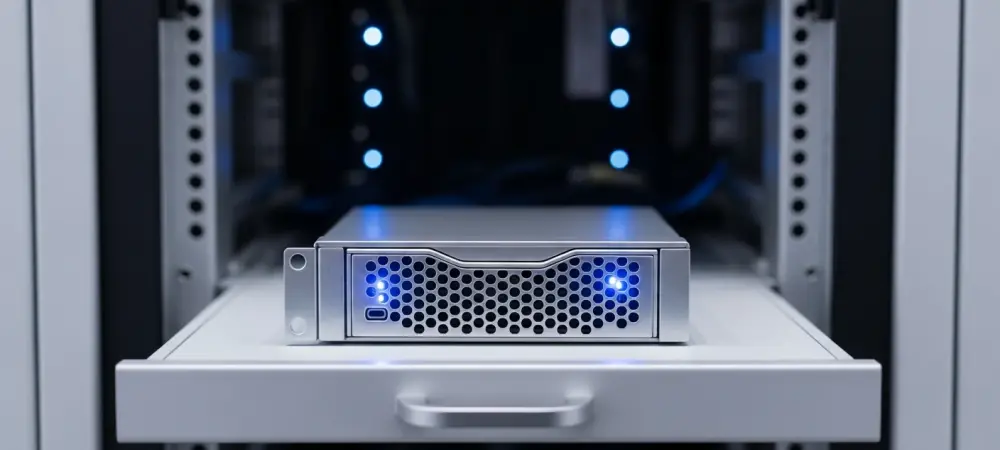
Traditional data centers are rapidly shrinking as high-density computing modules like the Minisforum MS-A2 compress the raw power of a full-sized rack into a handheld chassis. While small form factor PCs have historically been relegated to basic office tasks or media consumption, this arrival signals a definitive shift toward professional-grade computing. Packing a flagship processor into a 1.78-liter footprint, this machine attempts to answer whether raw power can thrive in a pocket-sized space without compromising connectivity.
The Dawn of the Ultra-Compact Workstation
The era of the bulky, floor-standing server is being challenged by a device no larger than a thick hardcover book. This transition marks a departure from the limitations of early mini-computers, which often struggled with heat and restricted processing capabilities. By integrating workstation-class components into such a small volume, the hardware allows professionals to maintain high performance in environments where traditional towers are impractical.
Modern engineering has reached a point where high-density electronics no longer require massive cooling towers to function effectively. The arrival of this compact system demonstrates that enterprise-level tasks can be performed on the edge of a desk or within a small travel bag. This development effectively redefines the expectations for portable infrastructure in the modern computing landscape.
Bridging the Gap Between Portability and Enterprise Performance
As remote work and edge computing become standard, professionals increasingly require “workstation-to-go” capabilities that do not sacrifice networking speed or storage depth. The demand for high-performance mini servers has surged among developers, virtualization enthusiasts, and data scientists who need localized high-speed processing without the noise of a traditional rack. This trend reflects a broader industry movement toward efficiency.
Mobile architectures are now being leveraged to solve thermal and spatial constraints that previously hindered the small form factor market. This evolution allows users to deploy high-bandwidth nodes in temporary locations or home offices without the infrastructure overhead of a server room. Consequently, the distinction between mobile hardware and stationary enterprise equipment continues to blur.
Under the Hood: Zen 5 Architecture and Storage Scalability
At the heart of the MS-A2 lies the AMD Ryzen 9 9955HX, a flagship mobile processor that utilizes 16 cores and 32 threads to handle intensive multi-threaded workloads. This processing power is supported by an internal architecture designed for extreme expansion, featuring three M.2 slots for up to 12 TB of NVMe storage. To ensure data moves without bottlenecks, the system integrates dual 10G SFP+ ports alongside dual 2.5G LAN ports.
Unique to this size class is the inclusion of a rare U.2 interface that accommodates enterprise-grade SSDs of up to 15 TB. This specific feature caters to high-endurance needs that standard consumer drives cannot meet. By bypassing the usual consumer limitations, the hardware provides a networking and storage profile typically reserved for full-sized server hardware found in professional data centers.
Industry Insights: The Pivot to Modular Barebones Computing
The pricing strategy for the MS-A2 underscores a significant shift in the hardware market, where the barebones model starts at $799 to allow users to navigate fluctuating component costs. Industry analysts note that offering the latest architecture at a premium over its predecessor highlights the value placed on contemporary efficiency. This modular approach empowers users to select their own memory and storage to fit specific budgets.
The inclusion of a PCIe x16 slot, physically limited to low-profile cards and x8 speeds, demonstrates a calculated compromise for graphical or AI acceleration. Maintaining ultra-compact dimensions of 196 x 189 x 48 mm required careful placement of these expansion points. This balance of size and modularity suggests a future where users no longer buy static systems but rather flexible platforms.
Evaluating the MS-A2 as a Strategic Server Solution
Integrating this hardware into a professional workflow required a focus on its high-speed connectivity and storage density. For users building a home lab, utilizing the dual 10G SFP+ ports allowed for seamless integration into high-bandwidth network backbones. The practical application of the U.2 interface enabled the use of high-endurance drives, making it a viable candidate for heavy database management.
By selecting the barebones configuration, power users tailored the 96 GB memory capacity to specific virtualization needs. This flexibility ensured the hardware remained optimized for its intended high-density role across various industries. Ultimately, the system proved that localized server power provided a sustainable alternative to cloud-only dependencies while maintaining a minimal physical presence in the workspace.