

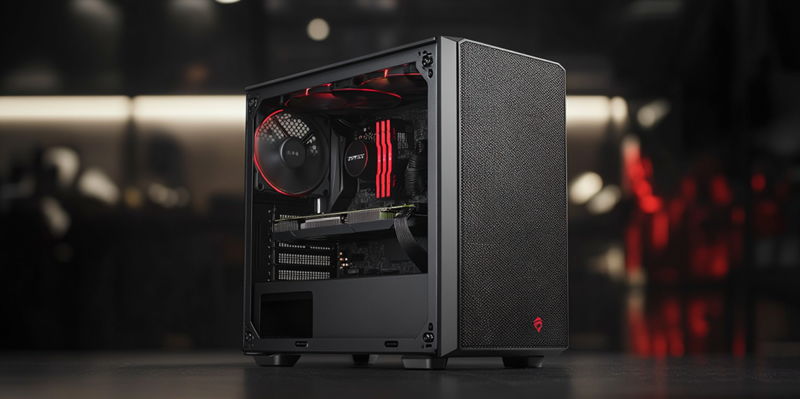
The launch of the new Minisforum EliteMini Ai370 Mini PC has generated significant buzz in the tech community. This cutting-edge device promises to deliver a blend of compact design and powerful performance, aiming to redefine what users can expect from mini PCs.
Introducing the EliteMini Ai370
The new EliteMini Ai370, equipped with the AMD Ryzen AI 9 HX 370 APU, stands out as a formidable player in the mini PC market. The device’s compact size, measuring just 5.12×5 inches and 1.85 inches in height, belies the powerful components housed within.
Superior Processing Power
The AMD Ryzen AI 9 HX 370 APU is the cornerstone of the Ai370, featuring 12 cores and 24 threads. This powerful configuration, supported by a robust 24 MB of L3 cache, enables clock speeds of up to 5.1 GHz. These specs mark a significant leap in processing capabilities for compact PCs. Enhanced by the Radeon 890M GPU, based on AMD’s latest RDNA 3.5 architecture, the Ai370 delivers up to a 30% improvement in gaming performance over its predecessor. This boost ensures that the device can handle modern AAA titles with ease, maintaining over 60 FPS at 1080p resolution in demanding games like Baldur’s Gate III, Far Cry 6, and F1 23.
Advancements in AI Performance
A standout feature of the new AMD Strix APUs is the inclusion of the XDNA 2 NPU, which offers up to 50 AI TOPS, contributing to a total platform capability of 80 TOPS. This integration significantly enhances the Ai370’s computational power, making it not just a gaming machine but also a potent tool for AI-intensive tasks. These advancements mean that users can expect smoother and more efficient performance in applications relying heavily on AI, broadening the scope of the Ai370’s usability beyond gaming to professional and creative workloads.
Compact Design without Compromise
The EliteMini Ai370 manages to pack all this power into a remarkably small form factor. Its dimensions make it ideal for users with limited desk space who do not want to compromise on performance.
High-Speed Memory and Storage Options
Supporting up to 32 GB of LPDDR5-7500 memory, which can be upgraded to 64 GB, the Ai370 caters to demanding application needs. Additionally, users can equip the device with up to 4 TB of PCIe Gen4 storage, ensuring fast data access and ample space for large files. This flexibility allows the Ai370 to handle vast amounts of data and multiple applications simultaneously, making it a perfect fit for professional environments requiring both speed and storage.
Extensive I/O and Connectivity
Versatility in connectivity is another strong suit of the Ai370. With multiple USB4 ports, users can enjoy rapid data transfer speeds and support for a wide array of peripherals. The dual 2.5GbE LAN ports further enhance network connectivity, beneficial for gaming setups and professional workstations requiring robust network performance. The comprehensive I/O options ensure that the Ai370 can integrate seamlessly into various setups, providing the necessary ports for all modern peripheral devices while maintaining high transfer speeds and connectivity stability.
Gaming Performance Analysis
The gaming performance of the Ai370 is one of its most compelling selling points. The combination of a high-performance CPU, advanced GPU, and robust cooling solutions ensures it can run contemporary games at impressive settings.
Benchmark Performance in AAA Titles
In performance tests, the Ai370 holds its ground against traditional gaming rigs. It consistently delivers over 60 FPS at 1080p resolution in games like Baldur’s Gate III, Far Cry 6, and F1 23, showcasing its capability to tackle the most demanding games with fluidity. These results are a testament to the device’s optimization and the capabilities of the RDNA 3.5 architecture, making it an optimal choice for gamers seeking a portable yet powerful solution.
Thermals and Noise
Effective thermal management is critical for maintaining performance under load. The Ai370 employs advanced cooling techniques to ensure the device stays within a safe temperature range, even during intense gaming sessions. Moreover, noise levels are kept to a minimum, a significant advantage for users in quiet environments or shared spaces. This balance of thermal efficiency and noise control further positions the Ai370 as a prime candidate for both gaming and professional use.
Professional Performance and Productivity
The EliteMini Ai370 is not solely designed for gamers. Its high-performance specs make it equally suitable for professionals requiring a compact yet capable machine.
Handling Intensive Applications
The powerful APU and memory support enable the Ai370 to manage intensive applications such as video editing, 3D rendering, and software development efficiently. The device’s ability to handle heavy multitasking and data-intensive tasks makes it a versatile tool for professionals.
AI-Driven Tasks and Creativity
The recent release of the Minisforum EliteMini Ai370 Mini PC has created a notable stir among tech enthusiasts and consumers alike. This state-of-the-art device is designed to combine a sleek, compact form with robust computing capabilities, intending to set a new benchmark for what mini PCs can offer. With advancements in technology, consumers increasingly demand more power and functionality in smaller packages. The EliteMini Ai370 rises to this challenge, packing impressive performance specs into its diminutive frame, ensuring that users do not have to compromise between space and power.
The device is aimed at a wide range of users, from professionals in need of reliable workstations to tech enthusiasts who desire high-performance computing in a portable form. Whether it’s for complex computational tasks, high-definition multimedia experiences, or seamless multitasking, the EliteMini Ai370 promises to handle it all with finesse. Minisforum’s commitment to innovation is evident in this latest offering, positioning the EliteMini Ai370 as a potential game-changer in the mini PC market. It will be fascinating to see how this new launch influences future developments in compact computing solutions.