

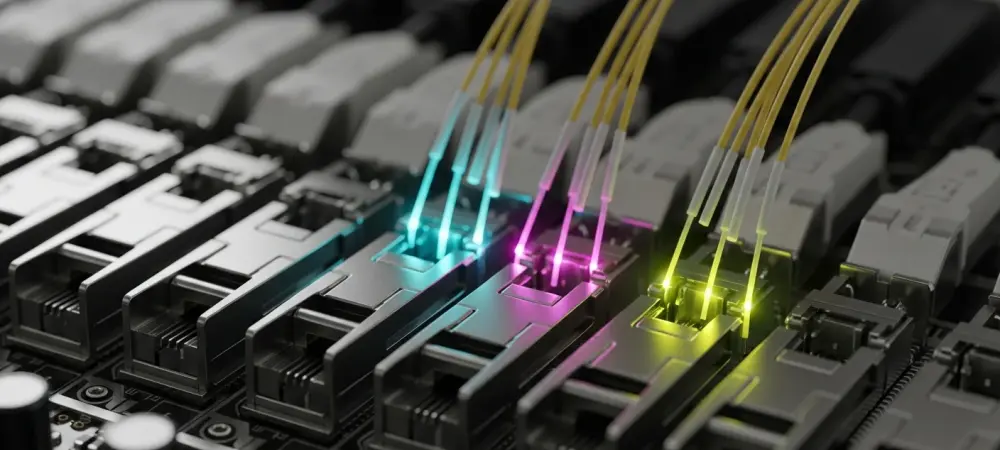
Beneath the abstract algorithms and disembodied intelligence of the current AI boom lies a far more tangible and demanding reality: a worldwide scramble for power, space, and the physical conduits of light that make it all possible. While silicon chips and complex software models capture the public imagination, the true story of artificial intelligence is increasingly being written not in code, but in the kilometers of fiber optic cable being laid to connect vast, power-hungry data centers. This foundational layer, long the quiet plumbing of the internet, has now become the central stage for the next act of the technology industry.
The Unseen Infrastructure Powering Tomorrow’s Intelligence
The prevailing narrative of an AI revolution driven solely by processing power and algorithmic breakthroughs overlooks its most critical dependency: an underlying, and often invisible, revolution in optical networking. The sheer scale and speed required to train and deploy modern AI models have pushed traditional data center infrastructure to its breaking point. Consequently, the ability to move massive datasets between processors, across racks, and among geographically dispersed facilities at the speed of light is no longer an operational detail but the primary enabler—and bottleneck—of progress.
This fundamental shift repositions optical technology from a supporting role to the main event. As computational demands continue their exponential ascent, the value in the ecosystem is migrating from the processors themselves to the high-speed interconnects that bind them into a cohesive, intelligent whole. The future performance gains in artificial intelligence will not be measured just in teraflops, but in terabits per second, cementing the importance of the physical network as the ultimate arbiter of what is computationally possible.
The AI Fiber Wave A New Foundation for Computing
The immense energy and data requirements of today’s AI systems have triggered what industry insiders call the “AI fiber wave”—a massive, global build-out of fiber optic communications infrastructure. This is not merely an upgrade cycle but a foundational reconstruction of how data centers are designed and interconnected. Training a frontier AI model requires tens of thousands of specialized processors working in perfect concert, a task that generates an unprecedented volume of internal network traffic. This demand has rendered legacy copper-based connections obsolete, forcing a structural migration to advanced fiber optics.
This transition is happening at every conceivable level of data center architecture. It begins with the long-haul networks that link distributed data center campuses across countries and continents, creating a seamless fabric for AI workloads. Within the data center walls, fiber is rapidly replacing copper for connecting rows of server racks. Most critically, the revolution is now extending deep inside the rack itself, with optical interconnects poised to link individual components like GPUs and memory, solving the final-meter bottleneck that has long constrained system performance.
Ciena’s Surge A Bellwether for an Industry Transformation
No company better exemplifies this profound industry realignment than Ciena, a long-standing specialist in optical networking. Once primarily associated with the telecommunications sector, Ciena has emerged as a standard bearer for the AI infrastructure boom, its recent trajectory serving as a powerful indicator of where the industry’s capital and priorities are shifting. The company’s performance is not a product of market speculation but a direct reflection of the immense physical demands of the AI era.
Unprecedented Financial Performance
Over the past twelve months, Ciena’s market valuation has soared, with its stock surging over 160% to reach a two-decade high. This dramatic ascent is anchored in stellar financial results, including a 20% year-over-year revenue increase in its final fiscal quarter to $1.35 billion and total annual revenues of $4.77 billion. The company’s profitability has grown in lockstep, with annual EBITDA rising by more than 32%, signaling that this growth is both substantial and sustainable.
This momentum has fueled immense confidence within the company. Ciena’s leadership recently affirmed its ambitious revenue targets, projecting a range of $5.7 to $6.1 billion for 2026 alongside an expected operating margin of 17%. This confident outlook is a testament to the enduring nature of the AI fiber wave, which Ciena is uniquely positioned to ride as the digital world is rebuilt on a foundation of light.
A Strategic Shift in Customer Demand
The engine behind Ciena’s explosive growth is a fundamental shift in its customer base. While spending from its traditional telecom clients has seen a modest dip, this has been more than offset by a tidal wave of investment from hyperscale cloud providers. These technology giants are in a race to build out the global infrastructure needed to power their AI ambitions, and they are turning to specialists like Ciena to provide the critical optical backbone.
The scale of this pivot is stark. Analysis of the company’s 2025 sales revealed that a single, unnamed cloud provider was responsible for nearly 18% of Ciena’s total revenue. This single data point powerfully illustrates how the AI data center market has become the company’s primary growth engine, fundamentally reshaping its business and cementing its role as a critical supplier to the biggest names in technology.
Product-Led Growth and Strategic Acquisitions
Ciena’s success is directly tied to soaring demand for its core optical networking products. Its photonic optical line systems, which automate and simplify the management of high-capacity networks, and its advanced coherent pluggable transceivers have become indispensable tools for hyperscalers. These products allow cloud providers to build the vast, resilient, and high-performance networks required to connect thousands of GPUs into a single, functional supercomputer.
Recognizing that the demand for optics is moving closer to the processor, Ciena made a pivotal strategic move by acquiring Nubis. This acquisition expanded its portfolio into the short-reach optical interconnect market, a critical domain for connecting processors within a single server rack. This decision signals a clear strategy to capture value not just between data centers, but deep within them, positioning Ciena to capitalize on the next phase of the optical revolution.
The New Rules of Data Center Architecture
The unique and unforgiving demands of artificial intelligence are forcing a permanent and fundamental redesign of the data center, rendering decades-old architectural principles obsolete. The monolithic data center, a massive, self-contained facility housing all necessary components under one roof, is giving way to a more distributed and fragmented model. This change is not driven by choice but by the hard limits of physics, particularly the staggering power consumption and heat generation of modern AI clusters.
This fragmentation is occurring along two distinct axes. Geographically, AI “factories” are being broken apart into smaller, regional clusters located where sufficient electrical power is available. As Dimitris Mavrakis, a research director at ABI Research, notes, “There’s just not enough power in one place to support these massive sites.” This reality necessitates the construction of ultra-high-capacity fiber networks—requiring “thousands of fibres”—to link these distributed sites with such low latency that they can function as a single computational entity.
A similar decomposition is happening architecturally within the data center itself. To optimize performance and manage heat, components like processors, GPUs, and memory are being disaggregated across a rack or even multiple racks. This move shatters the traditional server model and makes the short-reach electrical interconnects that once linked these components a crippling performance bottleneck. This is pushing fiber optics deeper into the system than ever before, right down to the board level, to provide the necessary bandwidth and reach.
The Land Grab for Optical Dominance
The industry has reached a broad consensus: the future of high-performance computing is inextricably linked to the efficiency of optical interconnects. This realization has ignited a strategic “land grab” across the technology sector, as major companies race to acquire the expertise and intellectual property needed to dominate this critical layer of the technology stack. The market is currently characterized by a flurry of high-stakes acquisitions, all aimed at controlling the flow of data at the speed of light.
This trend extends far beyond Ciena’s acquisition of Nubis. In recent months, Marvell has acquired both XConn and Celestial AI, Qualcomm has purchased Alphawave, and the manufacturing giant Amphenol has closed a deal with CommScope. These are not isolated corporate maneuvers but clear signals of a coordinated, industry-wide pivot toward optics. Each move is a calculated bet that the company that controls the network—from long-haul fiber to on-chip photonics—will hold a decisive advantage in the AI era.
Reflection and Broader Impacts
The industry’s decisive pivot from copper to fiber optics represents more than a simple technology upgrade; it is a fundamental reordering of the principles that govern high-performance computing. For decades, the guiding rule in data center design was “copper if you can, fiber if you must,” a maxim born from copper’s lower cost and relative simplicity for short-distance connections. AI has rendered this calculus obsolete.
Reflection
The inherent strengths of fiber optics—its immense bandwidth and its ability to transmit data over long distances with minimal signal degradation—have always been clear. Its adoption, however, was historically tempered by its higher cost and the complexity of its implementation. For modern AI workloads, where clusters of over 100,000 GPUs must communicate seamlessly, copper’s physical limitations, such as its one-to-two-meter reach for high-speed links, have become an insurmountable barrier. The adoption of fiber, once a choice, is now an unavoidable necessity.
Broader Impact
This technological shift is triggering a profound economic realignment. For years, the primary locus of value creation in the tech ecosystem was the processor—the silicon chip at the heart of the computer. Today, the performance bottleneck is rapidly moving from the processor to the interconnect that links everything together. As a result, economic value, research and development funding, and strategic investment are flowing aggressively into the optical layer. This change is fundamentally altering the competitive landscape, elevating companies with networking expertise and creating a new hierarchy of power in the technology world.
Conclusion The Future is Woven from Light
The narrative of the AI revolution was never solely about software or silicon. It was, from the beginning, a story about infrastructure. The insatiable computational demands of artificial intelligence created physical constraints that could not be solved by faster processors alone. This led to a necessary fragmentation of the data center, both geographically to find power and architecturally to manage performance, which in turn elevated the network from a peripheral component to the central nervous system of modern computing.
In this new reality, optical technology emerged as the only viable solution, the connective tissue capable of binding distributed systems into a single, intelligent whole. The surge of Ciena and the industry-wide land grab for optical assets were not market anomalies but the logical outcomes of this deep, structural transformation. The future of artificial intelligence was ultimately built on a foundation of light, proving that its revolution was, and always will be, an optical one.