

The telecommunications landscape in Texas is undergoing a seismic shift as the state positions itself to become the global epicenter of data storage and processing. With decades of experience in artificial intelligence and high-performance computing, Dominic Jainy provides a unique perspective on how the physical infrastructure of fiber optics is rising to meet the insatiable hunger of modern technology. This discussion explores the strategic expansion of high-capacity networks across the South Dallas and Austin corridors, the technical hurdles of deploying 800G backbones to support AI, and the regulatory environment that is accelerating Texas toward its goal of surpassing Northern Virginia as the world’s data center capital. We delve into the logistics of connecting thousands of “on-net” buildings and the critical role of speed in the race for digital dominance.
South Dallas and the Austin-to-Bastrop corridor are seeing massive investment from tech giants and infrastructure firms. How do these specific geographies influence fiber route planning, and what logistical steps are required to connect these outlying zones to primary carrier hubs in downtown Dallas and Fort Worth?
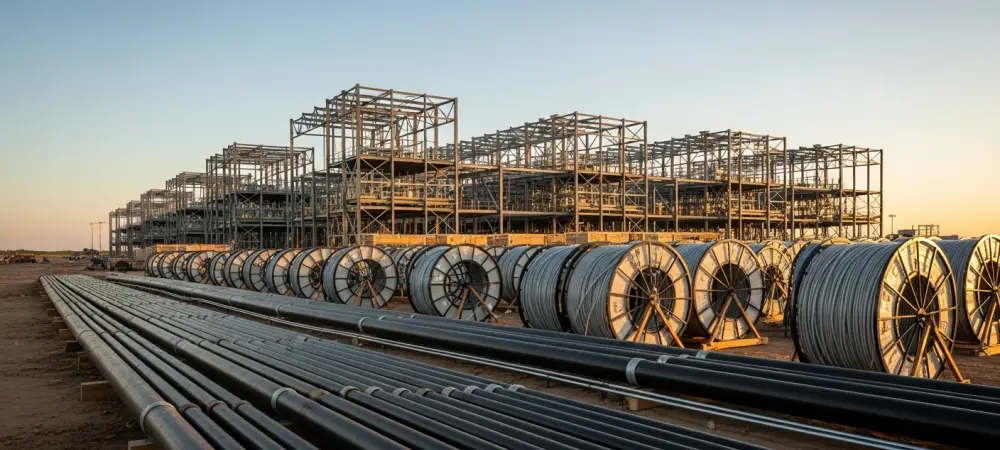
The geography of Texas is both a canvas and a challenge, where the vast stretches of land between Wilmer, Red Oak, and Midlothian dictate a very specific blueprint for connectivity. When you look at the $600 million Google has committed to Red Oak or the 220 MW flagship campus Stack Infrastructure is carving out in Lancaster, the primary goal is creating a direct, frictionless path to the massive carrier hubs in downtown Dallas. We aren’t just laying glass in the ground; we are building high-capacity corridors that act as the nervous system for these 100-acre campuses. Logistically, this requires navigating the sprawling outskirts to ensure that a data center in a place like Midlothian has the same sub-millisecond heartbeat as one located in the city center. It involves a massive mobilization of crews to lay high-count conduits that can withstand the growth of the 190 data centers already dotting the Dallas-Fort Worth landscape, ensuring the 425.1 MW of preleased space is ready the moment the servers are bolted into the racks.
AI and cloud computing demands are requiring high-count conduits and 400G wavelength services on 800G backbones. What technical challenges arise when deploying this density of infrastructure, and how do these advancements specifically address the latency needs of hyperscalers moving into the Texas market?
Deploying 400G wavelength services on an 800G backbone is like building a ten-lane superhighway where everyone is driving at the speed of light, and the margin for error is non-existent. The sheer density of these high-count conduits is a direct response to the “AI era,” where massive datasets are moving constantly between clusters for training and inference. The primary technical hurdle is maintaining signal integrity over long distances while ensuring the physical fiber miles—more than 300,000 in our network alone—don’t become a bottleneck for the 1.54 GW market in Austin. By upgrading to an 800G backbone, we can offer low-latency transport that hyperscalers crave, allowing them to move petabytes of data without the lag that would otherwise cripple real-time cloud applications. This infrastructure provides the “speed of innovation” that allows a developer to see their project go from a blueprint to a humming, high-speed reality faster than in any other region.
National providers and local firms are all vying for a share of the expanding Texas market. How does a company differentiate a metro-dense network from broad national footprints, and what are the specific operational advantages of being “on-net” in thousands of buildings during a period of rapid construction?
The difference between a national provider and a metro-dense specialist is the difference between a high-altitude map and knowing every alleyway in the city. While national players maintain a broad, “mile-wide” footprint, a metro-dense network focuses on the “last mile” connectivity that actually brings a building to life. Being “on-net” in over 3,000 buildings across Texas means we already have the physical fiber inside the walls, which drastically reduces the time it takes to get a new client online. During this period of rapid construction, where QTS Realty Trust is filing $650 million plans for new facilities, having established connections to over 80 third-party data centers is a massive operational advantage. It allows us to pivot quickly and provide immediate scalability, whereas a national firm might still be stuck in the permitting phase for their local spurs.
Texas is projected to potentially overtake Northern Virginia as the global data center capital by 2030. Given the availability of land and energy, how does the state’s regulatory framework accelerate project timelines, and what metrics should developers prioritize to ensure they maintain this speed of innovation?
Texas has created a “perfect storm” for development by combining an abundance of raw land with a regulatory environment that prioritizes speed over bureaucracy. Unlike the more congested and heavily regulated markets on the East Coast, the framework here is noticeably more relaxed, which is why we saw Central Texas construction surge by 463.5 MW in just the 2023-2024 period. Developers need to prioritize “speed-to-market” as their primary metric, because in the world of AI, a six-month delay in construction can mean falling behind an entire generation of technology. We are seeing a shift where availability of energy and the ability to break ground quickly are the ultimate deciders for hyperscalers. If the current trajectory holds, and we continue to double the Dallas-Fort Worth market capacity by the end of this year, the 2030 projection isn’t just a possibility—it’s an inevitability.
What is your forecast for the Texas data center market?
I forecast that the Texas data center market will transition from a regional powerhouse to the undisputed “global brain” of the AI economy by the end of this decade. We will see the Austin-to-San Antonio and Dallas-Fort Worth corridors merge into a singular, interconnected megaregion of compute power, likely exceeding 3 GW of total capacity before 2030. This growth will be fueled by the continuous deployment of 800G and eventually 1.6T backbones, making Texas the primary hub for not just American data, but international cloud traffic. The state’s ability to offer both the space for massive 100-acre campuses and the dense fiber networks to connect them will create a gravity well that attracts every major tech firm on the planet. By 2030, the “Northern Virginia” standard will be a legacy benchmark, and the world will look to the Texas regulatory and infrastructure model as the blueprint for the next century of digital growth.