

With a distinguished career spanning the frontiers of artificial intelligence, machine learning, and blockchain, Dominic Jainy has consistently been at the forefront of technological innovation. Today, we sit down with him to dissect one of the most audacious proposals in recent memory: SpaceX’s plan for a million-satellite orbital data center constellation. Our conversation will explore the immense technical and logistical challenges of such a project, its specific applications and limitations for different AI workloads, and the profound strategic and geopolitical implications of vertically integrating launch, network, and compute. We’ll also delve into the economic realities of this celestial venture and what it signals for the future of global technology infrastructure.
SpaceX has proposed a one-million-satellite constellation for orbital data centers, a massive leap from current infrastructure. What specific technological and logistical hurdles must be overcome to deploy and maintain such a system, and could you walk us through the step-by-step process of making one unit operational?
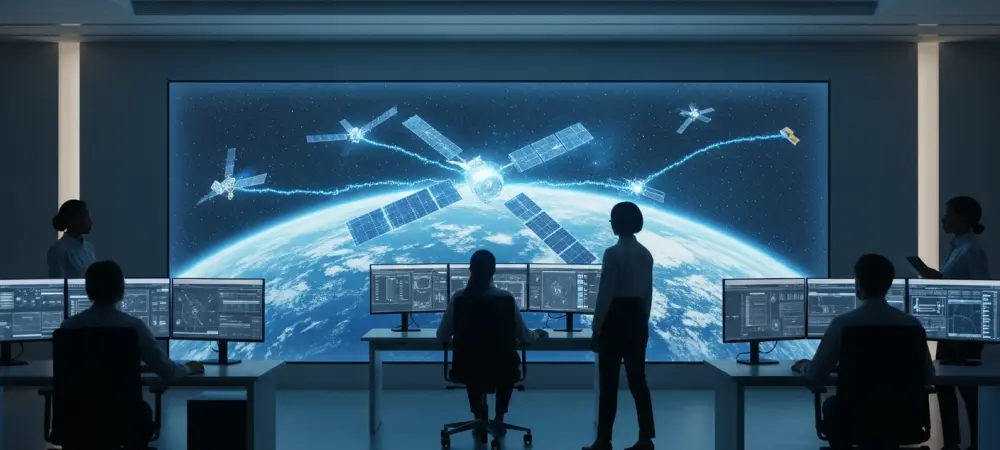
The sheer scale of a million satellites is staggering, and the hurdles are monumental. The first step, obviously, is the launch. Even for SpaceX, this represents an unprecedented logistical campaign. Once a satellite is in orbit, it needs to power up and establish a connection. This involves deploying its solar arrays, which the filing says will be in sunlight 99% of the time, and then creating a stable, high-bandwidth connection through inter-satellite optical links. This isn’t just one link; it’s about weaving a single satellite into a dynamic, moving mesh network of thousands of others. Finally, it must connect to the Starlink network to transmit data back to Earth. The biggest ongoing challenge is what the filing calls “minimal operating and maintenance costs.” In reality, this means zero-touch maintenance. You can’t send a technician up there. The hardware becomes a rapidly depreciating asset due to constant threats from radiation and space debris, so the entire system must be designed for remote diagnostics, automated recovery, and eventual, graceful degradation.
Orbital data centers benefit from near-constant solar power but face challenges like latency, radiation, and zero-touch maintenance. How do these trade-offs impact their suitability for different AI workloads, such as frontier model training versus other applications? Please provide some concrete examples.
This is the central paradox of orbital compute. You solve the terrestrial power and cooling problems, which are becoming massive bottlenecks for AI, but you introduce a completely new set of constraints. For something like frontier AI model training, the environment is fundamentally hostile. Training these enormous models demands incredibly dense compute clusters with tight, low-latency connections for fast east-west traffic. You need hardware packed together, communicating instantaneously. Space, by its nature, introduces delay and limits physical density. So, I see it as being structurally weak for that specific, high-intensity workload. However, for other applications—perhaps AI inference at the edge, certain types of data processing, or serving as a redundant backup—it could be viable. Think of it less as the primary factory for building new AI and more as a distributed network for running already-trained models, where the trade-off for constant power outweighs the need for extreme performance.
With reports of a potential merger between SpaceX and xAI, some see a move toward total vertical integration. What specific strategic advantages does controlling launch, network, power, and compute create, and how might this reshape the competitive landscape for established terrestrial cloud providers?
The potential convergence of SpaceX and xAI is the real story here. This isn’t just about building data centers; it’s about building an unassailable strategic moat. If this merger happens, you’d have a single entity that controls the entire stack: the rockets to launch the hardware, the global satellite network for data transmission, the orbital platform for power generation, and the AI workloads themselves. This is a level of vertical control that no current cloud provider can even dream of replicating. They are all beholden to power grids, fiber optic networks, and supply chains they don’t own. This integrated system creates an alternative supply of compute that is completely independent of those terrestrial constraints. It fundamentally reshapes the competitive landscape by introducing a player that doesn’t play by the same rules. The one-million-satellite filing feels less like a concrete construction plan and more like a powerful statement of intent in these negotiations.
The concept of orbital data centers has been described as “strategic insurance” and a path to a “sovereign compute monopoly.” Could you elaborate on what geopolitical, regulatory, or resource-scarcity scenarios on Earth might make this off-planet compute so critical? Please share a few potential examples.
“Strategic insurance” is the perfect term. The ground is becoming an increasingly precarious place to house the world’s most critical digital infrastructure. Imagine a scenario of widespread terrestrial conflict where undersea cables are cut or major data center regions are targeted. An orbital network could ensure AI continuity. Consider a regulatory scenario where a nation or bloc decides to heavily restrict AI development or data processing within its borders; an off-planet system operates outside that direct jurisdiction. Furthermore, as terrestrial AI hits the physical wall of power and cooling availability, an energy-independent orbital system becomes invaluable. The entity that controls this off-planet compute essentially holds a monopoly on resilience. They own the ultimate backup plan for AI, which, in the future, could be synonymous with economic and strategic continuity.
SpaceX’s filing claims its orbital system will achieve transformative cost and energy efficiency. How realistic are these claims when factoring in the immense cost and environmental impact of launching a million satellites? Can you break down the long-term operational savings versus the upfront capital expenditure?
The claim of “transformative cost and energy efficiency” needs to be carefully unpacked. The upfront capital expenditure is astronomical—the R&D, manufacturing, and launching of a million satellites is an undertaking that dwarfs any single terrestrial project. The environmental cost of that many launches is also a significant and valid concern. However, SpaceX is betting on a long-term operational calculus. Terrestrial data centers have massive, ongoing operational costs: enormous electricity bills from the grid and the constant expense of sophisticated cooling systems. By harnessing near-constant solar power and operating in the vacuum of space, the orbital model aims to virtually eliminate those two specific, massive line items. The bet is that over the lifespan of the constellation, these operational savings will be so profound that they will eventually offset the colossal initial investment. It’s a high-risk, high-reward economic model that hinges entirely on their ability to mass-produce and launch at a scale no one has ever attempted.
What is your forecast for the development and role of orbital data centers over the next decade?
Over the next decade, I don’t see orbital data centers replacing the massive terrestrial hyperscalers. Instead, I forecast them emerging as a critical, niche, and strategic layer of global infrastructure. We will likely see the first true prototypes and smaller-scale constellations become operational, moving beyond theory into practice. Their primary role will be as this “strategic insurance”—providing resilient compute for governments, critical industries, and sovereign AI initiatives that cannot afford terrestrial disruption. They will become the ultimate fail-safe. As terrestrial power and regulatory constraints tighten, the value of this off-planet alternative will skyrocket, making it one of the most vital and contested geopolitical assets of the 2030s.