

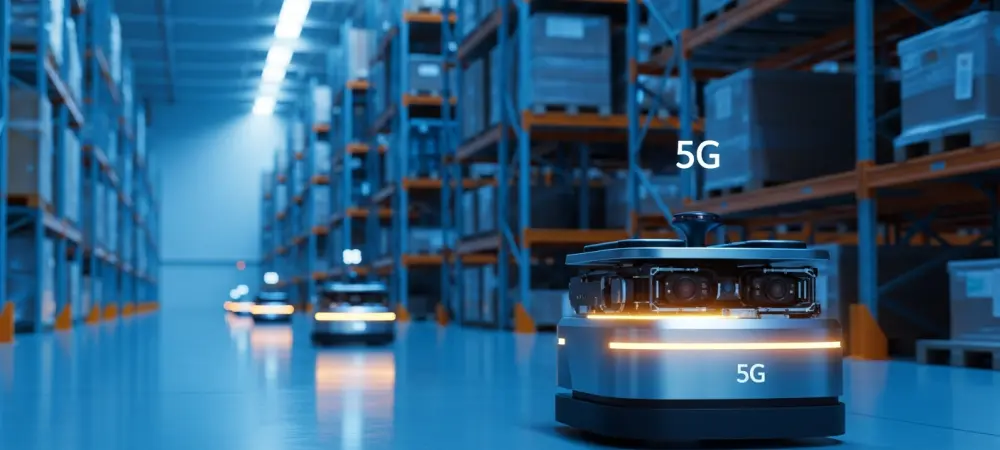
The once-deafening roar of consumer 5G hype has largely faded into a quiet background hum of routine utility, yet within the gated perimeters of industrial campuses, a silent and far more consequential digital transformation is gathering momentum. While the average smartphone user has grown accustomed to high-speed streaming as a baseline expectation, the world’s most critical industrial hubs are discovering that public connectivity is insufficient for the rigorous demands of modern automation. In this current landscape of 2026, the emergence of “physical AI” has changed the stakes, requiring machines to not only communicate but to think and move with millisecond precision. This shift has turned the spotlight toward private cellular networks, which are no longer experimental novelties but the essential nervous systems of the next industrial age.
The economic reality of this transition is stark, with the private cellular sector currently valued at approximately $2.8 billion. As the demand for reliable, low-latency connectivity intensifies, experts project this market will surge by 135 percent over the next few years, reaching a valuation of $6.6 billion by 2029. This growth is not merely a statistical anomaly but a reflection of a fundamental need to bridge the gap between digital intelligence and physical operations. While public networks struggle with the saturation of consumer data, private campuses offer a controlled environment where the “hard math” of industrial reliability can be solved. Consequently, the blueprint for the AI-driven economy is being drafted not in the public square, but within the private corridors of factories, mines, and logistics hubs.
The Silent Surge: Why the Real 5G Revolution Is Happening Behind Factory Gates
The traditional Wi-Fi signal, once the workhorse of the enterprise office, has reached its breaking point in the high-stakes environment of the modern factory floor. Industrial processes in 2026 require a level of deterministic connectivity that legacy wireless technologies simply cannot provide. When a fleet of autonomous mobile robots navigates a crowded warehouse or a robotic arm performs precision welding, a single dropped packet or a momentary spike in latency can result in costly downtime or safety hazards. Private 5G solves this by offering dedicated spectrum and localized infrastructure, ensuring that mission-critical data remains isolated from the congestion of public traffic. This reliability is the foundational requirement for physical AI, where the fusion of sensors and machine learning demands a constant, uninterrupted flow of information.
The current surge in adoption is driven by the realization that while public 5G was built for people, private 5G is built for machines. Across the globe, industrial leaders are recognizing that the “one-size-fits-all” approach of public carriers fails to address the unique topographical and security challenges of a deep-pit mine or a sprawling chemical plant. By deploying a dedicated campus network, these enterprises gain total control over their coverage, capacity, and security protocols. This autonomy is proving to be a powerful catalyst for innovation, allowing companies to implement advanced use cases such as augmented reality for maintenance and real-time digital twins. As these private networks proliferate, they are creating a new standard for industrial excellence that emphasizes resilience over raw speed.
Furthermore, the transition to private cellular infrastructure represents a strategic shift in how organizations perceive their technological assets. In the past, connectivity was viewed as a utility expense, much like electricity or water. Today, it is regarded as a competitive advantage that enables a higher degree of operational agility. The ability to reconfigure a production line in hours rather than days, supported by wireless rather than wired connections, provides a level of flexibility that is essential in a volatile global market. This “silent surge” is effectively decoupling industrial progress from the limitations of public infrastructure, allowing the most forward-thinking enterprises to build their own bespoke ecosystems of intelligence.
The Great Infrastructure Decoupling: Navigating the 34 Percent Growth Gap
A historic divergence is currently unfolding within the telecommunications industry, where the fortunes of public and private infrastructure have taken vastly different paths. The global public Radio Access Network (RAN) market, once the primary engine of the industry, remains largely stalled with a value fluctuating between $30 billion and $45 billion. In contrast, the private 5G sector is carving out a 34 percent compound annual growth rate, representing a rare bright spot in a maturing market. This decoupling is a direct consequence of the different investment cycles governing these two segments. While public carriers have largely completed their initial 5G rollouts and are now focusing on monetization, industrial enterprises are just beginning to unlock the potential of dedicated cellular technology.
This growth gap highlights a fundamental shift in where the value of connectivity resides. For public operators, the challenge lies in increasing average revenue per user in a saturated consumer market. However, for the private sector, the value is derived from the massive efficiency gains and cost savings associated with automation. Analysts suggest that by the mid-2030s, private 5G could represent as much as one-third of all cellular infrastructure spending. This suggests that the future of the telco equipment market is increasingly tied to the success of industrial digital transformation. Vendors that once relied solely on massive contracts with national carriers are now pivoting their strategies to serve a fragmented but rapidly growing landscape of thousands of individual campus networks.
Moreover, the decoupling of these markets is forcing a reevaluation of the technical requirements for 5G equipment. Public networks prioritize wide-area coverage and high user density, whereas private networks require deep indoor penetration and specialized features like high-precision positioning and ultra-reliable low-latency communication. This divergence has created a fertile ground for innovation, as equipment manufacturers develop “ruggedized” and “compact” versions of their hardware specifically for industrial environments. The 34 percent growth gap is not just a financial metric; it is a signal that the center of gravity for wireless innovation has moved from the public airwaves to the private factory floor.
Powering the Physical AI Economy: From Autonomous Mines to Future Railway Systems
The momentum behind private 5G is increasingly characterized by a “pull” effect from sectors that cannot afford a second of downtime. In the world of logistics and mining, the stakes are measured in both productivity and safety. Global logistics hubs are now deploying dedicated networks to manage massive autonomous fleets that transport containers with surgical precision. Similarly, deep-pit mines are using private 5G to remove human operators from dangerous environments, allowing for the remote operation of heavy machinery from hundreds of miles away. These use cases represent the “physical AI” economy in its most tangible form, where high-performance connectivity is the prerequisite for turning massive amounts of sensor data into actionable intelligence.
This transition is not limited to the private sector, as government and public infrastructure projects are adopting private 5G at an unprecedented scale. In the United Kingdom, Project Morpheus is redefining battlefield communications through rapidly deployable private networks, while Germany’s D-LBO initiative focuses on the digitalization of land-based military operations. These projects demonstrate that the security and reliability of private cellular technology are now viewed as essential for national defense. By creating isolated, secure bubbles of connectivity, these organizations can maintain operational integrity even in the most challenging environments. This trend underscores the versatility of private 5G as a tool for both industrial profit and public security.
Perhaps the most ambitious application of this technology is seen in the global railway sector, which is currently undergoing a massive overhaul. The industry is moving away from the aging GSM-R standard in favor of the 5G-based Future Railway Mobile Communication Systems (FRMCS). This transition involves installing private 5G infrastructure across hundreds of thousands of kilometers of track to support high-speed data transfer and enhanced signaling. For the railway industry, this is not just an upgrade in speed; it is a fundamental shift toward a more intelligent and autonomous transport network. These massive infrastructure projects serve as a proof of concept for the scalability of private 5G, showing that it can support both localized campuses and vast, linear networks.
The Profitability Paradox: Expert Insights on Nokia’s Strategic Pivot and Market Realities
The rapid expansion of the private 5G market has brought with it a complex set of economic challenges that are forcing industry giants to recalibrate their strategies. A prime example of this “profitability paradox” is Nokia’s recent decision to divest its Enterprise Campus Edge (ECE) unit. Despite being a pioneer in the sector, Nokia has shifted its focus away from small-scale campus projects to prioritize high-margin wide-area networks. This move highlights a critical distinction in the market: the difference between selling a standardized solution to a national utility and providing a highly customized network for an individual factory. While the campus segment is growing rapidly, it often requires a level of integration and support that can strain the margins of traditional equipment vendors.
Market analysts from SNS Telecom & Research suggest that this strategic pivot reflects a maturing market where players are choosing their battles more carefully. The “hard math” of private networks reveals that while large-scale projects mirror the economics of public 5G, the small-scale segment is increasingly the domain of specialists. This shift has opened the door for agile vendors like Celona and Druid Software, which have built their business models around the unique needs of hospitals, warehouses, and factories. These specialists thrive by offering “software-defined” solutions that are easier to deploy and manage than traditional carrier-grade equipment. By focusing on the specific pain points of individual venues, these smaller players are capturing a significant share of the burgeoning “AI supercycle.”
However, this divergence does not mean the major vendors are exiting the space entirely. Instead, they are repositioning themselves as the hardware foundation for these specialized ecosystems. Nokia, for instance, continues to collaborate with partners like NVIDIA to develop AI-optimized RAN hardware that can be utilized by various integrators. This trend toward a more fragmented and specialized market is a sign of a healthy ecosystem. It allows for a diversity of solutions that can cater to everything from a small medical clinic to a massive autonomous port. The profitability paradox is essentially a lesson in market segmentation, proving that the blueprint for success in the private 5G era requires a balance between technological scale and operational customization.
Architecting the Industrial Network: Practical Strategies for Multi-Vendor Success
As enterprises navigate the complexities of private 5G, the industry is moving away from monolithic, single-vendor solutions toward a more flexible, decoupled architecture. The most successful deployments in 2026 are those that leverage a multi-vendor ecosystem, pairing high-performance hardware from established giants with agile software cores from specialists. A prominent example of this strategy is the Sydney Metro West project, which successfully integrated Nokia’s RAN hardware with a software core from HPE. This approach allows organizations to pick the best-in-class components for their specific needs, avoiding the “vendor lock-in” that has plagued the telecommunications industry for decades.
For many organizations, the key to a successful private network lies in its ability to support a “neutral host” capability. This allows the private infrastructure to not only serve mission-critical industrial applications but also provide seamless public cellular coverage for employees and visitors. By integrating with public carriers, enterprises can ensure that their connected workers remain reachable while maintaining a dedicated, secure core for their AI-driven operations. This dual-purpose architecture transforms the network from a specialized industrial tool into a comprehensive communication platform. Organizations should prioritize systems that offer deep integration with existing industrial workflows, ensuring that the network is an asset that enhances productivity rather than a siloed piece of technology.
Ultimately, the goal of architecting an industrial network is to create a platform that is as dynamic as the AI it supports. This requires a shift in mindset from traditional network management to a more software-centric approach. Enterprises are increasingly adopting cloud-native cores that can be updated and scaled with ease, allowing them to keep pace with the rapid evolution of physical AI. By focusing on interoperability and open standards, businesses can ensure that their connectivity infrastructure remains resilient and future-proof. In this era of rapid change, the most effective strategy is to build a network that is not just a series of wireless access points, but a strategic foundation for long-term industrial intelligence.
The transition toward private cellular infrastructure represented a pivotal moment for global industry. Organizations that successfully navigated this period prioritized deep integration and multi-vendor flexibility over simplistic, off-the-shelf solutions. They recognized that the network was not merely a utility but the central nervous system of their automated operations. Leaders looked beyond the initial hype to focus on the “hard math” of reliability and low latency, ensuring their systems could handle the rigorous demands of real-time machine intelligence. This strategic shift toward dedicated, secure, and localized connectivity provided the decisive edge needed to thrive in a competitive landscape. By treating private 5G as a foundational pillar of the economy, these firms established the operational speed and resilience required for the modern age.