

With a deep background in artificial intelligence and machine learning, Dominic Jainy offers a unique perspective on a graphics card market currently being reshaped by those very technologies. We sat down with him to unpack the latest industry report, exploring the nuances behind Nvidia’s strategic pivot toward AI, the resulting shifts in market share for AMD and Intel, and the complex economic forces creating a turbulent forecast for the entire sector.
The latest report shows Nvidia’s discrete GPU share dipped slightly to 92% in Q3 2025, which seems minor but is significant given its near-total dominance. From your perspective, what specific strategic decisions are leading to this, and how are competitors like AMD and Intel managing to carve out their combined 8% share?
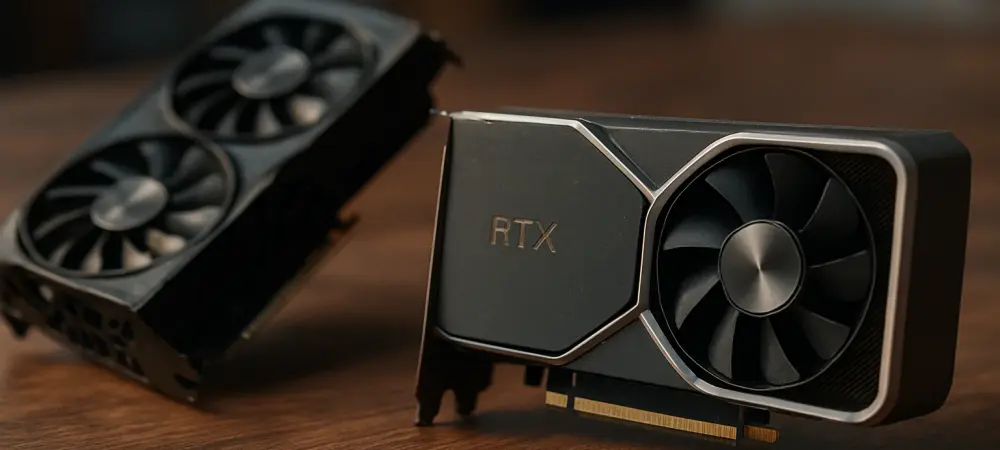
That slight dip is the most telling number in the entire report. It’s not a sign of failure for Nvidia; it’s a calculated consequence of their monumental pivot to becoming an AI-first company. They are consciously reallocating their most valuable resources—top engineering talent, R&D budgets, and even silicon wafer allocation—away from the consumer GeForce line and toward their data center and AI accelerators, where the profit margins are astronomical. This creates a vacuum. AMD and Intel are cleverly stepping into that void, not by trying to launch an “RTX killer” at the highest end, but by aggressively competing on price-to-performance in the mid-range and entry-level segments. They’re capturing the market that feels left behind by Nvidia’s high-end focus, winning over system builders and gamers who need solid performance without a four-figure price tag.
We saw a very modest 2.8% sequential growth in add-in board shipments, far below the ten-year average. Could you walk us through the market dynamics at play here, especially how the “panic buying” in Q2 created this unusual situation?
The market is essentially nursing a hangover from the second quarter. What we saw then wasn’t organic growth; it was a surge of fear-based purchasing. When whispers of new tariffs started circulating, distributors and system integrators went into a frenzy, pulling their orders forward by months to hoard inventory before prices potentially shot up. This created a massive, artificial spike in Q2 shipments. So, that small 2.8% rise in Q3 isn’t a sign of a weak market; it’s the market slowly digesting that enormous glut of inventory. We’re seeing a return to a more traditional, seasonal pattern, but it looks sluggish because it’s being compared to a quarter that was completely distorted by external economic pressures.
Jon Peddie Research is forecasting a negative CAGR of -0.7% for discrete GPUs through 2029, pointing to trade wars and recession fears as major headwinds. In this climate, what are the most critical metrics you’re watching, and what would it take for the market to defy this pessimistic forecast?
In this environment, I’m less focused on raw shipment numbers and more on channel inventory levels and consumer sentiment. Are cards gathering dust on shelves? Are consumers still willing to spend on high-end discretionary items like a new GPU when inflation is a concern? Those are the real indicators. For the market to turn this forecast around, two major things would need to happen. First, a significant de-escalation of trade tensions would be required to stabilize supply chain costs and restore predictability. Second, and perhaps more importantly, we’d need a true catalyst on the software side—a new generation of “must-have” games or a killer consumer AI application that makes upgrading your graphics card feel essential, not just desirable. Without that demand driver, it’s hard to fight the downward pull of a shaky economy.
Even with competitors gaining some ground, the Steam survey reveals that the top 10 most-used discrete cards are all from Nvidia. What is it about their product or marketing strategy that fosters such incredible loyalty, and can you share an example of how a competitor has struggled to break that hold?
Nvidia’s dominance on Steam is a masterclass in ecosystem building. It’s not just about selling the fastest chip; it’s about selling a complete, reliable experience. Features like DLSS and their best-in-class ray tracing performance have become genuine reasons to choose their hardware, and their driver support is famously stable. I recall a competitor launching a card a while back that had incredible raw performance on paper, almost beating Nvidia’s equivalent for a lower price. But it was plagued by unstable launch-day drivers and lacked a compelling software feature to counter the appeal of DLSS. Gamers are incredibly savvy; they’ll watch a dozen review videos, and if they see stuttering, crashes, and a lack of features, they’ll always retreat to the “safe” option. That brand trust has been built over decades, and it’s proven nearly impossible to break with hardware alone.
What is your forecast for the discrete GPU market?
Looking ahead, the short-term forecast certainly looks choppy, colored by the economic headwinds we’ve discussed. That negative CAGR reflects a market bracing for a period of cautious consumer spending. However, I believe the long-term outlook is more optimistic than those numbers suggest. The very AI technology that is currently diverting Nvidia’s focus will eventually become the next major driver for consumer GPU upgrades. Once AI-powered features become integral to operating systems, creative applications, and gaming, the demand for powerful, dedicated silicon on our desktops will reignite. The market may be entering a challenging cycle, but the underlying need for high-performance parallel processing is only going to grow.