

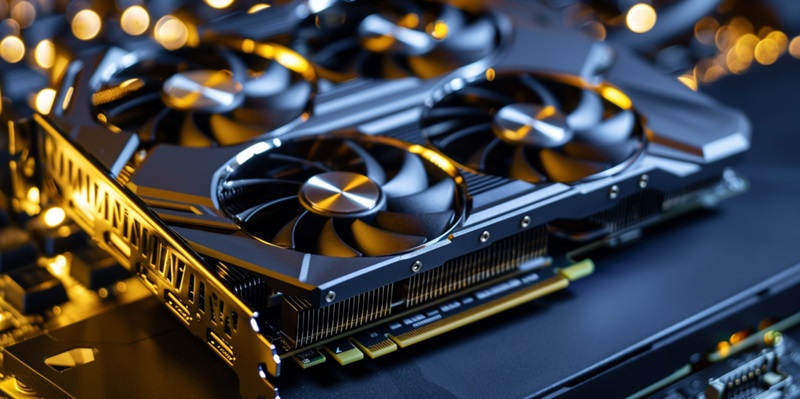
As the tech community buzzes with anticipation, leaked images and insider chatter suggest Nvidia is not taking thermal management lightly with their upcoming RTX 5000 series graphics cards. Tentatively dubbed “Blackwell”, these prototypes boast significantly enlarged cooling systems, ranging from the substantial triple-slot to an unusual quad-slot size. This has set the stage for speculation regarding the potential thermal demands of Nvidia’s future powerhouse GPUs.
Nvidia’s Increasing Thermal Management Needs
The Importance of Advanced Cooling
Leaked information points to a groundbreaking leap in power requirements for Nvidia’s “Blackwell” GPUs, spanning from a modest 250W to a stunning 600W. Such an uptick in power consumption necessitates a parallel sophistication in cooling technology. With the industry’s relentless pursuit of enhanced performance capabilities, these proposed coolers may serve as a testament to Nvidia’s commitment to pushing the boundaries of GPU power while mitigating the associated heat production.
Prototype Designs and Potential Power Supplies
When considering the prototypical behemoth coolers and Nvidia’s historical power consumption trends, it’s clear that the company is preparing for a substantial increase in thermal output. Existing models like the RTX 4090 already sport a significant thermal design power (TDP) of 450W, suggesting that future flagships could necessitate power supply units (PSUs) well over the 1000W mark—highlighting the importance for consumers to anticipate potential upgrades to their power delivery systems to accommodate such enhancements.
Size Matters: Balancing Power Consumption with Thermal Output
Balancing Performance with Heat Dissipation
As graphical fidelity and computational horsepower reach new heights, Nvidia finds itself at the crossroads of performance and thermal management. Industry whispers tell of significant advancements in the RTX 5000 series’ capabilities, intensifying the need for efficient and effective cooling systems. Enlarged coolers may provide a proportionate solution to the heat dissipation challenge, allowing for sustained performance without compromising on system integrity.
Learning from Past Challenges
Nvidia’s latest moves could be seen as a direct response to recent hardware issues. The melting connectors of the RTX 4090 underscore the necessity for robust thermal strategies. Nvidia’s current explorations of larger cooling solutions reflect a preventive approach, potentially setting a new benchmark in the stability and reliability of high-performance GPUs while addressing preceding design shortcomings.
Industry-wide Shift in GPU Cooling Trends
Nvidia’s Possible Roadmap and Consumer Trends
Nvidia’s prototypical ventures signal an impending industry-wide shift, with implications far beyond their own product lineup. AMD’s entrance into the realm of high-power GPUs with offerings like the XFX RX 7900 XTX influences market trends and reshapes consumer expectations. Nvidia’s roadmap, implied by their experimental cooler designs, could catalyze similar innovations across the sector, generating a ripple effect in the pursuit of cooler, more powerful graphics cards.
Balancing Cooling, Power, and Practicality
These bold explorations into larger cooling solutions raise critical questions around the industry’s direction. The impracticality of housing such expansive hardware in average PC setups could be a point of contention, weighing the promise of top-notch performance against the constraints of physical space and energy consumption. Nvidia’s strategy may juggle the demands of future-proofing against day-to-day practicalities faced by the end user.
Proactive Innovation or Necessary Evil?
Advanced Cooling Solutions Looking Forward
Nvidia’s larger coolers could either herald a new era of GPU design or stand as a safeguard against the ever-increasing thermal demands of cutting-edge technology. Their proactive approach towards cooling suggests a vision geared towards accommodating the rigorous demands of next-generation gaming and professional applications. The industry watches intently as Nvidia potentially redefines what it means to cool a GPU effectively.
The Complexity of Modern GPUs
In technology circles, there’s a growing sense of excitement as Nvidia gears up to unveil their RTX 5000 series, which insiders are referring to as “Blackwell”. Leaks and conversations from those in the know suggest that Nvidia is laser-focused on cooling solutions for these forthcoming graphics cards. Eyebrow-raising prototype images show an audacious approach to thermal management, with cooling systems ranging from a hefty triple-slot configuration to an even more striking quad-slot design. These sizable coolers hint at the impressive thermal output that Nvidia’s new GPU behemoths may possess. While no official details have been released, this focus on advanced cooling technology implies that Nvidia’s next-gen cards might be packing serious power to necessitate such substantial thermal solutions. The tech community is abuzz, eagerly piecing together clues and awaiting confirmation of the capabilities that will accompany these robust cooling features.