

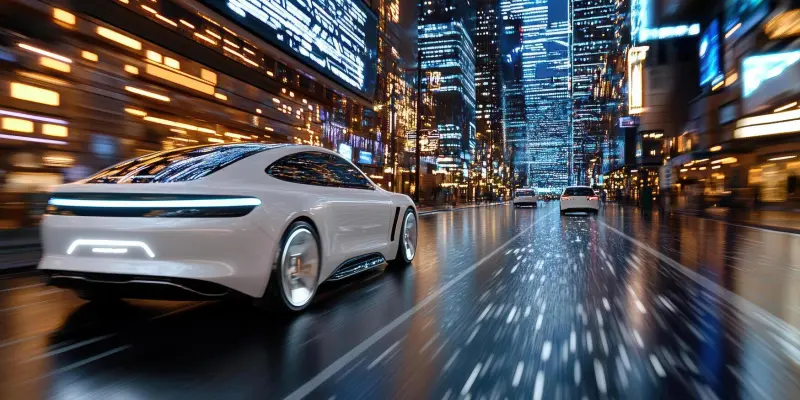
Nissan has made a groundbreaking announcement that is set to change the landscape of autonomous driving technology. Partnering with the British startup Wayve, Nissan is working to integrate advanced AI technology into its upcoming driver assistance systems. Scheduled for release in 2027, Nissan’s upgraded ProPILOT system will uniquely combine its Ground Truth Perception technology with lidar sensors, and for the first time in a commercial passenger vehicle, Wayve’s AI software will be implemented. This collaboration represents a significant step forward in the pursuit of fully autonomous driving.
Cutting-edge Embodied AI Technology
A New Era in Vehicle Interaction
Wayve’s revolutionary technology, known as Embodied AI, is designed to transform how vehicles interact with human behavior. This end-to-end learning approach leverages real-world data to create an adaptable intelligence that can handle both assisted and ultimately autonomous driving. By eliminating the need for detailed geographical mapping, which is a standard practice among competitors, Wayve’s technology promises significant time and cost savings. The adaptability of Embodied AI means it can better understand and react to dynamic environments, enhancing safety and efficiency. Nissan believes that the integration of Wayve’s AI will elevate the capabilities of its ProPILOT system. This move will likely set new benchmarks in autonomous driving, offering unparalleled intelligence and collision avoidance features. Although the initial version will correspond to Level 2 of the Society of Automotive Engineers’ automation scale—where the vehicle can handle some driving tasks but still requires driver vigilance—this represents a crucial step towards achieving full autonomy. The collaboration with Wayve showcases Nissan’s commitment to leading innovation in the automotive industry.
Industry Confidence and Future Prospects
Wayve’s advancements in AI have garnered considerable interest and funding, reflecting the industry’s growing confidence in AI-driven technologies. The collaboration between Nissan and Wayve signifies a pivotal moment in the automotive sector, highlighting a shift towards more intelligent, adaptive, and human-like machine interactions. This partnership emphasizes the potential for AI to revolutionize driver assistance systems, pushing beyond the limitations of traditional technologies and moving towards more sophisticated autonomous operations.
Although Nissan has not yet specified which models or markets will debut this advanced AI technology, the implications are far-reaching. The integration of Wayve’s technology could extend to commercial vehicles, robotaxis, and a wide array of car models in the future. This strategic collaboration underscores the potential of AI to not only enhance but also redefine what is possible in vehicle automation. As Nissan aligns its future with cutting-edge AI innovations, it sets an example for the automotive industry, driving forward the vision of autonomous mobility.
The Path to Full Autonomy
Setting Industry Standards
As Nissan continues to advance its ProPILOT system with the inclusion of Wayve’s AI, it aims to set new industry standards for autonomous driving. The sophisticated AI will support the production of vehicles capable of an increased understanding of their surroundings through real-world data learning. This places Nissan on the forefront of the movement towards creating more intelligent and responsive vehicles. The collaboration represents both companies’ dedication to pioneering technologies that promise greater safety, efficiency, and convenience for future users.
Wayve’s AI has been designed to evolve continuously, learning from its experiences to improve performance over time. This characteristic of continuous improvement is crucial for addressing the complexities of real-world driving environments. By leveraging this technology, Nissan aims to achieve a higher level of precision and reliability in its autonomous systems. The continuous data-driven learning process employed by Wayve’s AI could very well become the gold standard in the automotive industry, guiding other manufacturers toward similar innovations.
Broader Implications and Future Developments
The partnership between Nissan and Wayve has the potential to influence broader market trends in autonomous driving. As more automotive companies take note of the advancements achieved through AI integration, it is likely that similar collaborations and innovations will follow. The successful implementation of AI-driven driver assistance systems could lead to more widespread acceptance and adoption of autonomous vehicles. This would not only change how we interact with our cars but also transform urban planning, road safety, and mobility solutions. Nissan’s decision to integrate Wayve’s technology into its ProPILOT system marks a significant milestone in its journey toward autonomy. While the immediate focus may be on enhancing Level 2 automation, the long-term vision clearly points towards a future where vehicles are capable of fully autonomous operations. By investing in AI and collaborating with forward-thinking startups like Wayve, Nissan is positioning itself as a leader in the next phase of automotive innovation.
Embracing AI for Autonomous Driving
Nissan has unveiled an innovative announcement that could revolutionize the field of autonomous driving technology. Teaming up with the British startup Wayve, Nissan plans to incorporate cutting-edge AI into its future driver assistance systems. Slated for a 2027 release, Nissan’s enhanced ProPILOT system will be a unique fusion of its Ground Truth Perception technology and lidar sensors. In a groundbreaking move, Wayve’s AI software will be integrated into a commercial passenger vehicle for the very first time.
This partnership signifies a monumental leap forward in the quest for fully autonomous driving, illustrating Nissan’s commitment to advancing automotive technology. The integration of sophisticated AI and sensor technology is expected to enhance the vehicle’s ability to perceive and respond to its environment with unprecedented accuracy. By blending Wayve’s pioneering AI capabilities with Nissan’s existing technologies, the collaboration aims to push the envelope of what is possible in autonomous driving, paving the way for safer and more efficient transportation solutions.