

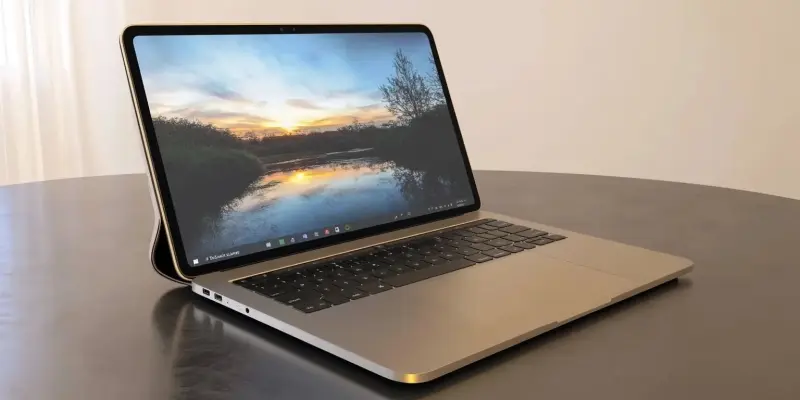
The astonishing innovation from Lenovo at CES 2025 showcased the world’s first consumer laptop with a rollable display, the ThinkBook Plus Gen 6 Rollable. This groundbreaking laptop aims to revolutionize the way users experience portable computing by offering a unique blend of advanced hardware and an innovative display. The ThinkBook Plus Gen 6 Rollable is designed to cater to a range of tasks, from professional work and coding to multimedia consumption and beyond.
Innovative Display and Enhanced Functionality
Rollable Display Technology
One of the most striking features of the ThinkBook Plus Gen 6 Rollable is its 14-inch OLED display, which can expand vertically to a remarkable 16.7 inches. This can be achieved either at the press of a button or through a simple hand gesture. This unprecedented flexibility allows users to adjust their screen size according to their needs, whether for reading, multitasking, or viewing content. The resolution also adapts to the expanded size, scaling from 2,000 x 1,600 to an impressive 2,000 x 2,350 pixels, ensuring a clear and vibrant display at all dimensions.
The convenience offered by this rollable design cannot be overstated. Unlike dual-screen models that require additional peripherals such as a wireless keyboard or a support stand, the ThinkBook Plus Gen 6 provides an all-in-one solution that remains compact and efficient. This is particularly beneficial for professionals who require a substantial amount of screen real estate without the bulk or hassle of carrying extra devices.
Intelligent Software Integration
Lenovo has not only innovated in terms of hardware but has also integrated intelligent software features into the ThinkBook Plus Gen 6 Rollable. One of these features, the ThinkBook Workspace, enables users to pin widgets and virtual app windows at the bottom screen area. This allows them to keep essential tools and shortcuts readily accessible while utilizing the top part of the screen for primary work applications. Moreover, the Smart Copy feature enhances productivity by maintaining a searchable history of clipboard contents, which can also be pinned for easy access.
These intelligent software integrations are designed to streamline workflows and enhance user productivity. They represent a harmonious blend of hardware and software that takes full advantage of the rollable display’s capabilities. By minimizing the need for constant window-switching and providing quick access to frequently used tools, Lenovo has crafted a user experience that is as efficient as it is innovative.
Powerful Hardware and Advanced Features
High-Performance Specifications
Beneath its sleek and innovative exterior, the ThinkBook Plus Gen 6 Rollable houses powerful hardware components designed to deliver top-notch performance. The laptop is equipped with up to an Intel Core Ultra 7 processor from the Ultra 200V series, providing the computational muscle needed for demanding tasks. Coupled with 32GB of LPDDR5x RAM, users can expect seamless multitasking capabilities and swift performance even when running resource-intensive applications.
Storage needs are well catered for with a 1TB PCIe 4.0 SSD, ensuring fast data retrieval and ample space for files and applications. Additionally, the integrated Intel Xe2 graphics offer improved performance for light graphics work, making the laptop a versatile tool for a varied range of activities. Whether it’s for professional use or casual content consumption, the ThinkBook Plus Gen 6 Rollable is built to handle it all with ease.
Connectivity and Multimedia
The ThinkBook Plus Gen 6 Rollable also excels in connectivity and multimedia features. It comes equipped with Wi-Fi 7 and Bluetooth 5.4, ensuring fast and reliable wireless connections for both internet and peripheral devices. This makes it an excellent choice for users who rely on stable and high-speed connectivity for their work or leisure activities. The laptop includes dual 2x2W speakers, delivering clear and powerful audio for media playback or virtual meetings.
For those who frequently participate in video conferences, the ThinkBook Plus Gen 6 Rollable features a 5MP webcam with IR support for Windows Hello. This offers enhanced security and convenience for logging in, as well as providing sharp image quality for video calls. Dual microphones also ensure that audio input is clear and effective, making it a well-rounded device for comprehensive communication needs.
Trade-offs and Future Outlook
Price and Portability Concerns
While the ThinkBook Plus Gen 6 Rollable’s cutting-edge technology is impressive, it does come with a significant price tag, starting at $3,499. This premium cost may be a barrier for some consumers, but it reflects the innovative design and advanced features packed into the laptop. Additionally, the rollable display mechanism adds a bit of bulk to the device. Measuring 0.78 inches thick and weighing 3.73 pounds, it is slightly bulkier compared to other laptops in its class. This trade-off in portability may be a consideration for users who prioritize lightweight and slim devices.
Future Developments and Advancements
The rollable display allows for greater versatility and multitasking, offering an expandable screen that can adapt to different needs and environments. Whether working on spreadsheets, watching videos, or browsing the web, the rollable screen enhances productivity and user engagement. This inventive design is complemented by premium materials and a sleek aesthetic, making the ThinkBook Plus Gen 6 Rollable not only powerful but also visually appealing. With Lenovo’s latest offering, consumers can expect a new era in portable computing, marked by versatility and innovation.