

Introduction
As data centers evolve to support increasingly powerful high-density computing, operators face the critical challenge of safely managing the immense energy required to keep these facilities running without interruption. The quest for more compact and efficient power backup has led to the adoption of high-energy lithium-ion batteries, but their placement directly within the server environment introduces significant safety considerations, most notably the risk of fire and toxic gas release. This article explores how emerging technologies like immersion cooling are addressing these dangers, examining the fundamental principles, practical applications, and the potential for a paradigm shift in data center power architecture. It aims to answer key questions about whether this innovative approach can truly deliver a safer, more integrated power infrastructure.
Key Questions or Key Topics Section
What Is Driving the Need for New Battery Safety Solutions
The relentless demand for processing power is pushing data center designs toward greater density, which in turn requires more power in a smaller footprint. Traditionally, large, lead-acid battery rooms provided uninterruptible power but were kept separate from the main data hall due to safety and maintenance needs. Modern lithium-ion batteries offer a much higher energy density, making it feasible to place backup power directly within or alongside server racks.
However, this proximity creates new risks. High-density battery chemistries like Nickel Manganese Cobalt (NMC) are susceptible to thermal runaway, a dangerous chain reaction where a single failing cell can overheat and ignite neighboring cells. This event can release flammable and toxic gases, posing a severe threat to both equipment and personnel within the enclosed “white space” of a data center. Consequently, a new generation of safety technology is essential to mitigate these risks and enable the full benefits of in-rack power.
How Does Immersion Cooling Address These Safety Concerns
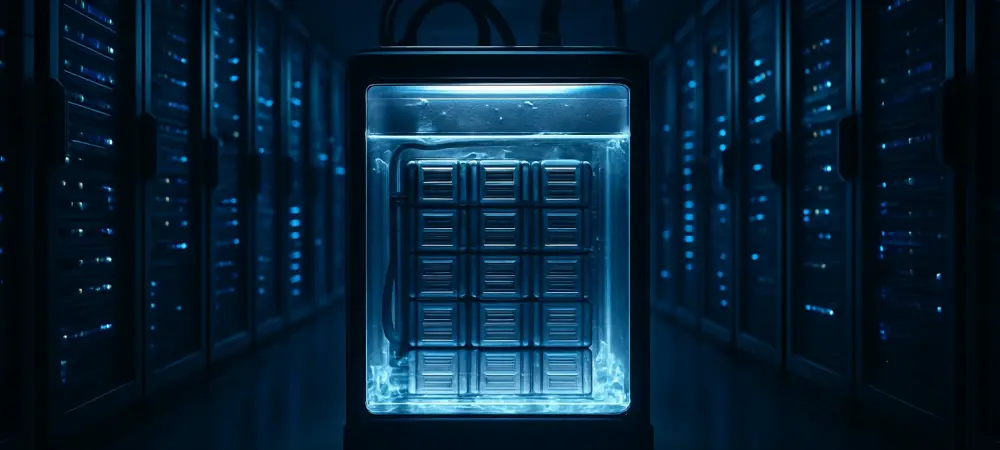
Immersion cooling technology offers a direct and highly effective solution to the thermal challenges of high-density batteries. The core principle involves submerging battery cells in a non-conductive, biodegradable dielectric fluid. This fluid makes direct contact with the surface of every cell, allowing it to absorb heat far more efficiently than air ever could. By continuously circulating this coolant, the system can prevent any single cell from reaching the critical temperatures that trigger thermal runaway.
Moreover, leading solutions combine this thermal management with advanced gas mitigation. For instance, EticaAG’s system pairs its LiquidShield immersion cooling with a HazGuard ventilation system designed to capture and neutralize any gases that might be released in an off-nominal event. This dual-pronged approach tackles the two primary dangers of lithium-ion battery failure—ignition from heat and exposure to toxic fumes—creating a robust safety architecture that isolates and contains potential failures at the source.
What Are the Practical Applications of This Technology
The versatility of immersion-cooled battery systems is enabling their integration into diverse data center power strategies. These solutions are not a one-size-fits-all product but are engineered for specific use cases, from long-duration backup to short-term power stabilization. One practical example is the Fortis Sidecar, designed to connect to a traditional UPS DC bus and provide up to 30 minutes of runtime, ensuring business continuity during extended outages.
In contrast, a model like the Fortis 400 Rack is built for high-power, short-duration events, delivering a massive surge of energy for 45 to 90 seconds. This capability is critical for supporting modern DC-voltage architectures, such as the Open Compute Project’s Diablo 400 standard, which rely on rack-level power ride-through. With commercial availability for these U.S.-manufactured systems expected in late 2026, the technology is poised to serve both legacy and next-generation data center designs.
Summary or Recap
In essence, immersion cooling is emerging as a critical enabler for the safe integration of high-density lithium-ion batteries into the data center white space. This technology directly counters the primary risk of thermal runaway by using a dielectric fluid to maintain optimal cell temperatures. When combined with sophisticated gas mitigation systems, it provides a comprehensive safety net that addresses both fire and toxicity hazards. The development of specialized products for different backup durations and power architectures underscores its adaptability, signaling a move toward more resilient and integrated power solutions.
Conclusion or Final Thoughts
The introduction of commercially viable, immersion-cooled battery systems represented a significant milestone in data center engineering. By fundamentally redesigning the approach to thermal management, this technology effectively neutralized the long-standing safety objections to placing high-density energy storage in close proximity to sensitive IT hardware. This advancement did not just offer a new product; it provided a blueprint for how future data centers could be designed with greater power density, efficiency, and intrinsic safety. The conversation shifted from isolating risk to engineering it out of the system entirely.