

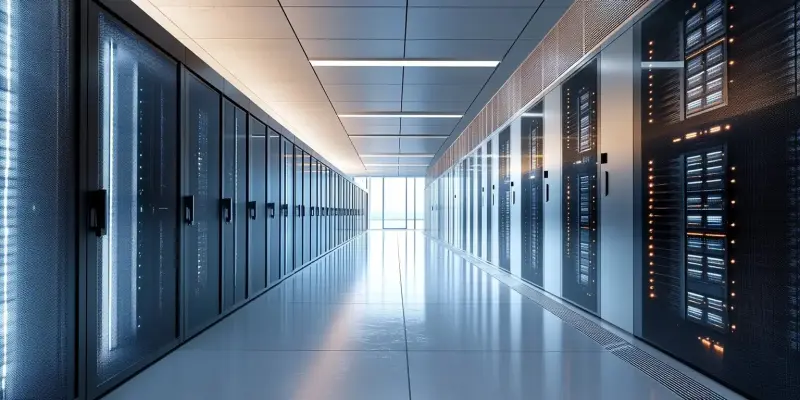
Digital Realty has launched a state-of-the-art data center named FRA18 in Frankfurt, Germany, at its Digital Park Fechenheim campus. This cutting-edge facility, strategically located on Hanauer Landstrasse, spans an impressive 8,200 square meters of colocation space. With an initial capacity of 6.4 MW, FRA18 is designed to expand by an additional 9.6 MW in future phases, illustrating Digital Realty’s commitment to modernizing and scaling its infrastructure to meet growing demands. What distinguishes FRA18 is not just its advanced technology, but its unique location within a historically preserved building—once the headquarters of the mail-order company Neckermann. The data center has been upgraded to meet contemporary technological requirements while carefully preserving distinctive architectural elements, intertwining heritage with modernity.
Technological Capabilities and Sustainability
FRA18 is designed to support high-performance computing (HPC) and artificial intelligence (AI) workloads, catering to the increasing demand for robust computational abilities. The facility’s environment is optimized for reliability and efficiency, crucial for enterprises relying on data-intensive applications. In addition to technological advancements, Digital Realty has implemented an innovative heat reuse system in collaboration with Mainova, marking a strong commitment to sustainability. This system repurposes residual heat generated by the data center, thus reducing the carbon footprint and contributing to environmental conservation.
The ambitious plan for the Digital Park Fechenheim campus includes a full build-out by 2028, aiming to encompass 11 data centers. These centers will collectively provide 100,000 square meters of IT space and a substantial 200 MW of capacity. This massive expansion is part of Digital Realty’s broader strategy to provide scalable, eco-friendly solutions that align with global sustainability goals. Furthermore, the integration of historical preservation with state-of-the-art technology sets a precedent for future developments in the data center industry, blending tradition with innovation seamlessly.
Strategic Expansion in Asia
Digital Realty’s growth is not confined to Europe. The acquisition of a 20 percent stake in the Digital Osaka 3 data center from Mitsubishi Corporation by Digital Core REIT, a Singapore-listed entity sponsored by Digital Realty, exemplifies a significant strategic expansion in Asia. This purchase, valued at $87 million, enhances Digital Realty’s presence in the Japanese market. The Digital Osaka 3 facility, completed in July 2021, offers an impressive 19.9 MW of IT load and is fully leased to leading global cloud providers. This strategic move follows previous stake purchases in Osaka’s data centers, reinforcing Digital Realty’s commitment to expanding its footprint in key global markets.
Moreover, the joint venture between Digital Realty and Mitsubishi, established in 2017, now operates nine data centers across Tokyo and Osaka. This collaboration has become a significant trend in the industry, where partnerships between major corporations are pivotal in enhancing data center infrastructure globally. Such ventures not only facilitate resource sharing and technological advancements but also enable companies to meet the increasing demand for data center services efficiently and sustainably.
Future Implications and Industry Trends
Digital Realty’s extensive growth plans in Europe and Asia reflect broader industry trends toward global collaboration, eco-friendly operations, and the escalating demand for robust data center infrastructures capable of handling AI and HPC workloads. The integration of modern technology with historical preservation demonstrated in FRA18 showcases a forward-thinking approach that could set new standards in the industry. This blend of past and future symbolizes a holistic approach to development, ensuring that technological advancements do not come at the expense of cultural heritage.
The commitment to sustainability, as seen in Digital Realty’s heat reuse system, aligns with global efforts to reduce carbon emissions and promote environmental responsibility. Such initiatives are becoming increasingly important in an industry that consumes vast amounts of energy. By focusing on eco-friendly practices, Digital Realty is not only enhancing its operational efficiency but also setting a benchmark for other companies to follow.
Summary of Key Takeaways
FRA18 is designed to support high-performance computing (HPC) and artificial intelligence (AI) workloads, addressing the growing need for powerful computational capabilities. The facility is optimized for reliability and efficiency, which are essential for enterprises depending on data-intensive applications. Besides technological advancements, Digital Realty has embraced sustainability by implementing an innovative heat reuse system in partnership with Mainova. This system recycles excess heat from the data center, reducing its carbon footprint and aiding environmental conservation.
Digital Realty’s ambitious plan for the Digital Park Fechenheim campus includes a complete build-out by 2028, aiming for 11 data centers. These centers will collectively offer 100,000 square meters of IT space and a substantial 200 MW of capacity. This massive expansion aligns with Digital Realty’s strategy to provide scalable, eco-friendly solutions that meet global sustainability goals. Moreover, integrating historical preservation with cutting-edge technology sets a new standard in the data center industry, blending tradition with innovation seamlessly.