

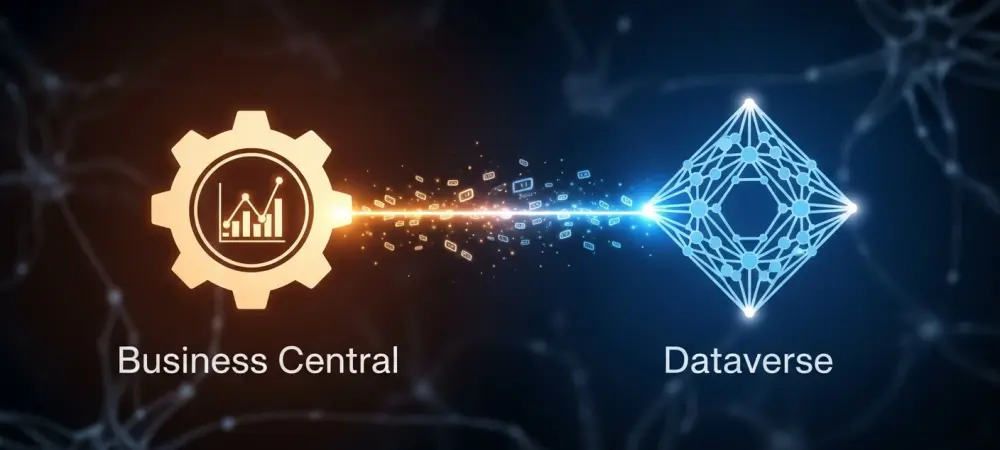
Modern enterprise resource planning has shifted from being a back-office accounting tool into a dynamic engine that must synchronize perfectly with customer-facing platforms to ensure survival in a hyper-competitive digital economy. For many years, the integration between an ERP like Dynamics 365 Business Central and a CRM or data backbone like Dataverse was treated as a luxury or a secondary convenience. Decision-makers often viewed these systems as independent pillars where data was shared only when necessary, usually through manual exports or rigid syncs. This siloed approach created a lag in information that businesses could tolerate when market conditions were slower. However, by 2026, the threshold for acceptable latency has vanished completely. Organizations now operate in an environment where real-time data flow is the baseline for efficiency. The transition from connectivity to operational dependency signifies that the health of the enterprise hinges on how well these environments communicate.
The Evolution of Operational Interdependence
The traditional boundary between financial records and customer engagement has dissolved, giving way to a model where Business Central and Dataverse act as a singular, cohesive organism. Business Central remains the definitive system of record for inventory, procurement, and financial health, but its value is severely diminished if the front-line teams using Dataverse-driven applications cannot access that data instantly. When a sales professional is negotiating a contract, they require immediate insight into credit limits, current stock levels, and historical payment behaviors stored within the ERP. Without this synergy, the sales process becomes a series of back-and-forth inquiries that frustrate the customer and slow the conversion cycle. This shift toward dependency means that the integration layer is no longer a bridge between two islands; it is the central nervous system that allows the entire business to respond to market stimuli with precision and speed.
Furthermore, the rapid expansion of the Microsoft application ecosystem has turned Dataverse into the essential gravitational center for modern business logic. As organizations deploy a variety of tools, including Dynamics 365 Sales, Power Automate, and specialized industry solutions, the complexity of the data landscape grows exponentially. Dataverse functions as the common language that allows these disparate applications to speak to one another, but this conversation is only meaningful if the core financial data from Business Central is present. When this connection is poorly architected or restricted to a few basic entities, the entire ecosystem becomes fragmented. This fragmentation forces departments to create their own data sets, leading to a “multi-truth” scenario where the finance team and the sales team are looking at different numbers for the same customer, effectively paralyzing the organization’s ability to automate complex cross-departmental workflows.
Quantifying the Cost of Fragmented Data
Incomplete integration rarely causes a sudden and dramatic system collapse, but it consistently imposes a heavy “invisible tax” on daily productivity and operational agility. This tax manifests as a thousand small frictions, such as the manual reconciliation of invoices or the constant verification of shipping statuses across different platforms. When employees spend their hours moving data from one window to another, they are effectively acting as human middleware, a role that is both expensive and prone to error. In a landscape where speed is a primary competitive advantage, these manual interventions create bottlenecks that prevent the business from scaling. These inefficiencies often go unnoticed at first, but over time, they erode profit margins and lower employee morale as staff become bogged down in administrative tasks rather than focusing on high-value strategic initiatives that drive revenue.
Beyond the immediate loss of productivity, a lack of deep integration creates a mounting pile of technical debt that can become a massive barrier to future growth. Many organizations attempt to bridge the gaps between Business Central and Dataverse using temporary custom extensions or brittle, point-to-point connections. While these fixes might solve an immediate problem, they are difficult to maintain and often break during routine system updates. This approach also centralizes critical operational knowledge within a small group of specialists who understand the “logic” behind the workarounds. If these key individuals leave the company, the organization is left with a complex web of undocumented integrations that are nearly impossible to untangle. This reliance on tribal knowledge creates a fragile environment where innovation is sacrificed for the sake of just keeping the systems running, limiting the ability to adapt to new trends.
Technical Strategies for a Unified Foundation
To move past these limitations, businesses must adopt a strategic approach to integration that treats data synchronization as a core architectural capability rather than an afterthought. Standard integration tools often fall short because they are designed to synchronize only a small subset of standard data entities, leaving custom fields and industry-specific extensions isolated. To achieve a truly unified foundation, it is necessary to utilize solutions that can expose the entire Business Central data model within Dataverse. Tools like the Bluefort Dataverse Integrator provide a more robust path by allowing for bidirectional, near real-time data flow that includes every relevant table and field. This comprehensive exposure ensures that when a change is made in the ERP, it is immediately reflected across the entire Power Platform, providing a consistent and reliable environment for automation and reporting.
Building this unified foundation requires a shift in mindset from simple data mirroring to intelligent data orchestration. It is not enough to simply move data; the data must be transformed and contextualized so that it is useful in the environment where it lands. For example, a raw financial transaction from Business Central needs to be translated into an actionable insight for a customer service agent working in Dataverse. By establishing a robust architecture that supports this level of detail, companies can eliminate the need for manual reconciliation and ensure that every automated process is built on a foundation of truth. This stability allows for the creation of more sophisticated workflows, such as automated credit approvals or real-time inventory alerts, which would be impossible or dangerously inaccurate in a fragmented data environment where information is frequently outdated.
Strategic Realignment for Intelligent Automation
The strategic importance of a seamless connection between Business Central and Dataverse is magnified by the rapid adoption of artificial intelligence and advanced analytics. Technologies like Microsoft Copilot and other generative AI tools are entirely dependent on the quality and accessibility of the data they consume. If the underlying data architecture is fragmented, the AI will provide incomplete or misleading insights, rendering the investment in these modern tools ineffective. Organizations that have successfully integrated their ERP and Dataverse environments are finding that they can deploy AI-driven solutions with significantly less friction. By having a clean, synchronized stream of operational and financial data, these companies are gaining a massive competitive edge, using predictive analytics to anticipate customer needs and optimize their supply chains before problems arise.
To secure a future-ready position, leadership teams focused on long-term growth prioritized the overhaul of their integration strategies to eliminate silos once and for all. They recognized that the path forward required moving away from basic connectivity and toward a model of deep operational dependency. The successful implementation of a unified data layer allowed these organizations to reduce their technical debt and improve their resilience against market volatility. By ensuring that every department operated from the same factual base, they simplified their internal processes and enhanced the customer experience. This proactive stance on integration architecture was not merely a technical upgrade but a fundamental business decision that provided the necessary stability for continuous innovation and the seamless adoption of the next generation of digital transformation tools.