

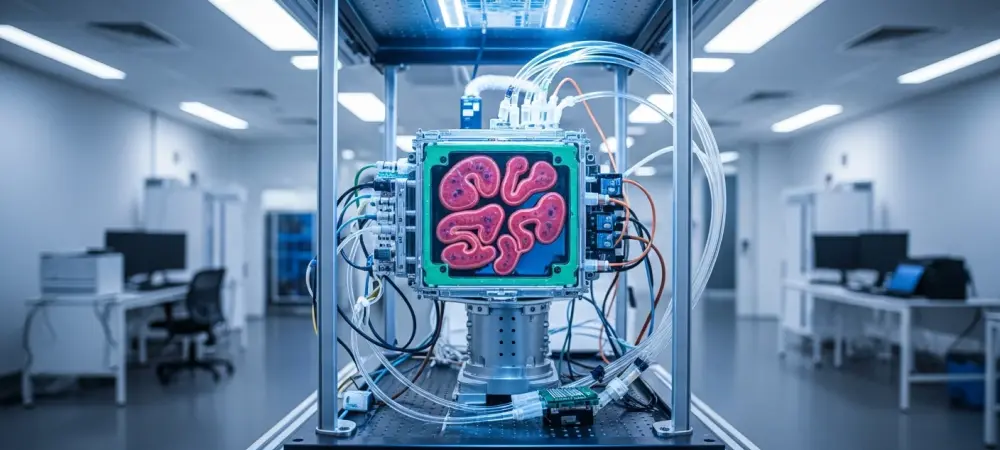
Traditional computing is currently hitting a thermal wall that even the most advanced liquid cooling cannot fix, forcing engineers to look toward the three pounds of wet tissue inside the human skull for the next leap in processing power. This shift from pure silicon to “wetware” marks a departure from the brute-force scaling of transistors that has defined the last half-century. Biological computing represents an integration of living human neurons with synthetic hardware, aiming to solve the dual crisis of energy consumption and data dependency in modern artificial intelligence. By utilizing the inherent efficiency of cellular biology, these systems provide a pathway to intelligence that operates at a fraction of the power required by a standard GPU cluster.
Architecture and Core Components of Biological Systems
The CL1 System: Navigating Bidirectional Communication
The CL1 system serves as a foundational bridge in this new technological landscape, representing the first commercialized interface capable of executing computational logic on living human neurons. This hybrid architecture does not replace silicon; instead, it utilizes a microelectrode array to create a two-way street between electronic signals and biological activity. These electrodes send electrical stimuli to a culture of human neurons—derived from stem cells—and subsequently record the neural spikes as data outputs. This allows for a unique feedback loop where the cells can be “trained” to perform specific tasks, such as pattern recognition or motor control simulations.
The significance of the CL1 lies in its ability to translate abstract code into biological responses, effectively treating a layer of living cells as a specialized processing unit. Unlike traditional chips where logic is static, the neural network within the CL1 is plastic and adaptive. This means the system can physically rewire its connections in response to inputs, a process known as neuroplasticity, which silicon hardware can only mimic through complex software layers. The result is a system that learns through physical reconfiguration rather than just weight adjustments in a digital model.
Biological Infrastructure: From Labs to Distributed Data Centers
The move toward scalable biological computing has necessitated a total reimagining of what a data center looks like. Instead of standard server racks filled with fans and heat sinks, biological hardware consists of specialized incubators that maintain the life-support systems for cell cultures. These units manage the delivery of oxygen and nutrients while strictly regulating temperature to ensure the neurons remain viable. This shift from a dry, electronic environment to a liquid, biological one changes the fundamental requirements of technological maintenance and infrastructure design.
Currently, this infrastructure has moved beyond the proof-of-concept stage with the establishment of functional biological data centers in Melbourne and Singapore. These facilities provide researchers with remote access to neural processing power, allowing for the execution of experiments without the need for an on-site biology lab. This transition into a cloud-based service model is a critical milestone, as it proves that biological computing can be scaled and managed as a utility, much like traditional cloud computing, rather than remaining a boutique laboratory curiosity.
Recent Advancements in Neural Learning and Processing
One of the most compelling performance metrics observed in these systems is the capacity for few-shot learning, where biological neurons outperform traditional machine learning models in speed and data efficiency. While a silicon-based artificial intelligence might require millions of images to accurately identify a specific pattern, biological systems can achieve similar results with significantly fewer exposures. This efficiency stems from the brain’s natural ability to extract high-level features and ignore irrelevant “noise” in a dataset, a task that often requires immense computational overhead in purely digital systems.
Moreover, recent innovations have focused on standardizing the interface between the cells and the electronics, which has traditionally been a significant bottleneck. By automating the setup and calibration of microelectrode arrays, the time required to prepare an experiment has dropped from several months to just a few days. This acceleration in the development cycle allows for more rapid iteration, enabling scientists to observe how neural cultures adapt to complex stimuli in real time. The ability of these systems to handle uncertain or “noisy” data makes them ideal for environments where traditional algorithms struggle.
Real-World Applications in Medicine and Robotics
Pharmacological Research: Precision Through Disease Modeling
The medical sector is poised to be the primary beneficiary of biological computing, particularly in the realm of personalized medicine. Because neurons can be grown from a specific patient’s stem cells, they carry that individual’s unique genetic signature. This allows researchers to create a “digital twin” of a patient’s neural environment to test the efficacy of drugs or the progression of neurological diseases without any risk to the person. This high-fidelity modeling provides a level of insight that animal models or digital simulations cannot match, as it utilizes the exact biological mechanisms of the human subject.
AI Development: Enhancing Robotic Control Systems
In the field of robotics, biological units are being integrated to manage complex, adaptive tasks that require a high degree of situational awareness. While silicon processors are excellent at high-speed mathematical calculations, biological components excel at managing the unpredictable variables of the physical world. This synergy allows for the creation of robotic controllers that are more resilient to sensor errors and environmental changes. By offloading sensory processing to biological layers, developers can create AI models that are more fluid and lifelike in their responses.
Technical Hurdles and Ethical Considerations
The Challenge: Moving Beyond Two-Dimensional Networks
Despite the progress, biological computing faces a major technical ceiling in its current reliance on flat, two-dimensional neural networks. These 2D cultures lack the structural complexity of a living brain, which limits the number of connections each neuron can form. To achieve higher levels of computational power, the industry must transition toward three-dimensional “organoids”—small, lab-grown structures that better replicate the architecture of a real brain. However, maintaining the health of these 3D structures is significantly more difficult, as they require advanced vascularization to provide nutrients to the cells at the core of the mass.
Ethical Frameworks: The Question of Machine Sentience
The prospect of integrating human cells into a machine raises unavoidable ethical questions regarding the potential for consciousness. As these systems grow in complexity and begin to use 3D organoids, the risk of inadvertently creating a sentient entity increases. This necessitates the creation of robust regulatory frameworks that define the moral status of biological computing units. The scientific community must balance the potential for life-saving medical breakthroughs against the ethical responsibility of working with human-derived biological material that could, in theory, develop subjective experiences.
Future Outlook and Potential Breakthroughs
The trajectory of this technology points toward the development of “green” data centers that leverage the energy efficiency of biology to reduce the carbon footprint of the tech industry. As the complexity of 3D organoids improves, biological computing could provide a more sustainable alternative to the massive silicon arrays currently used for large-scale AI training. This would represent a paradigm shift where computing power is grown rather than manufactured, leading to a new era of carbon-neutral intelligence.
Future breakthroughs are also expected to bridge the gap between biological adaptability and silicon precision. We are moving toward a future where the distinction between a software update and a biological growth cycle becomes increasingly blurred. This could eventually lead to the development of true artificial general intelligence, as these systems possess the structural flexibility required for generalized learning. The focus will likely shift from merely copying neural processes to creating entirely new types of hybrid intelligence that are tailored for specific, high-complexity tasks.
Summary of Biological Computing Evolution
The evolution of biological computing demonstrated that the limitations of silicon could be overcome by looking at nature’s most efficient processor. This transition toward wetware integration represented a shift in how engineers conceptualized the relationship between hardware and software, moving from static structures to dynamic, living systems. While the technical challenges of 3D organoid maintenance and the ethical dilemmas of sentience remained prominent, the successful deployment of biological data centers proved the viability of the technology. These systems provided the groundwork for a more sustainable approach to artificial intelligence, ultimately reducing the energy dependency of global digital infrastructure. The advancements in personalized medicine and robotic resilience confirmed that biological computing was not just an alternative to silicon, but an essential expansion of the technological horizon. Research successfully highlighted that the future of intelligence lay in the balance of biological nuance and electronic speed.