

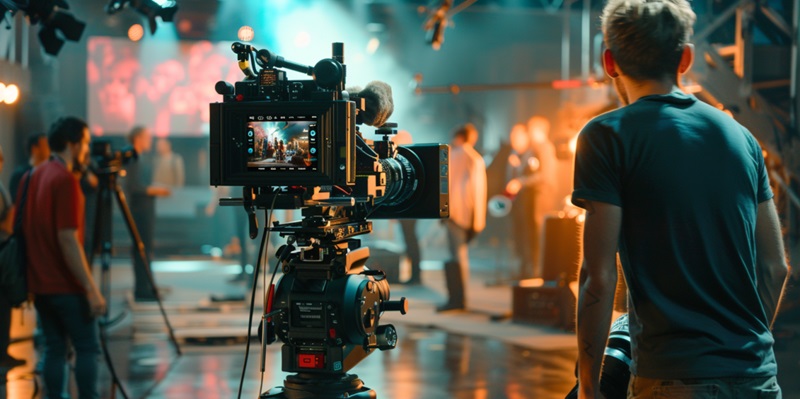
The journey from the first flickers of motion on a screen to the high-definition, digitally-rendered images we enjoy today marks more than a century of innovation in film. The art of cinema, seeded by Eadweard Muybridge’s groundbreaking experiment to capture a horse in motion, has grown through various technological revolutions—each transforming storytelling and bringing dreams to life in increasingly vivid ways. Now, as artificial intelligence begins to weave its way into the filmmaker’s palette, the question arises: Are we on the brink of another monumental shift in the way we create and experience movies?
The Evolution of Film Technology
The Dawn of Cinema
In 1878, the galloping horse was more than Eadweard Muybridge’s fascination—it was the cornerstone of the cinematic realm. His sequence of photographs captured for the first time, living movement frozen in time, then animated through successive projection. This pioneering act planted the seeds of an entertainment medium that would dominate the 20th century and beyond. Recognizing the importance of this achievement is essential, for it wasn’t merely the capture of motion but also the opening chapter to the story of film as an art form and a technological marvel.
The Silent Film Era
Imagine a theater where gestures and pantomime speak volumes, and orchestras fuel the drama playing out on-screen—that was the beauty of the silent film era. Without the power of the spoken word, movies relied on visual grandeur and musical accompaniment to tell tales of love, adventure, and intrigue. This mode of storytelling cultivated an era where the image was sovereign, and cinema’s unique language began to be mastered by legendary directors and actors alike.
The Advent of Sound
The silence was broken forever when “The Jazz Singer” echoed its first tunes, marking the advent of “talkies.” This breakthrough wasn’t just an addition of audio—it was a redefinition of the narrative structure and directorial approach. Sound synchronized with moving images gave birth to new genres, enhanced the rhythmic pacing of scenes, and made dialogue a pivotal element of film. This era demanded a fresh approach to screenwriting, acting, and directing, reverberating changes that are still central to film today.
The Color Film Transformation
From grayscale to an explosion of colors, the film industry witnessed another enchanting era with the introduction of Technicolor and other color processes. More than just enhancing realism, color became a storyteller itself—setting moods, defining characters, and shaping films’ visual identities. This vibrant addition made the experience of going to the movies not just a viewing but a sensory experience, opening filmmakers’ palettes to new creative possibilities.
Home Video and Camcorders
Hollywood no longer held exclusive rights to filmmaking with the advent of camcorders and VCRs. These technologies allowed for stories to be told from countless perspectives, both poignant and mundane, far removed from the glitzy studios. The influence of home videos and camcorders cannot be overstated; they fostered a generation of auteurs and inspired guerrilla filmmaking tactics, leading to unexpected classics and contributing significantly to the democratization of film creation and consumption.
The Digital Age
We live in a world where videos are at our fingertips—anyone with a smartphone can not only consume but also produce content. From YouTube sensations to viral TikToks, the barriers to entry have all but crumbled. Films are no longer confined to theaters or televisions, as digital platforms have become new stages for premieres, and streaming services have broadened the horizons of distribution and viewership. The digital age has forged a global, connected community of creators and audiences, reshaping the film landscape fundamentally.
AI in Filmmaking: The Sixth Revolution?
The Emergence of AI-Driven Tools
Artificial intelligence in filmmaking isn’t just an incremental change; it’s a seismic shift akin to the introduction of sound or color. AI tools like Luma AI’s Dream Machine and OpenAI’s Sora are only the starting points in what might be film’s sixth technological revolution. These tools embody a significant change—the ability to generate video content that resonates with human creativity, potentially democratizing filmmaking beyond previous imaginings. The scope and speed of progress herald a future where AI’s role in filmmaking is not a question of if but when.
The Internal Revolution of AI
Prior revolutions in film technology were always about enhancing the outward experience—making what we see and hear more refined, more expressive. AI challenges this trajectory. It internalizes the creative process, using algorithms to tap directly into the well of human imagination and manifest it into cinematic reality. This technology takes the abstract—text and static images—and breathes dynamic visual life into them with a fidelity once solely the domain of skilled human hands.
AI Enhancing the Creative Process
Artificial intelligence isn’t waiting in the wings; it has already stepped onto the filmmaking stage. Notable examples include the Academy Award-winning “Everything Everywhere All at Once,” illustrating the potential when AI is woven into traditional film production. Emerging filmmakers are experimenting with AI-generated content, finding that it can enhance, rather than impede, the creative process. This synergy between man and machine marks a new era of co-creation where imagination is the only limit.
Ethical and Legal Considerations
The Controversy over Training Data
For all the excitement surrounding AI in filmmaking, there’s a shadow of controversy regarding its underpinnings—specifically, the opaque nature of AI training data. Ethical debates are intensifying, focusing on whether content creators are being uncompensated for their works that train these models. This issue is further compounded by the lack of clarity and transparency from companies behind AI video generators. It’s a modern crossroads between innovation and integrity that the industry has yet to navigate fully.
Building on the Legacy of Creativity
Yet, this debate is not isolated to AI; it mirrors concerns from the past where new technologies raised similar ethical questions about data utilization. Creativity itself has often been a process of remix and reinterpretation, building upon former masterpieces while pushing into new territories. Recognizing this pattern doesn’t eliminate the concerns but contextualizes them as part of the broader narrative of artistic evolution.
AI: A Tool, Not a Replacement
Human Creativity and AI Collaboration
Artificial intelligence as the end of human storytelling is a misconception. Rather, AI stands as a new tool in the creator’s belt—an amplifier of human creativity, not its usurper. The fear that every new technology might displace artists is as old as cinema itself, but history has shown that these tools become integral to the craft. The relationship between filmmakers and AI is not binary; it is an evolving dialogue, a melding of thoughts and algorithms.
Accepting and Integrating AI in Film
The evolution of film, stretching over a hundred years, is a testament to the extraordinary march of innovation. The invention of motion pictures can trace its roots back to Eadweard Muybridge’s remarkable feat of capturing a galloping horse. This advancement planted the seeds for a flourishing art form that has seen a series of technological overhauls, each one reinventing the manner in which stories are told and projected, molding fantasies into ever-sharper realities.
Currently, as artificial intelligence starts to merge with the traditional tools of filmmakers, a burning question comes to the fore: Could we be at the cusp of a new era in cinematic creation and consumption? The potential of AI in movie-making suggests a future where the boundaries of imagination are broader than ever, hinting at yet another profound leap in the captivating journey of cinema. As the industry stands now, eagerly anticipating this tantalizing prospect, only the unfolding of time will reveal the full impact of this impending revolution in the realm of the silver screen.