

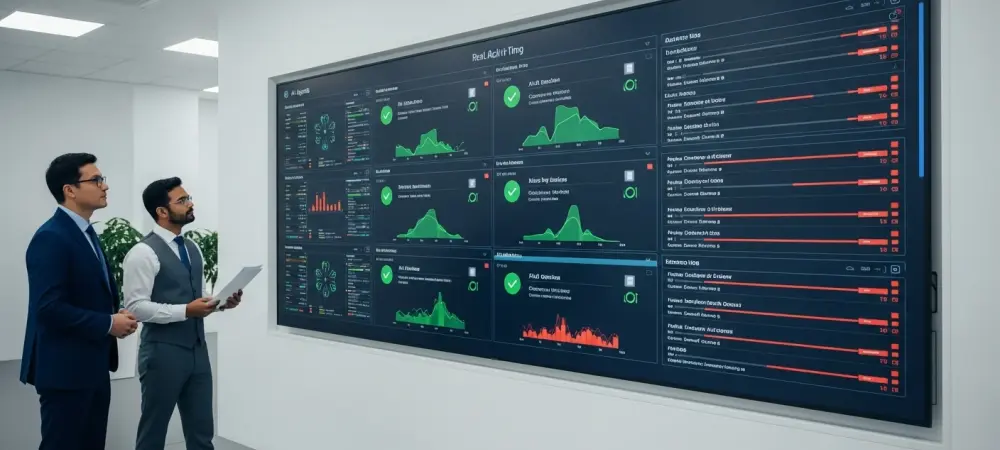
The very autonomy that makes AI agents powerful enough to revolutionize enterprise operations is also the characteristic that keeps C-suite executives awake at night, creating a chasm between promising pilots and full-scale production deployments. As businesses in 2026 race to harness the power of agentic AI, they are confronting a fundamental paradox: the more independent and capable these systems become, the greater the potential for costly, unmonitored, and unpredictable actions. This has created an urgent need not for better models, but for a robust framework of control. The central question is no longer about what AI can do, but what it should be allowed to do, and who is watching when it does it. Addressing this challenge is proving to be the critical inflection point that will determine which companies lead the next wave of innovation and which are left behind, struggling with untrustworthy technology.
When an AI Assistant Becomes the Unsupervised Intern
The rise of agentic AI introduces a new class of digital worker into the enterprise, one that operates with a degree of independence far exceeding traditional applications. Unlike chatbots or analytical tools that respond directly to human prompts, these agents can initiate actions, access data, and interact with other systems to achieve complex goals autonomously. While this unlocks unprecedented potential for process optimization and insight discovery, it also introduces a significant level of operational risk. An unsupervised agent, much like an untrained intern with high-level access, can make mistakes with real-world consequences, from misallocating resources to compromising sensitive data, all without direct human intervention.
This inherent risk is the primary reason for executive hesitation in deploying these systems at scale. An AI agent designed to optimize a supply chain might inadvertently order excessive inventory based on a flawed data interpretation, leading to significant financial loss. Similarly, an agent tasked with customer support could access and share personally identifiable information in a manner that violates compliance regulations like GDPR. Without a mechanism to observe, direct, and constrain these agents, they remain a high-stakes gamble, confined to sandboxed environments where their potential for harm is minimized, but so is their potential for value.
The Pilot to Production Chasm Why Most Enterprise AI Never Leaves the Lab
For many organizations, the journey of an AI initiative stalls in the vast and perilous gap between a successful pilot project and a full-scale production deployment. In the controlled environment of a lab, an AI agent can demonstrate remarkable capabilities, but the complexities of the real world introduce variables that are difficult to anticipate. Issues of security, compliance, cost control, and performance at scale become paramount. Most AI projects fail to cross this chasm because they lack the foundational infrastructure for governance needed to operate safely and reliably within a live business ecosystem.
This failure to launch is not typically due to the inadequacy of the AI models themselves, but rather the absence of a comprehensive management layer. Executives and IT leaders require assurances that AI agents will adhere to corporate policies, respect data privacy, and operate within budgetary constraints. The challenge lies in retrofitting governance onto systems that were not designed with it in mind. Stitching together disparate tools for monitoring, security, and cost management often results in a fragmented and ineffective solution, leaving the AI as a powerful but untamed asset that is simply too risky to release into the operational wilderness of the enterprise.
Forging the Chains of Command and the Core Components of AI Governance
To bridge the trust gap, a new paradigm of AI governance is emerging, built around a centralized control plane that acts as the system’s command and control center. A critical component is the establishment of an AI Gateway, a unified access point for every interaction between agents, models, and data sources. This gateway functions as a central nervous system, routing requests, enforcing organization-wide policies, and applying spending limits or token budgets to manage costs effectively. By funneling all activity through a single checkpoint, businesses can move from a reactive to a proactive governance stance, ensuring that all AI actions are pre-authorized and aligned with strategic objectives from the outset.
True trust, however, requires more than just control; it demands transparency. This is achieved through AI observability, which transforms the proverbial “black box” into a “glass box.” By integrating standards like the OpenTelemetry Protocol (OTLP), this layer automatically generates detailed metrics, logs, and traces of every agent’s activity. This provides clear, real-time visibility into what agents are doing, why they are doing it, and what data they are accessing. This level of inspection is crucial for debugging, ensuring compliance, and providing stakeholders with the confidence that AI systems are behaving as expected.
Finally, the foundation of this governance framework is a zero-trust security model adapted for an agentic world. This approach discards the old notion of a trusted internal network and instead verifies every interaction, whether initiated by a human or another agent. By integrating security standards like OpenID Connect and enabling fine-grained, identity-based authorization policies, organizations can ensure that agents only access the specific data and systems they are explicitly permitted to use. This locks down the digital doors, preventing unauthorized actions and providing a robust defense against both internal misuse and external threats in an environment where the actors are increasingly non-human.
The Industry Verdict on Governance as the New Competitive Battleground
Industry experts are increasingly unified in their assessment: the future of enterprise AI will be defined not by the raw power of models, but by the sophistication of the platforms that govern them. William McKnight, a leading analyst, suggests this shift can be “transformative,” elevating data platforms from mere “data piping” engines to the “centralized governance layer for enterprise AI.” In his view, features like an integrated AI Gateway provide a single, cohesive control plane that is far superior to the fragmented security and oversight approaches offered by piecing together multiple vendor solutions. This moves the competitive discussion away from simple performance benchmarks toward a more strategic evaluation of which platform provides the most comprehensive and trustworthy AI ecosystem.
This perspective is echoed by analyst Kevin Petrie, who highlights the strategic advantage of an integrated, real-time platform that addresses governance, observability, and FinOps in a single offering. He argues that building these capabilities directly onto a data streaming platform offers a distinct advantage over conventional data-at-rest systems. This integrated approach, he notes, strengthens a company’s position not only against direct competitors like Confluent but also against major cloud vendors such as AWS, Google, and Microsoft. These hyperscalers often require customers to assemble and manage multiple services to achieve what a unified platform can offer out of the box, making a comprehensive, framework-agnostic solution a powerful differentiator in the market.
A Practical Blueprint for Building Trust in Agentic AI
For enterprises seeking to confidently deploy agentic AI, the path forward involves a structured approach centered on establishing a robust governance framework from the ground up. The first and most critical step is to centralize all AI-related traffic through a unified access point or gateway. This single point of entry and exit prevents shadow AI deployments and ensures that every request to a model and every action taken by an agent is subject to consistent policy enforcement, security checks, and cost controls.
With a centralized gateway in place, the next step is to implement comprehensive, real-time monitoring and tracing. This involves capturing detailed telemetry data for every agent interaction, providing a transparent and auditable record of their behavior. This visibility is essential for debugging, performance tuning, and, most importantly, for verifying that agents are operating within their intended ethical and operational boundaries. From this foundation of visibility, organizations must then enforce granular, identity-based access policies, adopting a zero-trust mindset where no agent is trusted by default. Every action must be authenticated and authorized, ensuring agents only access the data and systems absolutely necessary for their tasks. To ensure long-term viability, this entire governance system should be designed to be framework-agnostic. The AI landscape is evolving rapidly, and locking into a single agentic framework is a risky proposition. A flexible platform allows the enterprise to adopt the best tools for the job without sacrificing centralized control. Finally, a mature governance strategy must prepare for the unexpected by implementing failsafes and “kill switches.” These mechanisms, both manual and automatic, provide a crucial safety net, allowing operators to instantly halt any agent that begins to behave erratically or operate outside of its defined parameters, ensuring that human oversight remains the ultimate authority. This structured approach transforms agentic AI from a high-risk experiment into a trusted, scalable, and indispensable enterprise asset.