

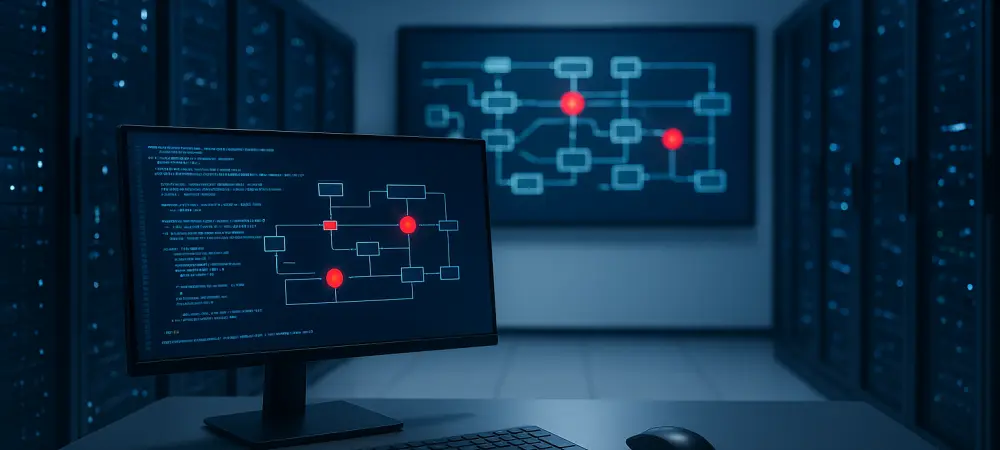
The massive discrepancy between the speed at which artificial intelligence generates code and the rate at which human teams can verify it has created a profound digital logjam within the modern enterprise. The promise of artificial intelligence was simple: write code faster and ship software sooner. However, as 2025 transitioned into the current high-velocity landscape of 2026, the reality in engineering departments is far from a streamlined utopia. Instead of a smooth flow from ideation to production, organizations are facing a massive digital logjam. We have built a high-speed engine for code generation but left the rest of the factory—the testing, auditing, and deployment machinery—running at manual speeds.
This imbalance is no longer just a technical hurdle; it is a fundamental threat to the stability of the modern software delivery lifecycle. The industry has reached a tipping point where the sheer volume of automated output is overwhelming the human-centric safety checks that have historically served as the final line of defense. As organizations struggle to reconcile these conflicting speeds, the risk of technical debt and security vulnerabilities grows exponentially. This friction represents a crisis of quality that demands a complete structural overhaul of how software moves from a developer’s prompt to a user’s screen.
Why the Traditional Pipeline: The Siege of Manual Review
The DevOps movement was founded on the principle of small, manageable batches of code moving through a deterministic pipeline. AI has effectively shattered this discipline by enabling developers to generate massive pull requests with a single prompt. The “top of the funnel” is now overflowing with complex logic that arrives faster than any human can digest. Consequently, the downstream processes, which rely on human review and binary pass/fail tests, were never designed to handle a 150% increase in code volume. The bottleneck has shifted from the developer’s keyboard to the reviewer’s inbox, creating a mathematical impossibility where the capacity to verify code cannot scale alongside the ability to write it.
Recent telemetry data highlights a staggering trend from 2025 toward the start of 2026, where pull request volumes grew by over 150%, yet the number of human reviewers remained stagnant. This has led to a state of automated sprawl where developers must manage nearly 70% more simultaneous pull-request contexts than they did just two years ago. The core DevOps tenet of small batch sizes is being largely ignored, as AI tools make it too easy to submit monolithic updates that are nearly impossible for a human to audit effectively without missing critical flaws.
The Infrastructure Gap: Speed vs. Safety
To understand the current breakdown, one must look at where automation is—and is not—being applied across the software lifecycle. There is a massive discrepancy in AI adoption across the pipeline that creates a high-velocity “fast lane” for creating code that abruptly hits a “slow lane” of manual deployment gates. While nearly 40% of code generation is now AI-assisted, AI’s role in continuous integration and deployment operations sits at a mere 13%, and its involvement in actual deployment decisions drops to roughly 6%. Even organizations claiming high DevOps maturity are finding that their release frequency hasn’t budged because their safety protocols are still built for a pre-AI world.
Furthermore, traditional pipelines are deterministic and expect a specific input to produce a specific output. AI-integrated software is probabilistic, meaning the same code might behave differently based on model updates or prompt variations. Currently, while 89% of teams use production observability, only about half have formal evaluation gates to test model behavior before a merge. This lack of formal evaluations means many teams are only discovering behavioral regressions—such as changes in tone or accuracy—once the software is already in the hands of users. This gap between creation and verification has turned deployment into a game of chance.
Expert Insights: The Risks of Blind Automation
Industry analysts warn that the obvious solution—using one AI to review code written by another AI—carries hidden dangers that could compromise system integrity. Experts refer to this as “automated consensus,” where the reviewing AI shares the same architectural blind spots or biases as the generating AI, resulting in a rubber-stamp process that lacks true critical judgment. When two systems built on similar training data agree, it does not necessarily mean the code is correct; it simply means they are making the same assumptions. This creates a false sense of security that can hide systemic risks until they manifest as major production failures.
Moreover, veteran platform engineers emphasize that the pipeline must now manage new types of artifacts, including prompts and model versions. These require the same level of versioning and security rigor as source code to prevent data leakage and prompt injection. The complexity of managing these non-code elements adds a new layer of friction to the delivery process. Without a unified way to track how a prompt change affects the final output, teams are left guessing which variable caused a regression, further slowing down the recovery process when things inevitably go wrong.
Strategies for Success: Building a Resilient AI-Driven Pipeline
Navigating the deluge requires more than just faster servers; it requires a fundamental rethink of how teams verify and deliver software. Organizations must leverage AI not just to write code, but to break large changes into discrete, small pull requests. By enforcing strict pull-request size limits at the platform level, teams can ensure that AI-generated output remains within the cognitive load limits of human reviewers. This structural enforcement prevents the pipeline from becoming a graveyard of massive, unreadable updates that developers are tempted to approve without a thorough inspection. Pipelines also had to evolve from simple unit testing toward statistical release criteria. This involved moving model and prompt evaluation from the research lab into the active deployment pipeline. Success began to be measured by whether a model’s output remained within a quality threshold compared to a baseline, rather than a binary pass/fail grade. This shift allowed for a more nuanced understanding of software health. Additionally, teams prioritized human judgment for high-stakes code, using auto-verification for boilerplate logic while preserving the limited, high-value attention of senior developers for security-sensitive components where human intuition remains irreplaceable.
DevOps teams successfully implemented behavioral canaries to safeguard their production environments. These monitors specifically looked for regressions in AI agent behavior, such as a drop in response accuracy or a violation of safety guardrails, allowing for automated rollbacks before a subtle AI failure impacted the entire user base. They moved toward a model where observability was integrated directly into the release gate rather than being an afterthought. This comprehensive approach allowed organizations to reclaim their release velocity by transforming the pipeline into an intelligent filter that prioritized safety over sheer volume. These steps ensured that the delivery lifecycle could finally keep pace with the machines that powered it.