

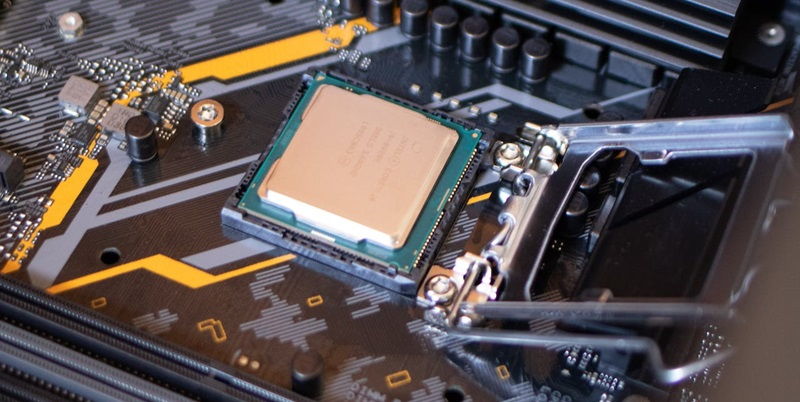
The latest leak of Intel’s Core i9-14900HX Raptor Lake Refresh CPU indicates that it is set to become one of the fastest chips for laptops. With its impressive specifications and enhanced performance, this successor to the Core i9-13900HX is part of the 14th Gen Raptor Lake-HX Refresh CPU family for notebook chips. Let’s dive deeper into its specifications, benchmark results, and the potential impact it could have on the laptop market.
Overview of the Intel Core i9-14900HX
The Intel Core i9-14900HX boasts 24 cores (8+16) and 32 threads, offering exceptional multitasking capabilities. It operates at a base frequency of 2.4 GHz, with the ability to reach boost clocks of up to 5.8 GHz, delivering lightning-fast performance for demanding tasks. Additionally, the chip features a generous 36 MB of L3 cache, ensuring efficient data access and retrieval.
Specifications of the Intel Core i9-14900HX
Notably, the Core i9-14900HX comes with a base TDP of 55W and a Maximum Turbo Power (MTP) of 157W. These power specifications highlight the chip’s ability to handle intensive workloads while maintaining optimal efficiency.
Comparison with its Predecessor and Related CPUs
While the Core i9-14900HX offers impressive performance, it only showcases a clock speed bump of up to +400 MHz compared to the i9-13900HX. In comparison to the Core i9-13980HX, it provides a +200 MHz improvement. While these increases may not seem significant, they contribute to the cumulative power of the Core i9 series.
Performance in Acer’s Predator PH16-72 Laptop
Early testing of the Core i9-14900HX within the Acer Predator PH16-72 laptop revealed stunning results. Paired with 32GB of DDR5-5600 memory, the 14900HX achieved a peak clock speed of approximately 5.8GHz. This achievement further solidifies its position as one of the fastest laptop CPUs available.
Benchmark Results
In rigorous performance benchmarks, the Intel Core i9-14900HX demonstrated its capabilities. It scored an impressive 2998 points in single-core tests and recorded an outstanding 17,937 points in multi-core tests. For comparison, the Core i9-13900HX achieved around 2920 points in single-core and 18,700 points in multi-core tests, showcasing the nuanced improvements of the Raptor Lake Refresh.
Analysis of Performance Expectations
As we anticipate the launch of retail laptops featuring the Core i9-14900HX, it is reasonable to expect slightly improved performance. However, it’s important to note that the 14th Gen Raptor Lake Refresh CPUs share similar core configurations and architectures, except for one SKU (14700HX). Therefore, the performance enhancements may be limited within this lineup.
Intel’s Core i9-14900HX Raptor Lake Refresh CPU stands as an emblem of exceptional laptop performance. With its impressive specifications, including 24 cores, high clock speeds, and generous cache, it promises to deliver unparalleled multitasking capabilities and speed. While the clock speed improvements over its predecessor may seem modest in isolation, the cumulative impact is observable in its benchmark results. As laptop manufacturers integrate this powerhouse into their offerings, users can look forward to an elevated computing experience that pushes the boundaries of what is possible in portable devices.