

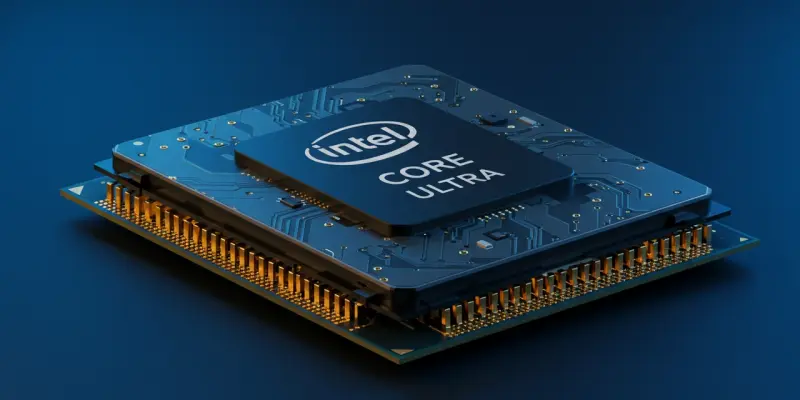
Intel’s latest announcement has captured attention in the tech world with the introduction of its new line of workstation CPUs: the Intel Arrow Lake Core Ultra 200 series. This release includes both desktop and laptop solutions, aiming to provide impressive performance at competitive prices, setting new standards in efficiency and capability for entry-level workstation processors. The desktop variant, known as the Core Ultra 200S, surpasses expectations by offering a significant edge over competitors, notably achieving up to 13% higher multithreaded performance in Cinebench Multicore 2024 compared to AMD’s Ryzen 9 9950X. Furthermore, it demonstrates 11% more efficient power usage with a thermal design power of 125W. Intel packed this series with cutting-edge features such as DDR5 ECC memory support up to 256 GB-6400, WiFi 6E, and Intel vPro, making it ideal for demanding tasks without compromising speed or efficiency.
Significant Improvements in Laptop Performance
In the domain of mobile processing, the Core Ultra 200HX emerges impressively, presenting exceptional single-threaded and multithreaded performance improvements of 8% and 42% over the Ryzen AI 9 HX 375, respectively. Its efficiency also stands out, delivering 41% better power usage than the Meteor Lake line. These enhancements translate to substantial benefits for laptops, including those within the HP ZBook Fury 18 and Dell Pro Max 16 series, characterized by notable performance boosts and expanded battery life, lasting over 21 hours under typical usage conditions. Such capabilities position the Core Ultra 200HX as a boon for professionals requiring prolonged mobile productivity without excessive energy demands. With these models, Intel showcases its commitment to pushing boundaries by integrating advanced capabilities within sleek designs, meeting modern computing needs with adept technology solutions aimed at widening its influence in the portable computing segment.
Advanced Capabilities and Market Strategy
Intel’s Core Ultra 200H processor marks significant advancements in processing power, outperforming the Ryzen AI 9 365 by 22% in Geekbench 6.3 multicore benchmarks and achieving a 36% increase in efficiency across nine applications. This highlights its robust performance in diverse processing environments. The Core Ultra 9 285H, the top-tier model, has also surpassed rivals with a 26% lead in six different applications, enhanced by the Arc 140T graphics. Expanding further into graphics, Intel introduces the Arc Pro B60 and B50 GPUs to desktop systems, giving users improved graphics performance. These strategic moves not only demonstrate Intel’s technological advancements but also strategically position the company to seize significant market share in the workstation sector. These innovative solutions offer credible alternatives to AMD’s offerings, reinforcing Intel’s dedication to delivering affordable and powerful options. This new series marks a pivotal moment in workstation computing, emphasizing substantial gains in efficiency and functionality.