

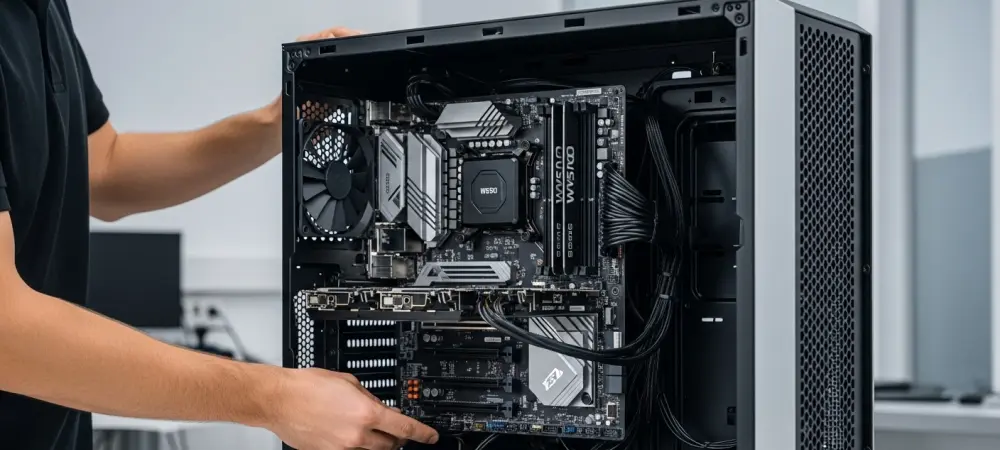
The workstation market has reached a critical inflection point where the sheer scale of data and computational complexity demands a fundamental rethinking of processor architecture. Intel’s Granite Rapids-WS CPU series represents a significant advancement in the professional workstation and high-end desktop (HEDT) sector. This review will explore the evolution from the Sapphire Rapids-WS generation, its key architectural features, expected performance metrics, and the impact it will have on demanding professional applications. The purpose of this review is to provide a thorough understanding of the technology, its current capabilities, and its potential future in the competitive workstation market.
The Next Generation of Workstation Power
The Xeon 600 “Granite Rapids” series marks a major evolutionary step beyond the preceding Sapphire Rapids-WS lineup, engineered from the ground up to address modern computational challenges. Its core principles are built around delivering a massive increase in core density and platform bandwidth, directly targeting the bottlenecks that have emerged in professional workflows. This new generation is not merely an incremental update; it is a strategic response to the exponential growth in AI development, data analytics, and high-fidelity simulation. In a technological landscape where processing power is a primary driver of innovation, Granite Rapids aims to provide the necessary horsepower for professionals pushing the boundaries of what is computationally possible, from machine learning model training to complex engineering analysis.
Architectural Innovations and Platform Enhancements
Redwood Cove Cores and Multi-Die Configurations
At the heart of Granite Rapids lies the new Redwood Cove P-Core architecture, a design focused on delivering enhanced performance and efficiency. Intel has strategically adopted a multi-die approach to cater to a diverse range of market segments. This methodology allows the company to scale its offerings effectively across the entire 11-SKU lineup.
The series is segmented into three distinct die configurations. The top-tier models leverage an XCC (Extreme Core Count) die to deliver the maximum number of cores. Mid-range processors utilize an HCC (High Core Count) die, balancing performance with cost, while entry-level SKUs are built on an LCC (Low Core Count) die. This tiered strategy enables Intel to offer a broad spectrum of performance and price points, from accessible workstation platforms to extreme-performance machines.
The W890 Platform a Leap in Connectivity and Memory
The foundational W890 platform provides a monumental upgrade in system-level capabilities, establishing a new standard for workstation I/O and memory throughput. The most significant enhancement is the expansion to 128 PCIe Gen 5 lanes, offering an unprecedented amount of bandwidth for GPUs, high-speed storage, and other accelerators. This massive I/O capacity is critical for professionals working with large datasets and complex, multi-device workflows.
Complementing the I/O improvements is a completely redesigned memory subsystem. The platform introduces support for eight-channel DDR5 memory, a crucial feature for memory-intensive applications. It accommodates both high-speed DDR5-6400 UDIMMs for mainstream performance and cutting-edge DDR5-8000 MRDIMMs, which provide extreme bandwidth for the most demanding data science and simulation tasks.
Unified Branding and SKU Strategy
With Granite Rapids, Intel has streamlined its product branding by unifying the lineup under the single “Xeon 600” family. This move departs from the split branding of the previous generation, simplifying the product stack for consumers and system builders. The strategy creates a clear and cohesive hierarchy from the entry-level Xeon 634 to the flagship, unlocked 86-core Xeon 698X.
This strategic alignment also extends to product availability. While the majority of SKUs are designated for pre-built systems from major OEMs, Intel has made five specific models, including the top-tier Xeon 698X, available through retail channels. This decision directly caters to the custom-build market, empowering enthusiasts and boutique system integrators to craft bespoke workstations tailored to specific needs.
Performance Expectations and Power Dynamics
The announced specifications for Granite Rapids signal a dramatic leap in performance potential. The flagship model’s staggering 86 cores, combined with boost frequencies reaching up to 4.8 GHz and a massive 336 MB L3 cache, point toward exceptional multi-threaded performance. These raw numbers suggest significant gains in tasks that can effectively leverage a high degree of parallelism. However, this immense power comes with a considerable thermal footprint, as indicated by the 350W base TDP. This figure places significant demands on system cooling and power delivery, making robust chassis and thermal solutions a necessity. The dynamic between raw performance and power efficiency will be a critical factor in evaluating the platform’s overall value, especially in environments where energy consumption is a key consideration.
Real-World Applications and Target Workloads
Granite Rapids is poised to excel in a variety of real-world applications where computational density is paramount. Industries such as media and entertainment will benefit from accelerated high-fidelity rendering and visual effects processing. Similarly, the platform’s high core counts and massive memory bandwidth make it an ideal solution for large-scale engineering simulations and scientific research. The processor series is particularly well-suited for the rapidly growing fields of AI training and data science, where the ability to process vast datasets is crucial. Furthermore, the availability of unlocked processors like the Xeon 698X carves out a unique niche in the prosumer and enthusiast markets. This provides an avenue for overclocking and performance tuning, appealing to users who demand absolute maximum performance for specialized tasks.
Competitive Landscape and Market Positioning
Intel enters a highly competitive arena with Granite Rapids, facing a direct and formidable challenge from AMD’s upcoming Threadripper 9000 series. The battle for dominance in the HEDT and workstation markets is intense, and success will depend on more than just raw performance metrics. In this context, Intel’s market positioning appears to be centered on an aggressive pricing strategy. With the entry-level Xeon 634 starting at $499 and the flagship 698X priced at $7,699, the lineup offers a notable price-to-performance advantage over its chief rival. This approach may prove decisive in influencing adoption, particularly among budget-conscious professionals and system integrators looking to maximize value without compromising on next-generation features.
Future Outlook and Release Timeline
The arrival of Granite Rapids is set to have a lasting impact on the workstation industry, pushing the boundaries of what is achievable on a desktop platform. The technology establishes a new baseline for core density, I/O capabilities, and memory performance that will likely influence hardware and software development for years to come. The platform’s release in late March 2026 places it squarely in a dynamic and rapidly evolving technological landscape. The interim period will undoubtedly see further shifts in both the competitive environment and the demands of professional applications. How Granite Rapids fares will depend not only on its initial capabilities but also on its ability to remain relevant as new challenges and competing technologies emerge.
Final Verdict and Summary
This review analyzed the Intel Granite Rapids-WS series and found it to be a transformative step forward for the professional workstation market. The platform’s substantial improvements in core density, I/O capacity, and memory performance represented a clear and compelling evolution from its predecessor.
Ultimately, the Xeon 600 family delivered a powerful and well-rounded solution that redefined expectations for high-end desktop computing. Its strategic combination of architectural innovation, a robust platform, and an aggressive pricing model positioned it as a formidable competitor to AMD, offering professionals a compelling new option for tackling the most demanding computational workloads.