

The rapid expansion of global digital marketplaces has forced many traditional enterprises to confront a harsh reality where their internal infrastructure cannot match the speed of modern consumer demand. As commerce enterprises scale with unprecedented velocity, moving into international territories and complex B2B sectors simultaneously, they encounter a level of operational friction that can paralyze growth. This complexity requires a robust back-end system to manage the heavy lifting of logistics and finance, yet many businesses are finding that their legacy frameworks were never designed for the era of instant digital transactions. The resulting performance gap often creates a bottleneck that stalls brand momentum just as a company begins to find its footing on the global stage. Recent industry data reveals that a significant majority of current ERP implementations fail to meet their original objectives, primarily due to the weight of legacy drag. This phenomenon occurs when companies are tethered to decades of custom code and fragmented data silos that no longer align with current market requirements. When these massive digital overhauls fail, the consequences are often catastrophic, with financial losses reaching hundreds of thousands or even millions of dollars.
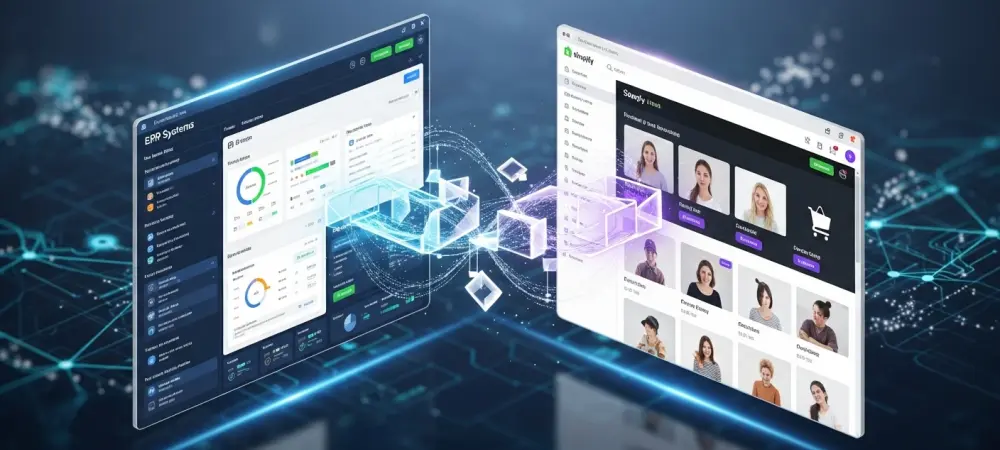
To navigate these treacherous waters, successful brands are increasingly adopting a hybrid strategy that pairs their Enterprise Resource Planning software with a specialized, flexible commerce platform like Shopify. The prevailing wisdom in the current market is to treat the ERP as the primary system of record for back-office data while utilizing Shopify as the system of engagement for all customer-facing interactions. This balanced environment ensures that the rigorous demands of financial stability and inventory accuracy are met without sacrificing the speed and agility necessary to compete in a hyper-competitive landscape. By segregating these functions, a business can maintain a high degree of operational integrity while remaining responsive to the shifting preferences of a global customer base. This approach represents a fundamental shift in how modern commerce is architected, moving away from the dream of a single, monolithic solution and toward a more integrated, best-of-breed ecosystem that prioritizes both stability and innovation.
Defining the Functional Scope: Foundations of Digital Infrastructure
The Core Responsibilities: Managing Back-Office Data
An ERP acts as the central nervous system of an enterprise, meticulously managing and centralizing data across vital categories such as finance, inventory, and human resources. By providing a single source of truth for stock levels and linking financial records directly to sales movements, these systems ensure that every product journey—from the initial manufacturing phase to final delivery—is tracked with extreme precision. This level of oversight is non-negotiable for organizations that must manage complex supply chains or diverse product catalogs across multiple warehouses. The inherent strength of an ERP lies in its ability to enforce process conformity, ensuring that accounting standards are met and that every dollar is accounted for in real-time. Without this central hub, a growing company would quickly find itself overwhelmed by the sheer volume of data generated by modern sales channels, leading to inventory discrepancies and financial reporting errors that could jeopardize the entire operation.
While these systems are exceptionally powerful at managing internal workflows, they were generally not designed to handle the nuances of the modern customer experience. Most ERPs lack the native tools required to build engaging online storefronts, process fluid retail transactions in person, or manage the sophisticated customer journeys that shoppers now expect. This is why a specialized commerce platform is essential; it takes the dense, complex data from the back office and transforms it into a seamless, user-friendly shopping experience that drives conversion. The primary role of the ERP is to maintain the integrity of the data, while the commerce platform’s role is to present that data in a way that resonates with the end user. When these two systems work in tandem, the business gains the ability to scale its operations without losing the personal touch that builds brand loyalty. This division of labor allows the internal teams to focus on operational efficiency while the marketing and sales teams focus on growth and customer satisfaction.
Modern Adaptations: Bridging the Gap Between Rigid Systems and Agility
There is an inherent and long-standing tension between the rigid standardization required by an ERP and the extreme flexibility needed by a high-growth brand. ERPs excel at enforcing rules and maintaining consistency, which is vital for financial auditing and regulatory compliance, but this same rigidity can become a hindrance when a marketing team needs to pivot quickly for a holiday promotion or a flash sale. In the current technological landscape, the rise of generative AI and automated workflows is beginning to dissolve this traditional logic. Modern businesses are learning to leverage their ERP for core stability—keeping the financial foundations solid—while relying on external commerce platforms to facilitate rapid changes in sales strategy and marketing execution. This hybrid approach allows for the best of both worlds: the unshakeable reliability of a legacy accounting system and the nimble responsiveness of a modern digital storefront.
The evolution of these systems has also changed the way teams interact with data, moving away from manual entry and toward automated synchronization. By using Shopify to handle the system of engagement, companies can experiment with new sales channels, international currencies, and localized marketing campaigns without needing to reconfigure their core ERP every time a change is made. This decoupling of the front-end and back-end means that the risk of breaking a vital financial process is significantly reduced while the opportunity for innovation is greatly increased. As organizations continue to integrate these technologies, they find that the ERP serves as a stabilizing anchor, allowing the commerce engine to push the boundaries of what is possible in the digital marketplace. This relationship is not just about moving data back and forth; it is about creating a symbiotic environment where each tool is utilized for its specific strengths, ensuring that the business remains both disciplined and daring in its pursuit of market share.
Navigating the Technical Landscape: Deployment and Vendor Selection
Choosing the Right Foundation: Cloud Flexibility Versus On-Premises Control
When selecting an ERP, enterprises are faced with a fundamental decision regarding their deployment model: whether to host their software on-premises or in a cloud environment. In the current market, the vast majority of organizations are opting for cloud-based deployment, as it offers a faster setup time and eliminates the burden of maintaining expensive internal hardware and specialized IT staff. Cloud systems provide a level of scalability that is difficult to achieve with on-premises solutions, allowing businesses to expand their server capacity instantly as they grow into new regions or experience seasonal spikes in traffic. Furthermore, cloud providers handle security patches and software updates automatically, ensuring that the system is always running on the latest version without requiring a manual overhaul. This accessibility has democratized high-level enterprise software, making it available to brands of all sizes that previously could not afford the entry costs of a legacy system.
Despite the surge in cloud adoption, approximately a quarter of the enterprise market continues to rely on on-premises systems to maintain total control over their data residency and specific upgrade cycles. For some organizations, particularly those in highly regulated industries or those with massive existing investments in hardware, the move to the cloud presents a level of risk they are not yet willing to take. These companies value the ability to customize every aspect of their server environment and manage their own security protocols. However, the trade-off is a significantly higher overhead cost and a slower pace of innovation, as every update must be manually tested and deployed across the entire network. As the landscape continues to evolve, even these traditional players are finding ways to implement “hybrid cloud” models, where some data remains on-premises for security while other functions are shifted to the cloud for better integration with modern commerce tools like Shopify.
Strategic Integration: Connecting the Front-End to the System of Record
The competitive landscape for ERP software is more diverse than ever, with major vendors offering specialized solutions tailored to different business needs and operational scales. Oracle NetSuite and SAP S/4HANA remain the dominant choices for global enterprises with complex, multi-layered operational requirements, providing the deep functionality needed to manage international tax laws and intricate supply chains. On the other hand, Microsoft Dynamics 365 has become a favorite for teams looking for deep AI integration, particularly for detecting financial anomalies and automating routine accounting tasks. For organizations focused on manufacturing and distribution, specialized options like Acumatica or Infor offer industry-specific workflows that can be difficult to replicate in a general-purpose system. Meanwhile, Odoo has carved out a significant niche by providing a modular, cost-effective solution that allows smaller organizations to start with basic features and add complexity as they grow. Rather than committing to a monolithic, all-in-one system that attempts to perform every function perfectly, many modern brands are moving toward a composable architecture. This strategy allows a business to select the specific tools that are best for each individual function—such as a dedicated warehouse management system or a specialized finance module—and connect them through robust APIs. By building a tech stack out of interoperable components, a company ensures that it is not locked into a single vendor’s ecosystem, making it much easier to swap out parts of the system as needs change. This modularity is particularly beneficial when integrating with a commerce platform, as it allows for a more direct and efficient data flow between the web store and the back office. The shift toward composability represents a move away from the “one size fits all” mentality and toward a more tailored, resilient infrastructure that can adapt to the unpredictable nature of global commerce.
Strategic Integration: Leveraging the Shopify Global Ecosystem
Implementing Purpose-Built Connectors: Simplifying the Integration Process
To ensure that an ERP does not become an isolated silo of information, Shopify has developed several sophisticated pathways for seamless data integration that cater to different enterprise needs. The Shopify Global ERP Program is a cornerstone of this effort, offering certified, purpose-built connectors for major systems like Oracle NetSuite, Microsoft Dynamics 365, and SAP. These connectors are designed to handle the heavy lifting of synchronization, making it much easier to keep inventory levels, order data, and customer information in perfect alignment across both platforms. For businesses, this means reduced development time and a lower risk of data errors that often plague custom-built integration projects. By using these verified tools, companies can achieve a high level of operational harmony without needing to build complex middleware from scratch, allowing them to focus their resources on marketing and product development instead of technical maintenance. For enterprises with highly specific operational requirements or fragmented data sources, middleware tools known as integration-platforms-as-a-service (iPaaS) provide an alternative route to connectivity. These platforms act as a sophisticated bridge between the warehouse and the web store, allowing for complex data transformations and custom workflows that a standard connector might not support. This level of flexibility is vital for businesses that must manage unique product configurations, complex discount structures, or varied shipping requirements across different regions. By utilizing an iPaaS solution, a brand can ensure that every piece of data is formatted correctly before it reaches the ERP, preventing the “garbage in, garbage out” problem that often ruins financial reporting. This strategic use of integration layers ensures that the entire tech stack remains flexible and scalable, capable of supporting the business’s ambitions as it ventures into new markets and sales channels.
Real-World Success: Driving Growth Through Synchronized Operations
The practical impact of a well-executed ERP integration is best illustrated by the success stories of brands that have managed to bridge the gap between their back-office and front-end systems. For instance, the fashion brand SilkSilky successfully linked its custom ERP to Shopify to manage production schedules and global sales in a single unified workflow. By letting the ERP handle the intricate details of manufacturing and supply chain management while Shopify managed the customer-facing storefront, the brand achieved a level of operational harmony that provided a solid foundation for rapid international growth. Furthermore, they were able to reduce their return rates by using automated risk filters to catch high-risk orders before they were even fulfilled, saving both time and money. By letting the ERP handle the intricate details of manufacturing and supply chain management while Shopify managed the customer-facing storefront, the brand achieved a level of operational harmony that provided a solid foundation for rapid international growth.
Similarly, the international home decor brand Jonathan Adler underwent a significant digital transformation by connecting its previously fragmented systems through a central integration layer. Before this transition, the company struggled with poor inventory visibility, which often led to overselling and customer dissatisfaction across its various sales channels. By moving to a synchronized system that linked its ERP directly to its Shopify store, the brand gained real-time visibility into its global stock levels, leading to a massive increase in revenue and a 65% boost in conversion rates. These results demonstrate that when the back office and the front end are properly aligned, the friction that typically slows down a large business essentially disappears. The ability to see exactly what is in stock and where it is located allows the business to fulfill orders faster and more accurately, creating a superior customer experience that drives repeat business and long-term brand loyalty.
Finalizing the Architecture: Moving Beyond Siloed Data
Building a Single Source of Truth: Data Consistency Across Channels
A primary objective for any modern retailer is the achievement of a state of unified commerce, where every sales channel—whether online, in-store, or through a third-party marketplace—is managed through a single lens. Unlike traditional multichannel models that treat online and offline sales as separate entities with their own inventory and customer databases, unified commerce ensures that the customer’s profile and product availability are consistent across every touchpoint. This architecture allows a brand to manage its wholesale, direct-to-consumer, and marketplace operations simultaneously, providing total visibility into the health of the entire enterprise. When the ERP and Shopify are fully integrated, a sale made on a mobile app instantly updates the inventory levels in the warehouse and records the transaction in the financial ledger, ensuring that there is no discrepancy between what the customer sees and what the business knows.
Brands that have successfully implemented this unified model, such as NRBY Clothing, have seen explosive growth by connecting their physical and digital channels into a single, cohesive ecosystem. Data indicates that even a small percentage of shoppers who interact with a brand across multiple channels can account for a significantly disproportionate share of the company’s total sales when the experience is seamless. This level of insight and performance is only possible when the back-end and front-end systems are working as complementary halves of a whole, sharing data in real-time to create a comprehensive view of the business. By breaking down the silos that traditionally separate different parts of an organization, companies can respond more quickly to market trends and customer needs. This unified approach not only improves operational efficiency but also provides the data-driven insights necessary to make informed decisions about product development, marketing spend, and international expansion.
Strategic Transitions: Lessons From Successful Implementation
The most effective enterprises shifted their focus away from total system replacement and toward strategic connectivity to minimize the risks associated with large-scale digital overhauls. Leaders in the space recognized that because ERP projects often carried a high risk of failure and significant costs, it was more effective to keep a functional system of record in place while integrating it with a world-class commerce engine. This hybrid approach allowed companies to maintain their financial foundations and regulatory compliance while adopting the aggressive scalability and modern features required to lead in the digital era. By prioritizing the flow of data over the perfection of a single platform, these organizations built resilient infrastructures that supported both stable internal operations and dynamic customer experiences. This strategy reduced the technical debt that often accumulated during massive migrations and allowed teams to see tangible results much faster than they would have with a traditional “big bang” implementation.
Forward-thinking organizations also moved toward a culture of continuous optimization, treating their technology stack as a living ecosystem rather than a static installation. They invested in robust integration layers and prioritized API-first architectures, which ensured that they could adapt to new market demands without rebuilding their entire back-end. This focus on interoperability proved to be a decisive advantage, as it enabled brands to quickly integrate new tools for AI-driven analytics, localized payment methods, and sophisticated loyalty programs. The transition to unified commerce was not merely a technical upgrade; it was a fundamental shift in how these companies approached their growth and customer relationships. By aligning their internal operations with their external sales goals, they created a harmonious environment where data served as the fuel for innovation rather than a source of confusion. Ultimately, the brands that thrived were those that embraced the complexity of modern commerce by building systems that were as interconnected as the global markets they served.