

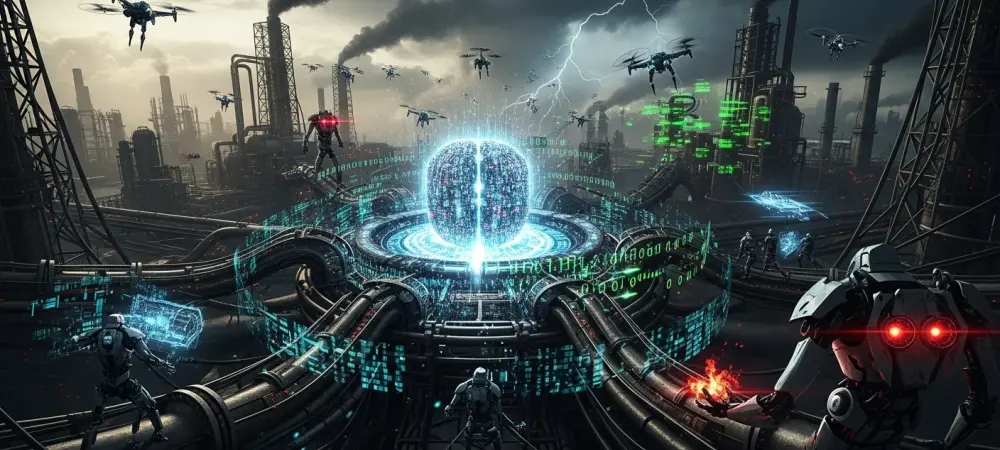
The rapid transition from isolated hacking attempts to a fully automated, assembly-line model of digital exploitation has fundamentally altered the security equilibrium for every modern enterprise. As we navigate 2026, the arrival of industrialized AI cyber threats marks a departure from the era when high-level breaches required elite human talent. Today, the synthesis of Large Language Models and automated execution frameworks allows even low-skilled actors to deploy campaigns with the precision once reserved for nation-states.
This shift is not merely about speed; it is about the structural democratization of malice. By integrating sophisticated AI into the reconnaissance and delivery phases of an attack, the barrier to entry has effectively vanished. This evolution creates a landscape where the volume of incoming threats is limited only by processing power rather than human expertise, forcing a complete re-evaluation of how organizations perceive risk and defense.
The Evolution of AI-Driven Cyber Criminality
The current technological landscape is defined by the migration of AI from a supportive analytical tool to the primary engine of offensive operations. Initially, attackers used basic automation for mass-mailing or simple brute-force attempts. However, the modern iteration of this threat involves autonomous systems capable of adjusting their tactics based on the defensive responses they encounter, creating a perpetual game of cat and mouse.
The emergence of these industrialized threats is rooted in the accessibility of high-performance computing and open-source models. This context has allowed criminal syndicates to build proprietary “black box” AI tools that lack the ethical guardrails found in commercial applications. Consequently, the digital ecosystem now faces a sophisticated adversary that learns from every failed breach, refining its methodology in real-time.
Core Mechanisms of Industrialized Threat Actors
LLMs: Force Multipliers in Social Engineering
Large Language Models have revolutionized the psychological aspect of cyber warfare by eliminating the linguistic “tells” that previously signaled a phishing attempt. By leveraging localized nuance and perfect grammar, these models generate correspondence that is indistinguishable from legitimate corporate communication. This capability allows attackers to scale personalized social engineering across thousands of targets simultaneously, significantly increasing the probability of a successful compromise.
Beyond simple text generation, these tools analyze the tone and style of existing corporate data to mimic specific executives or departments. This high-fidelity impersonation bypasses traditional employee awareness training, which often relies on identifying obvious errors. The result is a highly efficient delivery mechanism that exploits human trust with unprecedented mathematical precision.
Automated Technical Exploitation: Malware Generation
On the technical front, AI now serves as a tireless software engineer capable of writing, testing, and debugging custom malware on the fly. This automation allows for the creation of polymorphic code that changes its signature with every iteration, rendering signature-based antivirus solutions obsolete. Unlike manual coding, which takes days or weeks, an AI-driven framework can produce hundreds of unique exploits in minutes.
Moreover, these systems are proficient at mapping complex corporate networks to identify high-value data repositories. By automating the lateral movement phase of an attack, threat actors can navigate internal systems with surgical accuracy. This level of technical sophistication ensures that once a perimeter is breached, the time to data exfiltration is reduced from hours to seconds.
Emerging Trends in the Artificial Intelligence Threat Landscape
A particularly concerning trend is the rise of “identity synthesis” where deepfake technology is used to facilitate insider threats. Threat actors are no longer just breaking in; they are being hired in. By utilizing AI-generated personas and real-time video manipulation, malicious entities can bypass remote hiring filters to place “moles” within sensitive administrative roles.
This development shifts the battleground from the firewall to the HR department. Once an AI-augmented actor gains legitimate credentials, they can access financial systems and sensitive intellectual property without triggering traditional security alerts. This trend indicates that the next phase of cyber warfare will be defined by the corruption of identity and the erosion of the “verified user” concept.
Real-World Applications and Sector Impact
The industrialization of these threats has hit the supply chain sector with particular ferocity. Recent incidents have shown that attackers can use AI to identify a single vulnerability in a shared software component and then simultaneously exploit hundreds of different corporate tenants. This “one-to-many” attack strategy provides a massive return on investment for cybercriminals, as a single successful script can paralyze entire industries.
In the financial sector, the impact is seen in the automation of fraudulent transactions that mirror the behavior of legitimate users. By analyzing historical transaction patterns, AI-driven bots can execute micro-thefts that remain beneath the threshold of standard fraud detection algorithms. These use cases demonstrate that no industry is immune to the scalability offered by industrialized automation.
Technical Hurdles and Defensive Obstacles
Defending against an automated adversary presents significant technical challenges, primarily because human-led security teams cannot match the operational tempo of an AI. The primary obstacle is the “latency gap”—the time between an attack’s initiation and the defender’s response. When an exploit is generated and deployed in milliseconds, traditional manual intervention is essentially useless.
Furthermore, regulatory frameworks are struggling to keep pace with the dual-use nature of AI development. While developers aim for innovation, the same code can be repurposed for destruction. Ongoing efforts to implement “digital watermarking” or stricter model access have seen limited success, as the most dangerous actors operate outside of legal jurisdictions, utilizing decentralized and unmoderated infrastructure.
The Future Trajectory of AI-Enabled Warfare
The path ahead points toward an era of autonomous cyber warfare where defensive AIs and offensive AIs engage in constant, high-speed conflict without human oversight. We are moving toward a “zero-trust” environment where every digital interaction must be verified by an independent AI auditor. This shift will likely lead to the development of self-healing networks that can reconfigure their architecture in response to an active breach.
Long-term, the impact on society will be a fundamental distrust of digital communication. As the cost of generating convincing fakes drops to near zero, the value of verified, immutable data will skyrocket. This will likely drive the adoption of hardware-based security keys and decentralized identity ledgers as the only reliable means of ensuring that a person is who they claim to be in a world of synthetic actors.
Conclusion and Strategic Assessment
The review of industrialized AI cyber threats revealed a landscape where the traditional advantages of defenders have been largely neutralized by the scalability of machine learning. It became clear that the democratization of high-level exploitation tools shifted the primary risk from external “hacking” to the internal corruption of identity and the automation of social engineering. Organizations that continued to rely on reactive, human-centric security models found themselves increasingly vulnerable to the sheer velocity of these modern campaigns. The strategic necessity moved toward a proactive, intelligence-led posture that utilized AI to counter AI. Leaders recognized that maintaining a robust defense required not just more software, but a fundamental change in organizational philosophy regarding trust and identity. Ultimately, the transition to an industrialized threat environment demanded that security become an integrated, autonomous function of the business rather than a separate, secondary layer of protection.