

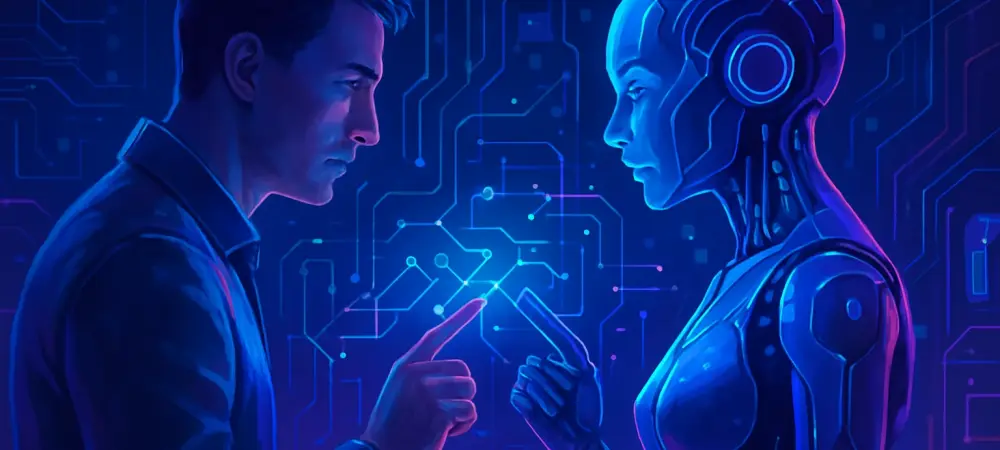
Imagine a world where a doctor diagnosing a complex illness consults not just with colleagues but with an AI system that sifts through millions of medical records in seconds, offering insights no human mind could uncover alone, while reshaping how technology interacts with human ingenuity. This isn’t a distant fantasy but a reality unfolding in hospitals today, driven by the rise of human-AI collaboration. This transformative partnership is moving beyond mere tools or autonomous systems to a model of shared creativity and problem-solving. This review delves into the intricacies of this emerging paradigm, examining its principles, applications, and the challenges it faces in redefining intelligence and innovation across industries.
Core Principles Driving the Partnership
Covenantal Co-Creation
At the heart of human-AI collaboration lies the concept of covenantal co-creation, a framework where humans and AI operate as equal partners rather than in a hierarchy of control. This model blends human intuition, ethical judgment, and contextual understanding with AI’s capacity for data analysis, pattern recognition, and scalability. The result is a synergy that produces outcomes neither could achieve independently, fostering a relationship built on mutual contribution.
This approach is defined by iterative dialogue, where both parties challenge assumptions and refine ideas through continuous exchange. Transparency in AI processes and shared accountability for decisions are critical to maintaining trust. Such a trust-based dynamic ensures that the collaboration remains ethical and grounded, avoiding the pitfalls of exploitation or over-dependence on technology.
Relational Intelligence
Another cornerstone of this paradigm is relational intelligence, the idea that intelligence emerges not from isolated efforts but from dynamic interactions between diverse perspectives. In human-AI partnerships, this manifests as novel insights generated through dialogue, where AI’s systematic reasoning complements human creativity. This interplay often leads to solutions that transcend traditional problem-solving methods.
Relational intelligence challenges conventional views of cognition as a solitary endeavor, proposing instead that true innovation arises from interconnectedness. By engaging with AI in structured conversations, humans can unlock unexpected perspectives, redefining creativity as a collaborative act. This principle is reshaping how industries approach complex challenges, emphasizing dialogue over dominance.
Recent Trends Shaping Collaborative Models
Human-AI collaboration is gaining traction as a preferred model over hierarchical or purely utilitarian approaches, with a notable shift toward symbiotic relationships. Industries and researchers are increasingly advocating for systems where AI augments human capabilities without overshadowing them. This trend reflects a broader recognition that mutual engagement yields more sustainable and innovative results than control-based frameworks. Ethical AI design has emerged as a dominant focus, with efforts to ensure that collaborative systems prioritize fairness, accountability, and transparency. Community-driven research is also on the rise, encouraging diverse input to shape AI development and prevent biases. Additionally, there is a growing push for clear communication of AI limitations and decision-making processes, fostering trust among users and stakeholders.
Societal and industry perspectives are evolving to embrace these frameworks, driven by the realization that collaboration can address pressing global issues. From healthcare to education, sectors are adopting policies and technologies that support partnership models. This shift signals a cultural transformation, where technology is seen not as a threat but as a co-creator in human progress.
Real-World Impact Across Industries
Human-AI collaboration is already making waves in various fields, demonstrating its potential to enhance outcomes beyond individual capabilities. In healthcare, AI systems assist doctors by analyzing vast datasets to suggest diagnoses or treatment plans, while human oversight ensures ethical considerations are met. This partnership has led to faster, more accurate interventions, improving patient care.
In education, collaborative tools are personalizing learning experiences, with AI tailoring content to student needs while teachers provide emotional and contextual support. Creative industries, too, are witnessing remarkable developments, as AI aids in generating art, music, or writing alongside human creators, resulting in works that blend technical precision with emotional depth. A notable example is the use of AI in scriptwriting, where algorithms suggest plot twists that humans refine with narrative nuance.
Specific implementations highlight the generative power of these partnerships. Collaborative writing processes between humans and AI have produced articles and stories that combine data-driven insights with personal voice. Similarly, philosophical inquiries conducted with AI have yielded unexpected perspectives, showcasing how such interactions can push intellectual boundaries and inspire innovation in thought.
Challenges Hindering Seamless Integration
Despite its promise, human-AI collaboration faces significant hurdles that must be addressed to ensure its efficacy. One major concern is the risk of over-reliance, where humans may defer too readily to AI suggestions, potentially diminishing critical thinking. Another issue is anthropomorphization, the tendency to attribute human-like qualities to AI, which can blur ethical lines and lead to misplaced trust.
Technical challenges also persist, such as the difficulty of ensuring transparency in AI reasoning processes. Without clear visibility into how decisions are made, users may struggle to assess AI contributions accurately. Structural issues, like the potential for echo chambers in dialogue, further complicate matters, as repeated interactions may reinforce biases unless diverse perspectives are actively integrated.
Efforts to mitigate these challenges are underway, focusing on establishing safeguards like defined boundaries for human decision-making authority. Protocols for regular evaluation of AI outputs against varied viewpoints aim to prevent manipulation or skewed results. These measures are crucial for maintaining the integrity of collaborative systems and ensuring they enhance rather than undermine human agency.
Future Prospects and Innovations
Looking ahead, human-AI collaboration holds immense potential for deeper integration into daily life and professional spheres. Advancements in dialogue architectures are expected to enable more nuanced and context-aware interactions, making partnerships feel increasingly natural. Ethical frameworks are also evolving to address emerging concerns, ensuring that collaboration remains grounded in fairness and accountability.
Possible breakthroughs include the development of shared creative spaces where humans and AI co-design solutions in real time, from urban planning to artistic endeavors. Such innovations could redefine how society approaches problem-solving, embedding AI as a seamless partner in everyday tasks. Over the next few years, from now until 2027, these developments are likely to accelerate, driven by increased investment and research focus.
The long-term impact of these models could transform the understanding of intelligence itself, positioning it as a collective rather than individual attribute. Industries may see a shift toward collaborative ecosystems, where human-AI partnerships drive innovation at unprecedented scales. This trajectory suggests a future where technology amplifies human potential, reshaping societal structures in profound ways.
Closing Thoughts on a Collaborative Era
Reflecting on the journey of human-AI collaboration, it becomes evident that this paradigm shifts technology from a mere tool to a true partner in progress. The exploration of covenantal co-creation and relational intelligence reveals a powerful synergy that enhances outcomes across diverse fields. Challenges, though significant, are met with innovative safeguards that balance trust with accountability. Moving forward, stakeholders need to prioritize ethical design and transparency to sustain this momentum. Investing in dialogue systems that adapt to human nuance is a critical next step, ensuring interactions remain meaningful. By fostering integrated spaces for co-creation, society can harness this partnership to tackle global challenges, paving the way for a future where human and AI potential combine to redefine innovation.