

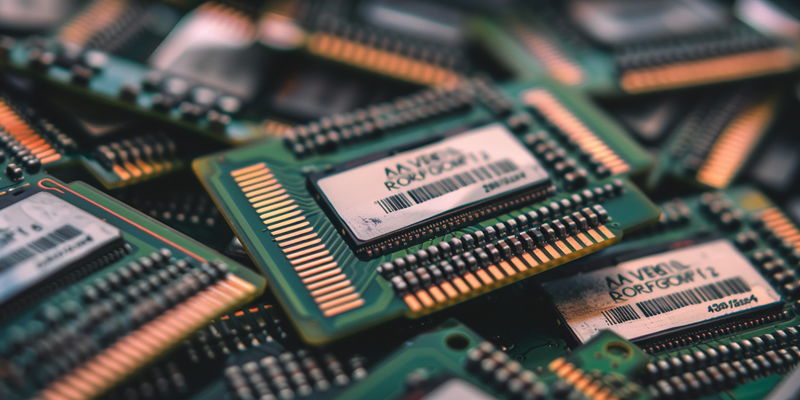
The imminent finalization of the HBM4 memory standard by JEDEC marks a critical development in the semiconductor and memory industries, driven by the surging demand in the AI markets. HBM4, or High Bandwidth Memory 4, is aimed at significantly enhancing memory capacities and performance metrics over its predecessor, HBM3. By introducing doubled channel counts per stack, HBM4 increases the utilization area substantially, resulting in marked performance improvements. This new standard is set to redefine the benchmarks of memory technology, transforming it into a pivotal enabler for next-generation AI applications and computing technologies.
Enhanced Memory Capacities and Performance Metrics
According to JEDEC’s preliminary specifications, HBM4 will feature memory layers with densities of 24 Gb and 32 Gb, which will be available in 4-high, 8-high, 12-high, and 16-high TSV stacks. This means that HBM4 will provide a significantly larger memory capacity, addressing the growing needs for data storage and processing in AI-driven applications. The initial speed bins for HBM4 are set at 6.4 Gbps, a substantial increase in speed compared to previous generations. However, ongoing discussions suggest that this speed threshold could be exceeded upon HBM4’s market debut, setting new records in memory performance.
Remarkably, the same controller used in HBM3 will be compatible with HBM4, ensuring a seamless transition for devices already utilizing HBM3. This compatibility leverages existing infrastructure while offering higher efficiencies and reducing the need for manufacturers to overhaul their current systems. A key anticipated feature of HBM4 is its “multi-functional” die design, which integrates memory and logic semiconductors into a single package. This design innovation eliminates the need for additional packaging technology, thereby enhancing the memory’s capabilities and its performance.
Strategic Partnerships for Accelerated Development
One of the pivotal strategies driving HBM4’s accelerated development is the strategic partnership between NVIDIA, SK hynix, and TSMC, commonly referred to as the “triangular alliance.” This collaboration aims to pool the expertise of three industry giants: NVIDIA’s cutting-edge product design, SK hynix’s breakthroughs in memory innovations, and TSMC’s advanced semiconductor manufacturing capabilities. This alliance is expected to fast-track the development of HBM4, enabling it to meet the rising demand for high computational power in the AI sector.
NVIDIA, for instance, plans to incorporate HBM4 into its next-generation Rubin AI accelerators, a move that underscores HBM4’s potential to set higher performance benchmarks for AI and computing technologies. This collaboration represents a collective effort to push the boundaries of what memory technology can achieve. As AI systems and applications become more sophisticated, the need for high-speed and high-capacity memory solutions becomes paramount. HBM4 is well-positioned to fulfill these requirements, promising substantial advancements in AI and computing capabilities.
Anticipated Market Impact and Future Prospects
The imminent finalization of the HBM4 (High Bandwidth Memory 4) standard by JEDEC represents a significant leap forward in the semiconductor and memory industries, propelled by the increasing demand from AI markets. HBM4 is set to enhance memory capacities and performance metrics substantially, offering significant improvements over its predecessor, HBM3. One of the standout features of HBM4 is its doubled channel counts per stack, which significantly boosts the utilization area. This results in not just enhanced performance but also greater efficiency. Such advancements are expected to set new benchmarks in memory technology, positioning HBM4 as a crucial enabler for next-generation AI applications and advanced computing technologies. This paradigm shift in memory capabilities will support the ever-growing data processing and storage needs of AI and machine learning workloads, driving innovation and performance in ways previously thought unattainable. By pushing the envelope of what memory technology can achieve, HBM4 stands to transform the landscape of AI and high-performance computing.