

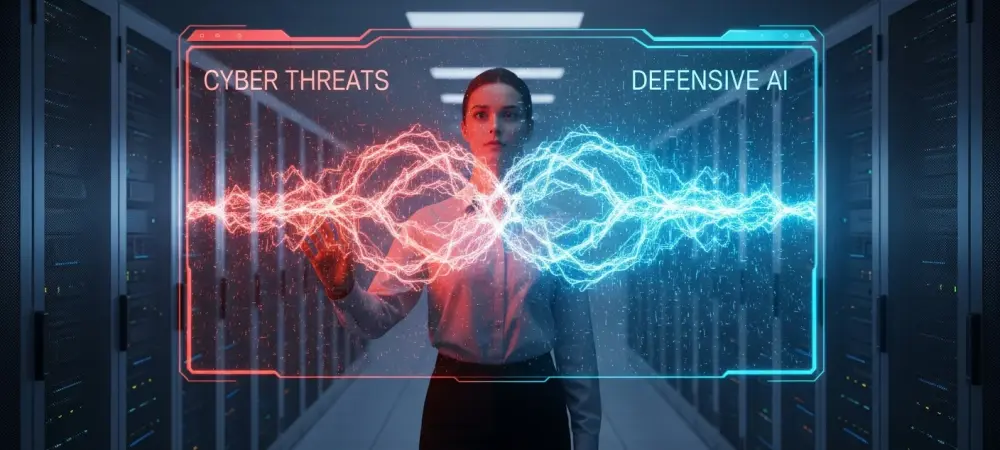
The very fabric of digital security is being rewoven by an artificial intelligence that acts as both the primary weapon of cyber attackers and the most sophisticated shield for defenders, creating an unprecedented and complex risk environment for organizations globally. This year marks a critical turning point where the speed of technological advancement in cybercrime is dramatically outstricing the pace of regulatory consensus, forcing businesses to navigate a landscape defined by innovation and instability. The challenge is no longer about simply adopting new tools but about fundamentally rethinking strategy in an era where the lines between threat and defense are increasingly blurred by a common, intelligent force.
The Dual Edged Sword AI as a Catalyst for Cyber Threats and Defenses
Artificial intelligence has become the central paradox in modern cybersecurity, simultaneously serving as a powerful catalyst for both offensive and defensive capabilities. For malicious actors, AI unlocks new levels of efficiency and sophistication, enabling the creation of highly personalized phishing campaigns and convincing deepfake media at a scale previously unimaginable. This technological empowerment allows attackers to automate and accelerate their methods, moving beyond traditional tactics toward more dynamic and elusive threats that can adapt to their targets in real time.
In response, organizations find themselves in a digital arms race where failing to integrate AI into their defensive strategies is no longer an option but a significant liability. AI-driven security systems are essential for detecting and neutralizing the advanced threats that manual processes can no longer manage. However, this reliance introduces its own set of challenges. The same tool used for protection is also the primary weapon for attack, forcing businesses to operate within a new risk paradigm where innovation in one domain directly fuels escalation in the other.
A Volatile Landscape The Confluence of Technological Disruption and Regulatory Fragmentation
This year is a pivotal convergence point where the rapid evolution of AI-powered cybercrime intersects with growing friction in the global regulatory environment. The technological landscape is shifting at an accelerated pace, with AI not just enhancing existing threats but also creating entirely new categories of risk. This rapid disruption presents an urgent and complex challenge for organizations worldwide, who must now defend against adversaries armed with increasingly autonomous and intelligent tools.
Compounding this technological volatility is a notable divergence in how world powers approach cybersecurity regulation. The European Union continues to champion coordinated, comprehensive frameworks, such as the Network and Information Security Directive, to create a unified defensive posture. In contrast, other nations are pursuing different, often conflicting, domestic agendas, leading to a fragmented global landscape. This lack of alignment makes it difficult to establish universal standards for cyber resilience, leaving multinational organizations to navigate a patchwork of rules that can hinder effective, cohesive security strategies.
Research Methodology Findings and Implications
Methodology
The forecast for the current cybersecurity landscape is built upon a comprehensive analytical approach. This method synthesizes in-depth analysis from subject matter experts with a rigorous evaluation of current market dynamics and technological trends. Furthermore, it incorporates an assessment of key geopolitical factors, recognizing that international relations and regulatory shifts play a crucial role in shaping cyber risks. This multifaceted approach allows for a holistic view, connecting technological developments with their real-world strategic and business contexts.
Findings
The primary discoveries point to a significant escalation in the sophistication and prevalence of AI-driven cyber threats. Attackers are increasingly leveraging artificial intelligence to launch personalized phishing attacks and generate highly convincing deepfake content, making deception more effective than ever. The analysis also reveals the emergence of adaptive malware, designed to evade conventional detection methods, and early indications of autonomous attacks where AI agents can operate with minimal human intervention.
Beyond these AI-centric developments, other critical risks have been identified. These include a projected rise in cryptocurrency thefts targeting both transaction platforms and digital wallets, exploiting vulnerabilities in the burgeoning digital finance ecosystem. Moreover, the report underscores the catastrophic potential of attacks on major cloud computing systems, where a single successful breach could have widespread and devastating consequences for countless businesses and their customers.
Implications
The practical consequences for businesses are stark: organizations that delay investment in AI-driven defenses will face heightened vulnerability to these advanced threats. Manual security processes are no longer sufficient to counter the speed and scale of AI-powered attacks, making the adoption of intelligent defensive systems a matter of corporate survival. This technological shift marks a definitive departure from traditional cybersecurity paradigms, requiring a proactive and forward-thinking approach to risk management.
However, artificial intelligence is not a “silver bullet” solution. The integration of agentic AI into defense systems introduces new operational risks, including the potential for unpredictable behavior and the accumulation of errors that could complicate incident response. Effective implementation therefore demands strong governance frameworks to manage these inherent complexities. The goal is not just to deploy AI but to ensure its application is safe, reliable, and aligned with the organization’s strategic objectives.
Reflection and Future Directions
Reflection
Forecasting in a field as dynamic as AI and cybersecurity presents a formidable challenge. The rapid pace of technological change, coupled with an unpredictable regulatory climate, makes long-term predictions difficult. A core tension exists between the urgent need for organizations to adopt AI for defensive purposes and the inherent risks associated with deploying agentic AI systems that can act with a degree of autonomy. This balance requires constant re-evaluation.
Further analysis could provide more granular insights by focusing on specific industry impacts. Sectors like finance, healthcare, and critical infrastructure face unique threat profiles and regulatory pressures. Tailoring research to these verticals would offer more targeted guidance on how to manage AI-related risks and leverage defensive AI capabilities most effectively, moving from a general forecast to actionable, industry-specific strategies.
Future Directions
Based on current projections, several areas warrant close monitoring and further research. A primary focus should be tracking the development of fully autonomous malware, which experts anticipate will become a reality within the next three to five years. Understanding the trajectory of this technology is critical for developing preemptive defensive measures before it becomes a widespread threat.
Another crucial area for future work involves addressing the challenge of international cooperation. Establishing global standards for cyber resilience is essential, but political fragmentation presents a significant obstacle. Research should explore viable pathways toward creating robust governance frameworks for defensive AI systems and fostering international agreements that strengthen collective security without being diluted by competing national interests.
Navigating the New Cyber Frontier A Call for Adaptive Strategy and Governance
The analysis concluded that 2026 is a defining year, shaped profoundly by the integration of artificial intelligence into every facet of cybersecurity. The central finding was that AI’s dual role as both a formidable weapon and an indispensable shield has created a new, more complex cyber frontier. This reality demands a strategic pivot from organizations, moving beyond a purely technological focus toward a more holistic approach to resilience. Ultimately, organizational survival and success depended not just on the adoption of AI-powered defenses but on the deep integration of these tools within a flexible and governance-focused strategy. This adaptive framework was deemed necessary to manage the intricate interplay of technological innovation and regulatory uncertainty. The ability to navigate this new landscape effectively distinguished the most resilient organizations from the most vulnerable.