

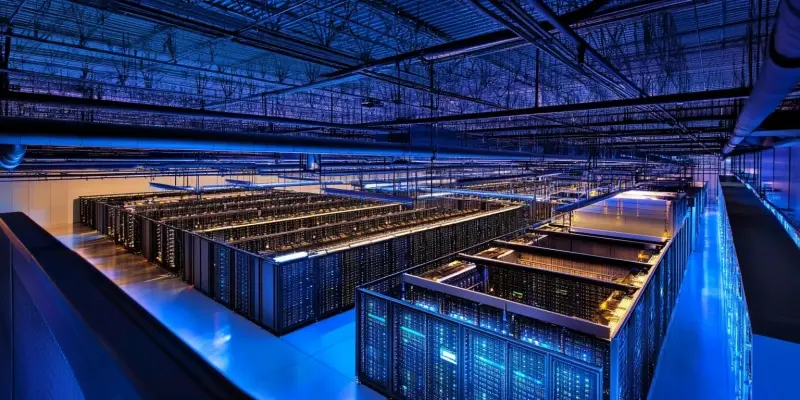
The AI data center market is poised for remarkable expansion, with forecasts estimating its value will reach approximately USD 20.17 billion by 2033. This rapid growth is driven by technological advancements and a surging demand for high-performance computing capabilities needed to support artificial intelligence (AI) and machine learning (ML) applications. Understanding the evolving role of AI data centers is essential to grasp their impact on technology and the global economy.
These specialized facilities are specifically designed to meet the high computational demands of AI and ML development. AI data centers are optimized to handle intensive processes, manipulate and store vast amounts of data, perform complex calculations, and support deep learning models and high-performance computing (HPC) tasks. Consequently, they incorporate advanced accelerators like GPUs and TPUs, tailored to the unique requirements of AI workloads. These centers are truly at the forefront of innovation, enabling groundbreaking scientific, technological, and economic advancements.
The Importance of AI Data Centers
AI data centers have become indispensable for accelerating growth in scientific, technological, and economic domains. Advanced AI systems can significantly bolster national security by aiding in the creation of new offensive and defensive technologies. Falling behind in AI development could not only weaken national security but also reduce a nation’s influence on global progression. Furthermore, losing another transformative technology to international competitors would reverberate across various sectors.
Organizations such as the National Institute of Standards and Technology (NIST) underscore the importance of building trust in AI technologies. By enhancing the design, development, governance, and usage of AI, NIST aims to improve safety, security, and the quality of life. Their focus on advancing measurement science, technology standards, and tools for AI evaluation and data management is pivotal in guiding the responsible development of AI applications.
Government Initiatives and Regulations
In response to the significant advancements in AI, governments around the world are taking proactive measures to ensure the safety, security, and trustworthiness of AI technologies. For example, President Biden signed an Executive Order on October 30, 2023, to strengthen the United States’ capabilities in evaluating and mitigating AI-related risks. This move aims to foster an innovative and competitive AI ecosystem that protects consumers and supports workers.
Such initiatives highlight the necessity of a robust regulatory framework to guide the development and implementation of AI technologies. By establishing clear guidelines and standards, governments can ensure that AI data centers operate efficiently and securely, benefiting society as a whole. The impact of this framework extends beyond immediate concerns, laying the groundwork for sustainable and responsible AI growth.
Sustainability in AI Data Centers
One of the critical aspects of modern data centers is their commitment to sustainability. As AI technologies require substantial energy, the power usage of data centers is continuously being planned and assessed. Countries like Japan are even considering nuclear power to meet these immense demands. Despite the evolving nature of energy efficiency practices, contemporary data centers are incorporating cutting-edge advancements like liquid cooling, which involves immersing servers in non-conductive liquids to reduce cooling energy, and AI-based tools to optimize operations further.
As we progress into an era marked by significant advancements in AI industries and the global economy, the evolution of data centers supporting these emerging technologies continues. The next generation of AI data centers aims to establish self-sustaining, scalable, and sovereign infrastructures. Companies and governments are preparing for the next wave of AI development with these advanced facilities that play a critical role in enabling technological progress.
Trends Shaping the AI Data Center Market
Several trends are shaping the future of the AI data center market, each contributing distinctly to the evolution of these critical infrastructures. AI-powered automation is one such trend, increasingly adopted for tasks like cooling, load balancing, and energy management. These systems analyze real-time data and make automatic adjustments to optimize performance, reducing manual intervention and operational costs significantly.
Another significant trend is the integration of edge computing. Data centers are shifting towards decentralized infrastructures where data processing occurs closer to its source. This approach leverages AI to enable real-time data processing at the edge, significantly reducing bandwidth bottlenecks and data centralization. The rise of edge computing represents a transformative shift in how data infrastructure is managed.
Security remains a top priority, and AI-driven solutions are at the forefront of developing advanced security protocols to combat growing cyber threats. AI-powered systems detect anomalies and identify potential threats in real-time, providing proactive protection of data. This trend is crucial given the sensitive information stored within data centers and the vital infrastructure they support.
AI-optimized cooling systems are another innovative trend, significantly impacting the energy expenses of data centers. These systems dynamically adjust cooling operations by monitoring environmental conditions, thus minimizing energy waste. This reduces both operational costs and the environmental footprint of data centers.
Finally, the integration of renewable energy sources into AI data centers highlights a commitment to global sustainability efforts. By analyzing weather patterns, energy production, and consumption forecasts, AI optimizes data centers’ use of renewable energy like solar and wind power. This reduces dependency on fossil fuels and aligns with broader environmental goals.
Regional Insights and Market Leaders
The AI data center market is on the brink of significant expansion, with projections indicating its value will soar to around USD 20.17 billion by 2033. This impressive growth is fueled by technological advancements and growing demand for high-performance computing required for artificial intelligence (AI) and machine learning (ML) applications. Understanding the evolving role of AI data centers is crucial to comprehending their influence on technology and the global economy.
These specialized facilities are designed to meet the rigorous computational needs of AI and ML development. AI data centers are optimized to manage intensive processes, handle and store vast datasets, execute complex calculations, and support deep learning models and high-performance computing (HPC) tasks. As a result, they integrate advanced accelerators like GPUs and TPUs, which are customized for AI workloads. These centers are at the forefront of innovation, driving groundbreaking scientific, technological, and economic advancements, and transforming numerous industries by enhancing AI and ML capabilities.