

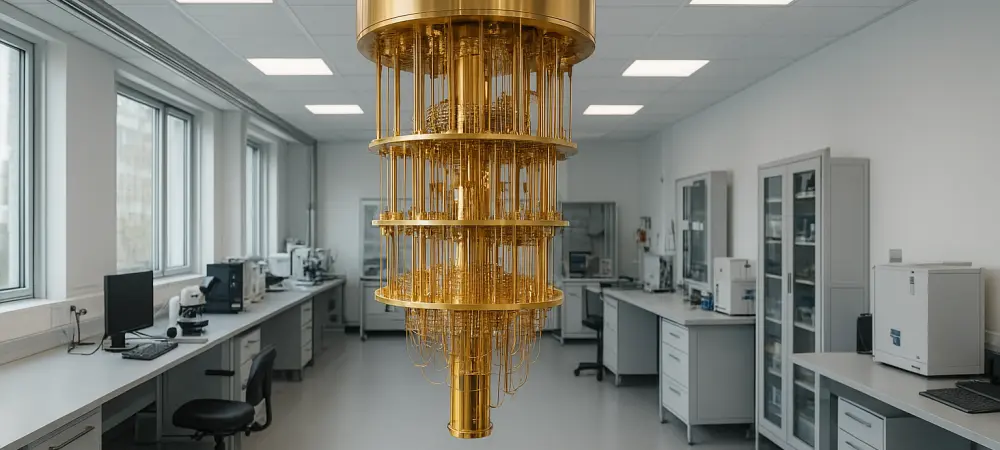
Technological evolution has reached a critical juncture where classical processors no longer possess the raw power necessary to manage the burgeoning complexity of global data ecosystems. As the sheer volume of information generated daily continues to skyrocket, the limitations of traditional silicon-based architectures have become increasingly apparent. Data scientists are now facing a computational wall where high-dimensional problems—once considered theoretical—are now essential for the next generation of artificial intelligence. This shift has catalyzed the move toward quantum computing, a paradigm that fundamentally reimagines how information is processed by stepping outside the constraints of classical logic.
The transition to quantum systems marks a definitive moment in the history of information science. While classical supercomputers have served as the backbone of industry for decades, they are inherently limited by their linear processing capabilities. Quantum computing, however, utilizes the principles of subatomic physics to perform calculations in ways that were previously thought to be impossible. By integrating these systems into the data science lifecycle, researchers are finally able to unlock patterns within massive datasets that classical hardware simply cannot perceive. This convergence is not merely a technical upgrade; it is a total reconstruction of the mathematical foundations of machine learning.
Beyond the Binary: Why the Future of Information Is Quantum
The physical limits of silicon are finally catching up with us, yet our demand for data processing continues to grow exponentially. For decades, the industry relied on shrinking transistors to boost performance, but we have reached a point where quantum tunneling and heat dissipation make further miniaturization nearly impossible. While classical supercomputers struggle with the sheer dimensionality of modern datasets, a new paradigm is emerging that does not just calculate faster—it calculates differently. By leveraging the strange realities of subatomic physics, quantum computing is moving from theoretical physics labs into the heart of the data science lifecycle, promising to solve “intractable” problems in seconds.
This movement represents a departure from the “yes or no” logic of bits toward a more fluid representation of information. Classical systems are forced to check every possible solution to a problem one by one, which creates a massive bottleneck when dealing with millions of variables. Quantum systems, in contrast, explore these possibilities simultaneously, allowing for a level of parallelism that was once relegated to the realm of science fiction. This ability to navigate complex probability spaces ensures that the limitations of the past no longer dictate the potential of future discoveries in artificial intelligence and deep learning.
The Convergence of Qubits and Big Data
As we enter the era of massive-scale AI, the traditional von Neumann architecture faces a significant “power wall” and computational overhead. The movement of data between memory and processing units has become a primary source of latency, hindering the real-time analysis required for modern applications. Data science thrives on pattern recognition and high-dimensional analysis, tasks that are naturally suited to the properties of quantum mechanics. Understanding the transition from bits to qubits is no longer just for physicists; it is becoming a core requirement for data engineers and AI researchers who need to navigate multi-dimensional search spaces that classical hardware simply cannot map.
Modern machine learning models require the processing of millions of parameters, a task that grows exponentially more difficult as models become more sophisticated. Qubits provide a unique advantage here because their capacity to represent information grows exponentially with their number. This synergy between quantum hardware and big data allows for the mapping of relationships within datasets that exist in higher-dimensional spaces. By using quantum-enhanced feature spaces, data scientists can identify subtle correlations in consumer behavior, environmental changes, or genomic sequences that would remain invisible to even the most powerful classical neural networks.
Core Mechanisms Redefining Computational Complexity
The true power of quantum computing is rooted in the mechanisms of superposition and entanglement, which allow qubits to exist in multiple states and remain interconnected across distances. Unlike a classical bit that is either a zero or a one, a qubit can represent a combination of both, enabling a quantum computer to process vast datasets simultaneously rather than sequentially. This is further enhanced by quantum interference, where quantum gates are used to amplify correct data patterns while canceling out computational noise. These mechanisms do not just speed up existing processes; they provide a completely different lens through which to view computational complexity.
Algorithmically, this shift is led by specialized tools like Grover’s Algorithm, which achieves quadratic speedups in database retrieval by replacing traditional linear search methods. In the realm of mathematics, the HHL Algorithm is revolutionizing the backbone of AI by solving complex matrix transformations at quantum speeds, a feat that is essential for training massive neural networks. Furthermore, optimization challenges that involve finding the “global minimum” in complex logistics and financial models—where classical algorithms often get stuck in local minima—are being solved via the Quantum Approximate Optimization Algorithm (QAOA) and quantum annealing. These tools allow for a level of precision and efficiency that transforms how we approach global logistics and economic modeling.
Specialized Applications Across Industrial Frontiers
The practical impact of quantum computing is already visible across various high-stakes industries, particularly in healthcare and genomic sequencing. By modeling protein folding and molecular structures with the Variational Quantum Eigensolver (VQE), researchers are accelerating the timeline for drug discovery and precision medicine. In the financial sector, firms are utilizing quantum systems to run high-fidelity Monte Carlo simulations and optimize portfolios in real-time, allowing them to detect fraud and manage risk with unprecedented accuracy. These applications demonstrate that quantum computing is no longer a peripheral technology but a central driver of industrial innovation.
Cybersecurity is also undergoing a radical transformation as we move beyond Shor’s Algorithm toward Quantum Key Distribution (QKD). This technology creates communication channels that are theoretically immune to hacking, ensuring that data remains secure in an era of increasingly sophisticated cyber threats. Meanwhile, Industry 4.0 is benefiting from the creation of quantum digital twins, which simulate entire supply chains and manufacturing floors to predict systemic failures before they occur. Even climate modeling is seeing a revolution, as quantum processors handle astronomical volumes of atmospheric data to generate hyper-accurate environmental strategies that help mitigate the effects of global warming.
Strategies for Integrating Quantum Machine Learning (QML)
Successfully integrating quantum capabilities requires a shift toward a hybrid quantum-classical model. This approach uses quantum circuits for high-performance preprocessing and optimization while retaining classical frameworks for general logic and data management. One of the most effective strategies involves quantum feature mapping, which encodes classical data into a higher-dimensional Hilbert space to identify subtle patterns in natural language and image recognition. This allows organizations to leverage the strengths of both worlds, ensuring that they do not have to abandon their existing classical infrastructure to reap the benefits of quantum speed.
To bridge the gap between quantum hardware and standard machine learning libraries like PyTorch, developers are increasingly leveraging open-source frameworks such as PennyLane and TensorFlow Quantum. Prototyping with Noisy Intermediate-Scale Quantum (NISQ) algorithms through tools like Google Cirq and IBM Qiskit has become a standard practice for teams looking to experiment without needing a fully fault-tolerant quantum computer. Scaling these efforts is often achieved through cloud-based quantum access, which allows companies to simulate their logic on classical hardware before deploying to actual quantum processors via the cloud. This tiered strategy ensures that quantum integration is both manageable and scalable for modern enterprises.
The transition toward quantum-enhanced data science was defined by a deliberate shift from theoretical exploration to practical implementation. Organizations that succeeded in this landscape were those that prioritized hybrid systems and invested in early-stage cloud access to build institutional knowledge. These pioneers established protocols for quantum-ready data structures and integrated specialized training into their engineering teams, ensuring they were prepared for the arrival of more stable hardware. By focusing on high-impact areas like optimization and complex simulations, they transformed their computational bottlenecks into strategic advantages. This proactive approach allowed the industry to move past the limitations of silicon, securing a foundation for the next decade of intelligent systems.