

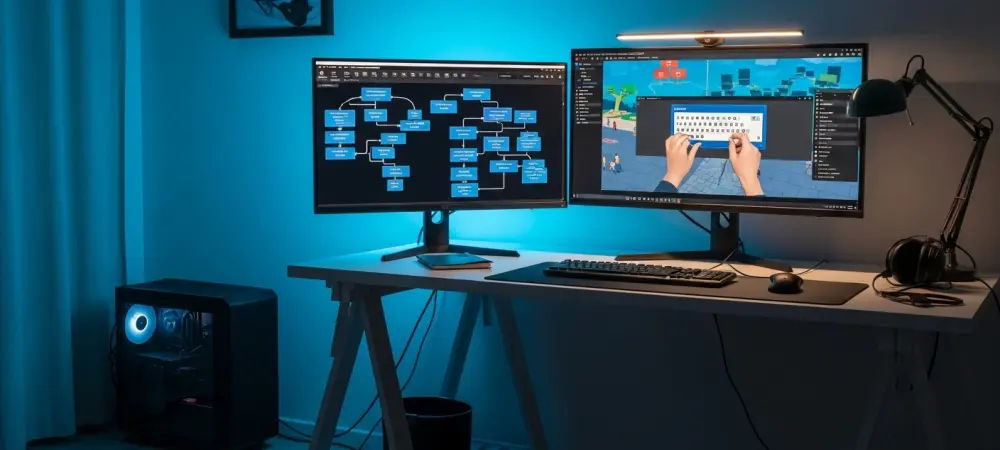
The traditional barrier to entry in the video game industry, once defined by a mastery of complex C++ syntax and advanced linear algebra, has fundamentally dissolved under the weight of accessible artificial intelligence. While the dream of creating a personal, narrative-driven masterpiece used to require years of formal training or the backing of a well-funded studio, the current landscape allows a single individual with a compelling story to build a functional prototype in mere days. This evolution does not merely represent a change in tools, but a complete reimagining of the creative process where the primary constraint is no longer technical skill but the clarity of the vision itself. For literature graduates and enthusiasts who have historically felt sidelined by the technical demands of software engineering, these advancements provide a bridge between abstract storytelling and concrete interactive experiences. The democratization of these technologies ensures that the next generation of games will be defined by diverse voices who prioritize emotional resonance and social complexity over standardized gameplay mechanics. By leveraging a combination of local hardware and sophisticated cloud-based reasoning, a solo developer can now inhabit the roles of lead programmer, creative director, and narrative designer simultaneously. This shift is turning the “impossible dream” of independent development into a structured, achievable reality for anyone with a modern computer and a willingness to experiment.
The Concept of Vibe-Coding: Intent Over Instruction
The emergence of “vibe-coding” marks a significant departure from traditional software development methodologies by prioritizing high-level creative intent over the tedious manual entry of code. In this paradigm, the developer acts more like a film director or an architect, describing the desired atmosphere, character reactions, and narrative flow to an artificial intelligence that handles the underlying logical implementation. For a project like a wedding simulator, which relies heavily on the nuance of human interaction and social pressure, this approach is invaluable because it allows the creator to focus on the “vibe” of a family gathering rather than the specific syntax required to trigger a dialogue box. This method effectively translates human language into functional instructions, enabling those without a deep background in computer science to iterate rapidly on complex ideas. By removing the friction of syntax errors and memory management, vibe-coding empowers creators to spend their mental energy on the elements that actually matter to the player, such as the emotional weight of a choice or the pacing of a scene.
This methodology is particularly beneficial for projects that do not fit into the standard templates of mainstream gaming, such as those focusing on intricate social dynamics or psychological depth. When a developer can describe a scene’s tension in natural language, the AI can suggest the logic for how background characters should whisper or how the environment should react to the player’s presence. This creates a more organic development loop where the feedback between the idea and the implementation is nearly instantaneous, fostering a sense of creative momentum that was previously interrupted by technical roadblocks. Vibe-coding does not eliminate the need for logical thinking; rather, it shifts the focus from “how to write the code” to “what the code should achieve.” This allows for a much broader range of creative experimentation, as the cost of trying out a new idea is reduced from hours of manual labor to a few sentences of description. The result is a more diverse catalog of games that reflect the unique sensibilities of their creators rather than the limitations of their technical training.
Furthermore, the practice of vibe-coding encourages a modular approach to game design where different components of the experience can be tweaked independently based on the desired emotional output. A developer can refine the “mood” of an entire chapter by simply adjusting the prompts that govern the AI’s behavior, allowing for a level of narrative flexibility that would be nearly impossible to achieve with hard-coded scripts. In a wedding simulator, for instance, the subtle shift from a festive atmosphere to one of underlying familial resentment can be achieved by updating the context provided to the AI. This level of control over the abstract qualities of a game world represents a new frontier for interactive storytelling, where the developer’s primary tool is their ability to articulate a specific vision. As this approach becomes more refined, it will likely lead to a surge in “boutique” gaming experiences that prioritize highly specific, curated atmospheres over broad, generic appeal. The developer’s role is thus elevated to that of a systems designer who orchestrates various AI components to produce a cohesive and meaningful player experience.
Technical Foundations: The Power of Local Hardware
Running sophisticated large language models locally on consumer-grade hardware has become a cornerstone of the modern independent developer’s toolkit, offering a level of autonomy that was previously unimaginable. Utilizing a high-performance graphics card like the NVIDIA GeForce RTX 4070 Ti provides the necessary video memory and processing speed to host models like Google’s Gemma with exceptional efficiency. By moving the AI processing away from the cloud and onto a local machine via frameworks like Ollama, creators can achieve a highly responsive development environment that is free from the constraints of internet latency or API subscription costs. This local setup allows for an endless cycle of trial and error, which is essential when fine-tuning the complex social logic required for a realistic narrative experience. The ability to run hundreds of iterations in a single afternoon without incurring significant expenses is a game-changer for hobbyists and solo developers working on tight budgets.
Privacy and data security also play a major role in the preference for local AI, as they ensure that the developer’s unique ideas and proprietary code remain entirely under their control. When working with cloud-based services, there is often a lingering concern about how input data is being used or whether sensitive project details are being stored on remote servers. By keeping all interactions within a private local network, a creator can experiment freely with unconventional or personal themes without the risk of external exposure. This local-first approach also guarantees that the game development process remains functional even in the absence of a stable internet connection, providing a consistent and reliable workspace. For a project as intimate as a wedding simulator, which may draw on personal experiences or sensitive social observations, this layer of privacy is not just a technical advantage but a necessary condition for creative freedom. The decentralization of AI power means that the tools for creating world-class software are now sitting on the desks of individual creators around the globe.
In addition to privacy and cost, the immediate feedback loop provided by local models significantly enhances the creative rhythm of a project. When a developer is testing a specific dialogue interaction or a reactive game mechanic, the near-instant response time of a local model allows them to stay “in the zone” without waiting for server-side processing. This speed is critical when attempting to capture the fluidity of natural conversation or the subtle shifts in a character’s mood. The local hardware acts as a dedicated engine that is tuned specifically to the needs of the project, allowing the developer to push the boundaries of what is possible within a text-based or narrative-driven game. As local models continue to improve in both size and capability, the gap between what can be achieved at home and what is produced in a professional studio will continue to shrink. This technological empowerment is the foundation upon which the next wave of independent innovation is being built, allowing for a more resilient and self-sufficient development culture.
Hybrid Strategy: Claude as the System Architect
While local models provide the daily muscle for executing game logic, high-tier cloud-based AI like Anthropic’s Claude serves as the essential strategic architect for the entire project. Claude’s superior reasoning capabilities and vast knowledge of software design patterns make it an ideal partner for laying out the initial framework of a game and solving complex structural challenges. For a solo developer, Claude functions as a senior lead engineer, offering guidance on how to organize Python scripts, manage data flow, and implement sophisticated libraries like Pygame. This two-tier strategy—using a powerful cloud model for high-level design and a local model for frequent execution—creates a balanced workflow that maximizes both intelligence and efficiency. When the project encounters a bug that the local model cannot resolve, or when a new feature requires a major architectural shift, the superior logic of the cloud-based “Architect” provides the necessary breakthrough.
The synergy between these two types of AI allows a developer to maintain a high level of code quality without needing to be an expert in every aspect of the software stack. Claude can be used to generate robust, well-documented blueprints for the game’s core systems, which are then populated and tested using the local model. This prevents the project from becoming a tangled mess of “spaghetti code” that is difficult to maintain or expand as the game grows in complexity. By relying on a sophisticated architect to define the rules and structures, the developer ensures that their creative vision is built on a professional-grade foundation. This approach is particularly effective for managing the intricate “memory” systems required for dynamic characters, as the cloud AI can design a scalable database structure that the local AI then interacts with during gameplay. The result is a project that is both technically sound and narratively rich, benefiting from the best that both local and cloud technologies have to offer.
Furthermore, this hybrid model facilitates a more educational development experience, as the creator is constantly exposed to the high-level reasoning and problem-solving strategies of a top-tier AI. By reviewing the architectural suggestions and code reviews provided by Claude, a developer from a non-technical background can gradually learn the principles of effective software engineering. This transition from being a “user” of AI to a “collaborator” with it is a key part of the modern developer’s growth, allowing them to take on increasingly ambitious projects over time. The architect-executor relationship provides a safety net that encourages experimentation, knowing that there is a sophisticated system available to help navigate the most difficult technical hurdles. This collaboration is not just about writing code; it is about learning how to think like a developer while maintaining the heart of a storyteller. As these tools become more integrated, the process of building a complex game will feel less like a solitary struggle and more like a guided journey toward a successful launch.
Data-Driven Narrative: Managing Memory with Spreadsheets
One of the most innovative and practical aspects of this modern development stack is the use of simple spreadsheets to manage complex game state and character memories. By utilizing the OpenPyXL library, a Python-based game can interact directly with an Excel file, treating it as a visual and easily accessible database. This choice is brilliant for creators who may find traditional SQL databases or JSON structures intimidating, as it allows them to organize character traits, histories, and relationships in a format they are already familiar with. In the context of a wedding simulator, a spreadsheet can serve as a master ledger for every guest, storing information about their loyalty to the bride, their past conflicts with the groom, and their current emotional state. This data-driven approach means that world-building becomes a task of filling in cells rather than writing hundreds of lines of conditional logic, making the management of a living world much more intuitive.
The integration of a spreadsheet as a persistent memory bank allows for a level of narrative depth that is often missing from purely scripted games. When a player interacts with a character, the game script reads the relevant data from the Excel file and passes it to the local AI as context. The AI then generates a response that is consistent with the character’s established history and current mood, ensuring that every interaction feels grounded in the world’s reality. If a player offends a relative in an earlier scene, the developer can simply update a “relationship score” in the spreadsheet, and the AI will automatically adjust all future interactions to reflect that tension. This method bridges the gap between static data and dynamic storytelling, creating a system where the player’s choices have visible, lasting consequences across the entire game. It is a practical solution that prioritizes functionality and ease of use, proving that sophisticated game logic does not always require high-end backend infrastructure.
Moreover, using spreadsheets for game management significantly lowers the barrier for collaborative storytelling and rapid content expansion. A writer can add a dozen new characters to the game world simply by adding new rows to the Excel file, without ever needing to touch the core Python code. This separation of content and logic is a hallmark of professional game development, yet here it is achieved with tools that are available on almost every personal computer. The visual nature of a spreadsheet also helps the developer maintain a bird’s-eye view of the game’s narrative balance, making it easy to spot where certain characters might need more depth or where social dynamics are becoming lopsided. This transparent and accessible way of handling data ensures that the creator remains in full control of their world’s complexity, allowing for a more deliberate and thoughtful design process. As the game grows, the spreadsheet grows with it, serving as a reliable and flexible backbone for a narrative that can branch in thousands of different directions.
Natural Language: Moving Beyond Dialogue Trees
The transition from rigid, choice-based dialogue trees to free-text natural language interaction represents a fundamental shift in how players engage with a virtual world. In a traditional game, the player is limited to a handful of pre-written options that often feel like “multiple choice” tests rather than actual conversations. By integrating a local AI model to handle dialogue, the wedding simulator allows players to type their own responses, which the AI then interprets based on the social context and character data provided. This creates a much more immersive and unpredictable experience, as the player is no longer searching for the “correct” button but is instead expressing their own personality and intent. The AI essentially acts as a digital dungeon master, maintaining the internal consistency of the character while providing a unique, unscripted reaction to the player’s input. This level of responsiveness makes the NPCs feel like genuine participants in the story rather than static obstacles.
This approach to interaction also solves one of the most persistent problems in narrative game design: the feeling of being restricted by the developer’s imagination. When a player encounters a social conflict in a game, they often have a specific idea of how they want to handle it, only to find that the available options do not reflect their strategy. With an AI-driven natural language system, those “invisible walls” are removed, allowing for a much broader range of player expression. Whether the player wants to be diplomatic, sarcastic, or confrontational, the AI can pivot and respond appropriately, creating a narrative that feels truly personalized. In a setting as socially charged as a wedding, this flexibility is essential for capturing the nuance of family politics and the high stakes of personal relationships. The game becomes a living conversation where the player’s unique voice is the primary driver of the experience, leading to a much deeper emotional connection with the characters and the plot.
Furthermore, the use of natural language input encourages a more thoughtful and engaged style of play, as the player must actually consider what they are saying rather than just clicking through menus. This increases the “agency” of the player, making their successes and failures feel more personal and earned. From a development standpoint, this system is surprisingly efficient, as it replaces the need for thousands of branches of scripted dialogue with a single, robust AI prompt that understands the character’s “vibe.” The focus shifts from predicting every possible player action to defining a clear and consistent identity for each character, which the AI then brings to life. This methodology represents the future of interactive narrative, where the goal is to create a playground for social interaction rather than a linear path through a pre-determined script.
Scalability and Perspectives: The Efficiency of Data Swapping
The power of an AI-driven, data-centralized system is most evident when it comes to scaling a project or exploring different narrative perspectives. Because the game’s logic is separated from its content, a developer can create entirely different versions of the same experience by simply swapping out the underlying dataset. In the wedding simulator project, this was demonstrated by creating two distinct versions of the game: one from the groom’s perspective and another from the bride’s. Rather than rewriting the entire game from scratch, the developer only needed to adjust the framing prompts and the data in the Excel sheets to reflect the different social pressures and emotional priorities of each protagonist. This allows for a massive amount of replayability and depth with a relatively small amount of additional technical work, making it possible for a solo creator to produce a multi-faceted epic.
This scalability is a direct result of the “vibe-coding” philosophy, where the AI is trained to understand the general context of a situation rather than just following a set of hard-coded rules. When the AI is told it is now representing the bride’s internal monologue, it naturally shifts its tone and focus, emphasizing the details that would be most relevant to her. This ability to repurpose the same underlying world for different stories is a significant advantage for independent developers who need to maximize their creative output. It allows for a more holistic exploration of a game’s themes, as the player can see how the same events are perceived differently by various characters. The characters themselves remain consistent across these different versions, but their reactions and priorities change in a way that feels organic and believable. This demonstrates a sophisticated understanding of social dynamics that would be incredibly difficult to program using traditional methods.
Moreover, this approach provides a clear path for future expansion, as the developer can add new “modules” or perspectives to the game without disturbing the core systems. For example, a “Best Man” or “Mother of the Bride” version could be added by simply creating new data profiles and adjusting the AI’s persona instructions. This modularity makes the game a living project that can grow and evolve over time based on player feedback or the creator’s new ideas. The efficiency of this system means that the developer can focus on the creative challenge of world-building rather than the logistical nightmare of manual coding. By letting the AI handle the heavy lifting of narrative adaptation, the creator is free to experiment with more complex and diverse storytelling techniques. This results in a game that feels much larger and more ambitious than its humble origins would suggest, proving that a smart technical foundation is the key to unlimited creative potential.
Future Horizons: Integrating Multimodal AI Experiences
The evolution of this project from a text-based prototype into a full multimedia experience represents the next logical step in the journey of modern independent development. By integrating additional AI tools like Stable Diffusion for real-time image generation, a developer can transform a narrative-heavy game into a visually stunning interactive novel. The AI can analyze the current state of the story and the player’s input to generate custom illustrations that reflect the specific atmosphere of the scene. This would allow the game to show the player exactly what is happening as the AI describes it, creating a much more visceral and immersive experience. The addition of AI-generated audio and music, which can adapt in real-time to the emotional tone of the conversation, will further enhance the atmosphere and draw the player deeper into the world of the wedding simulator. This unified creative process, where a single person can act as writer, programmer, artist, and composer, is only possible because of the supportive power of modern artificial intelligence. The developer is no longer limited by their lack of artistic or musical training; instead, they can use AI as a bridge to express their vision across multiple sensory channels. This does not mean the AI is doing the work for them, but rather that it is providing the technical execution for the creator’s high-level aesthetic choices. The ability to generate a cohesive visual and auditory style that matches the “vibe” of the narrative is a powerful tool for building a professional-grade product on a solo budget. This multimodal approach ensures that the final game is not just a clever tech demo, but a polished and emotionally resonant work of art. As these visual and audio tools become more integrated and easier to use, the quality of independent games will continue to rise, challenging the dominance of larger studios.
The developer’s journey of building a dream game “one day at a time” serves as an inspiring blueprint for anyone who has ever felt that their ideas were too big for their technical skills. By embracing a modular, AI-supported workflow, a personal idea can gradually grow into a complete and sophisticated product that rivals the complexity of much larger projects. The key is to start small, build a solid technical foundation, and use the best available tools to amplify one’s creative strengths. Whether it is through the use of local models for privacy and speed, or cloud-based architects for structural integrity, the path to game development is more accessible now than ever before. This new era of creation is defined by a spirit of experimentation and a belief that the only true limit is the clarity of the creator’s vision. As the tools continue to evolve, the distinction between “dreamer” and “developer” will continue to fade, opening the door for a more diverse and vibrant future for the entire gaming industry.
Actionable Frameworks for Modern Independent Developers
The successful development of a narrative-heavy simulator demonstrated that the traditional barriers between a creative vision and a functional product have been replaced by a manageable set of technical decisions. To replicate this success, developers prioritized the establishment of a robust local environment, utilizing high-VRAM hardware and efficient frameworks like Ollama to ensure a responsive and cost-effective iteration cycle. By offloading the execution of social logic to local models, creators maintained absolute privacy over their intellectual property while avoiding the latency issues that often plagued cloud-dependent systems. This technical foundation proved to be the most critical step in moving from a conceptual “vibe” to a playable prototype, as it provided the necessary sandbox for constant experimentation without financial penalty. Aspiring developers learned that investing in a capable local machine was not merely a hardware choice but a strategic move toward creative independence and long-term project sustainability. Strategic reliance on sophisticated cloud-based reasoning engines served as the necessary architectural oversight that kept complex projects from collapsing under their own weight. Developers used models like Claude to design modular Python structures and navigate the intricate requirements of libraries such as Pygame and OpenPyXL. This hybrid approach allowed individuals to maintain high standards of software engineering even without a formal background in the field, as they treated the AI as a collaborative senior partner rather than a simple code generator. The most effective workflows involved documenting the system’s architecture in a clear, high-level blueprint and then using local models to fill in the functional details of the game world. This disciplined separation of design and execution ensured that the project remained scalable and organized, even as new features and narrative branches were introduced.
The integration of accessible data structures, such as spreadsheets, proved to be an essential solution for managing character memory and persistent world states. By treating a familiar tool like Excel as a dynamic database, developers created a transparent and highly editable system that allowed for rapid world-building and narrative fine-tuning. This method enabled a seamless transition between different character perspectives and plot variations, proving that data-driven storytelling was the most efficient way to scale a solo project. Moving forward, the most successful independent creators focused on building these flexible data pipelines, recognizing that the true value of their work lay in the unique data and social context they provided to the AI. The journey showed that the combination of local execution, cloud architecture, and intuitive data management provided a complete toolkit for anyone ready to transform a personal dream into a tangible interactive reality.