

Machine learning models require access to negative data to understand what does not work, yet most published research focus only on successful binders. This fundamental gap highlights the evolving nature of therapeutic antibody discovery, which is rapidly moving away from the traditional, labor-intensive empirical screening toward a paradigm known as specification-driven engineering. For several decades, the pharmaceutical sector viewed the search for new treatments as a massive numbers game, relying on the construction and examination of vast libraries containing billions of candidates just to identify a single promising binder. However, the emergence of generative artificial intelligence is now redefining this entire methodology by utilizing massive computational power to design antibodies with specific, pre-defined properties from the very start. Rather than merely searching for a needle in a haystack, researchers are now empowered to engineer therapeutic candidates through a sophisticated digital blueprint.
Advanced AI Methodologies: The Rise of Protein Language Models
Several core artificial intelligence technologies are currently spearheading this radical transformation, most notably through the application of advanced Protein Language Models (PLMs) and structure-based generative tools. These models are meticulously trained on immense datasets of millions of protein sequences, which allows them to understand the underlying “grammar” of biological molecules. By recognizing these patterns, PLMs can predict and suggest specific mutations that enhance the binding performance of an antibody without inadvertently disrupting its vital structural integrity or causing the protein to unfold. This predictive capability is far more efficient than random mutagenesis, as it identifies high-probability candidates before any physical laboratory work begins. Consequently, the time spent in the initial design phase has plummeted, allowing teams to focus on refining candidates that already possess a strong biological foundation, ensuring that early development is guided by data.
Furthermore, geometry-aware generative models are taking protein engineering a step further by utilizing precise molecular data to design antibodies tailored to specific epitopes. These epitopes are the exact regions on an antigen that the immune system recognizes, and targeting them accurately is often the difference between a successful drug and a failed experiment. These sophisticated tools can model the three-dimensional interactions between molecules with high precision, ensuring that the designed antibody fits its target like a key into a lock. In practical terms, these tools have significantly reduced the amount of labor required in the laboratory; for instance, some contemporary models have successfully improved antibody affinity while testing as few as twenty variants. This stands in stark contrast to traditional methods that might require the synthesis and screening of thousands of different molecules to achieve similar results, allowing for a faster timeline for treatments.
Conquering Complexity: Targeting the Hardest Diseases
Beyond mere improvements in speed and efficiency, generative artificial intelligence is expanding the scope of what the industry considers “druggable” targets. G protein-coupled receptors (GPCRs) have long been a source of frustration for drug developers because they are embedded within cell membranes and constantly shift between various shapes or conformations. Traditional screening methods often struggle with these moving targets, frequently resulting in antibodies that bind but do not produce the desired functional effect in the patient. AI models can now navigate these geometric complexities by incorporating dynamic structural data directly into the design process. This allows for the creation of antibodies that are specifically designed to stabilize or target a particular conformation of the receptor, unlocking new possibilities for treating metabolic conditions. This precision-engineered approach effectively bypasses the limitations of older screening techniques that relied on static snapshots.
Similar breakthroughs are being seen in the treatment of neurological diseases, where the primary challenge is the blood-brain barrier. This protective layer is exceptionally selective, often preventing large molecules like antibodies from reaching their intended targets in the central nervous system. Generative AI is now being utilized to model the intricate transport mechanisms required to cross this barrier, designing antibodies that can bind to transport proteins for passage and then release their therapeutic cargo once they have arrived. By simulating these interactions at a molecular level, researchers are developing candidates that are much more likely to succeed in clinical trials for conditions like Alzheimer’s or Parkinson’s. This level of foresight in the design stage reduces the need for expensive, late-stage failures that have plagued the industry for decades. As these computational models continue to mature between 2026 and 2030, the ability to address biological hurdles will become a standard feature.
Integrated Systems: Breaking the Experimental Bottleneck
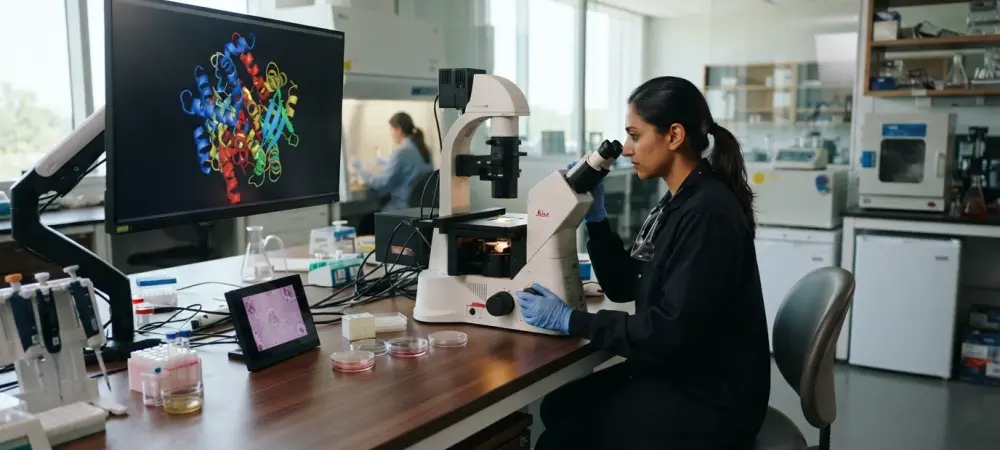
The sheer complexity of human biology means that the laboratory remains an essential part of the discovery process. Even the most advanced simulations cannot yet fully account for every environmental variable or unpredictable molecular interaction, necessitating physical validation of AI-generated designs. This has led to the adoption of a “closed-loop discovery” model, where the computational design and laboratory testing phases are inextricably linked. In this system, the AI proposes a selection of candidates, and the laboratory immediately synthesizes and tests them for binding and stability. The resulting data—whether a success or a failure—is then fed back into the AI model to refine its predictive algorithms for the next round of design. This iterative cycle creates a powerful feedback loop that allows the machine to learn from its own mistakes in real-time, drastically increasing the accuracy of subsequent generations of antibody candidates by focusing on performance.
The integration of generative intelligence and high-throughput validation established a more predictable and effective path for delivering bespoke therapeutics for the most challenging diseases. This evolution moved the industry toward a state where biological risks were mitigated much earlier in the cycle, leading to more resilient drug pipelines and lower overall development costs. Rather than repeating the mistakes of the past, organizations focused on building adaptive systems that leveraged both computational insight and rigorous experimental proof. The strategic priority shifted from simply finding a single working molecule to mastering the principles of protein design that governed all future discovery efforts. This transition ensured that the pharmaceutical sector was better prepared to respond to emerging health threats with speed and precision. Ultimately, the synergy between these disciplines redefined what was possible in medicine, creating a foundation for data-driven design.