

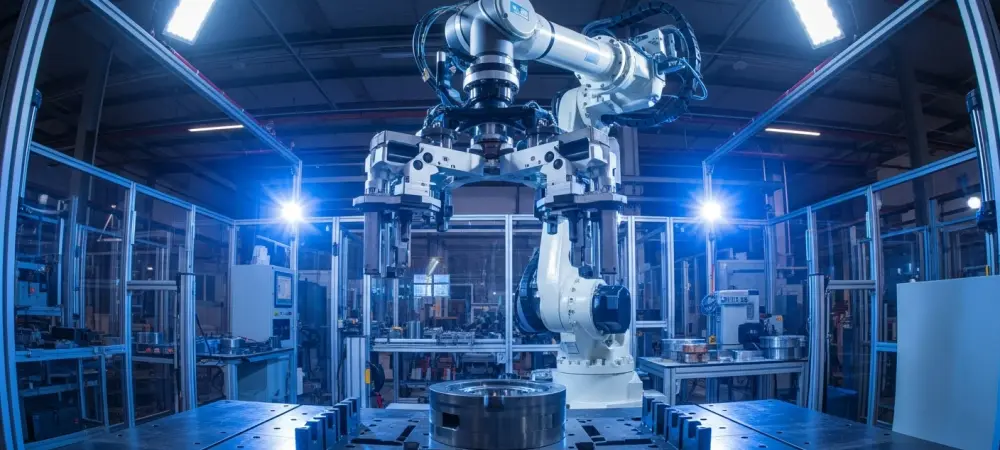
The mechanical arm hovers above a chaotic bin of unsorted parts, demonstrating a level of fluid decision-making that was once reserved solely for human workers on the assembly line. This represents a seismic shift in how machines interact with their environment. For decades, the factory floor was a place of strict predictability, where robots performed the same movements with robotic precision. However, the moment a new product arrived or a part shifted an inch out of place, the entire system would grind to a halt, waiting for a human programmer to fix the vision templates.
Moving Beyond the Rigid Constraints of Traditional Automation
Festo GripperAI is fundamentally changing this dynamic by replacing static code with dynamic intelligence, allowing robots to see, think, and adapt to the messiness of the real world without constant human intervention. By integrating neural networks directly into the handling process, the software provides a layer of cognitive flexibility. This shift moved the industry toward a model where hardware is no longer a prisoner of its initial programming, enabling a more resilient manufacturing ecosystem. Replacing manual vision tuning with automated perception allows for a seamless transition between different production tasks. In the past, every minor adjustment required a specialist to spend hours recalibrating sensors and updating coordinate databases. With the introduction of AI-driven logic, the machine identifies the task requirements autonomously, effectively bridging the gap between digital instructions and physical execution.
The Logistics Crisis: Why Static Templates No Longer Suffice
In an environment where consumers expect endless variety and rapid delivery, warehouses and manufacturers are facing an explosion of Stock Keeping Units (SKUs). Traditional robotic systems struggle in these high-mix environments because they rely on pre-loaded 3D models and specific coordinates for every item. When a mixed-product stream contains thousands of unique shapes, sizes, and weights, the “template-based” approach becomes a massive operational bottleneck that limits scalability and increases overhead costs.
Moreover, the time required to teach a robot a new object used to take a significant amount of engineering labor. As product cycles shortened, this manual labor became an unsustainable expense for most businesses. Logistics centers needed a solution that could handle an unknown item the first time it appeared on the conveyor belt, without a digital blueprint or a human safety net to catch errors.
Real-Time Intelligence: Identifying Items and Calculating Optimal Grips
The core of GripperAI lies in its ability to bypass manual programming entirely by using sophisticated neural networks to analyze 3D camera data. Instead of looking for a match in a database, the software identifies physical characteristics and calculates the most secure gripping point on the fly. This includes managing complex tool selections, such as choosing between a vacuum suction cup for a smooth surface or a mechanical jaw for a heavy box, all within a fraction of a second.
This “on-the-fly” calculation means the robot does not just see an object; it understands its physical geometry. Whether the item is a translucent plastic bag or a matte metal cylinder, the AI evaluates the surface friction and center of mass. Consequently, the machine’s dexterity began to mirror biological intuition, allowing for delicate handling in environments previously too complex for automation.
Efficiency Through Hardware Independence and Edge Computing
Unlike many AI solutions that require a constant, high-speed connection to the cloud, GripperAI operates locally on standard industrial PCs. This localized “edge” processing significantly reduces latency, ensuring that the robot does not have to pause and wait for a remote server to tell it how to move. Furthermore, the software’s hardware-agnostic design allows it to work with a wide range of robots, from massive industrial arms to collaborative cobots.
This independence from specific vendors changed the ROI calculations for many facility managers. By allowing for the integration of existing hardware, the software lowered the entry barrier for advanced automation. Companies were able to upgrade their current fleets with intelligent “brains” without discarding functional robotic limbs, effectively democratizing high-end AI capabilities across the sector.
Continuous Throughput and the Lights Out Operation
One of the most transformative features of GripperAI is its autonomous error recovery, which is essential for “lights out” or fully automated shifts. If the system fails to secure a pick, it does not trigger an alarm and wait for a technician; instead, the AI immediately recalculates its strategy, tries a different angle, and attempts the pick again. This resilience ensures that the production line remains active, maintaining high throughput even when dealing with unpredictable or difficult-to-handle items.
The self-healing nature of this workflow meant that human oversight could be redirected to more strategic tasks. Instead of clearing jams or resetting cameras, technicians focused on optimizing flow and managing higher-level logistics. This reliability turned “fully automated” from a marketing buzzword into a functional reality for facilities operating 24/7.
Validating Performance: The Würth Group Case Study
The practical impact of this technology was best seen at the Würth Group’s distribution hub in Germany. Tasked with managing a staggering inventory ranging from tiny electronic components to bulky boxes weighing up to 44 pounds, the facility integrated GripperAI to handle their mixed-product streams. The system successfully managed a tool station with various grippers, proving that AI can handle industrial-scale diversity while reducing the ergonomic strain on human workers.
The implementation showed a marked improvement in picking accuracy across thousands of unique products. By automating the most repetitive and physically demanding sorting tasks, the facility improved employee satisfaction while hitting throughput targets that were previously unreachable with manual labor alone. This case study served as a blueprint for global logistics leaders looking to stabilize their supply chains.
A Strategic Roadmap: AI-Driven Handling Integration
Transitioning to an AI-driven robotic cell required a shift in how facilities approached automation. Operators first identified the highest-variance points in their workflow where manual vision tuning acted as a bottleneck. From there, the integration process involved selecting compatible hardware, calibrating the software to the specific work envelope, and leveraging the AI’s ability to learn from various pick-and-place scenarios. Strategic planning focused on long-term scalability rather than immediate, isolated fixes. Organizations that adopted a modular approach found it easier to integrate future sensors and more complex grippers as they became available. This forward-looking stance ensured that the investment in GripperAI not only solved current logistical challenges but also established a flexible foundation for the next generation of autonomous industrial intelligence.