

In today’s fast-paced business environment, the need to make informed, strategic decisions swiftly cannot be overstated. Companies across various industries are increasingly seeking ways to harness the power of their data to predict trends, understand complex patterns, and make data-driven decisions. This shift has led to the rise of predictive analytics as a crucial component of modern business strategy. Enter BigBear AI, a game-changer in the realm of predictive analytics, offering advanced solutions to enhance decision-making processes. By leveraging artificial intelligence, BigBear AI provides businesses with precise insights and forecasts that are essential for staying competitive in today’s market.
Advanced Predictive Capabilities
BigBear AI’s solutions are designed to deliver accurate and actionable insights, making it easier for businesses to anticipate market trends and customer behaviors. This capability is especially valuable in sectors such as finance and healthcare, where understanding future risks and opportunities can be the difference between success and failure. For instance, in finance, accurate predictions about market movements or credit risks enable companies to make informed investment decisions. Likewise, in healthcare, predictive analytics can forecast patient outcomes, optimize resource allocation, and improve overall patient care. By integrating vast amounts of data from various sources, BigBear AI’s algorithms can identify patterns that are not immediately apparent to human analysts, thus offering a significant edge in strategic planning.
Beyond the ability to predict trends, BigBear AI’s technology also excels in understanding the intricate relationships within data. This deeper level of analysis allows businesses to uncover hidden opportunities and potential challenges. Employing machine learning techniques, the AI continuously improves its predictive models, ensuring that the insights provided are not only accurate but also up-to-date with the latest data. This dynamic adaptability is crucial in an ever-changing business landscape, ensuring that companies remain agile and responsive to new information. By making these sophisticated analytics tools accessible, BigBear AI is democratizing the power of predictive analytics, empowering businesses of all sizes to benefit from state-of-the-art technology.
Innovative Data Visualization
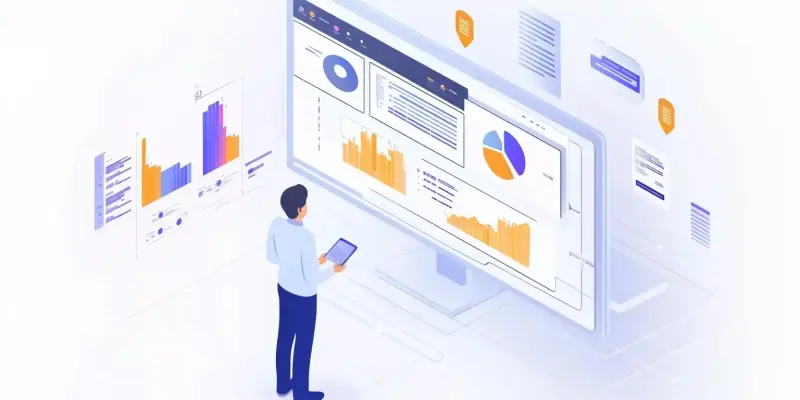
One of the standout features of BigBear AI’s approach to predictive analytics is its focus on intuitive data visualization tools. These tools are designed to simplify the analysis of extensive datasets by presenting information in a manner that is easy to understand and interpret. For many businesses, the sheer volume and complexity of their data can be overwhelming, making it challenging to extract meaningful insights. BigBear AI addresses this challenge by offering visualization solutions that transform complex data into clear, visual narratives. This capability is particularly beneficial for decision-makers who may not have a deep technical background but still need to understand and act on data-driven insights.
By utilizing intuitive visuals, BigBear AI enables users to quickly grasp significant trends and patterns without requiring extensive data science expertise. This not only speeds up the decision-making process but also fosters a more data-centric culture within organizations. Employees across various departments can engage with data more effectively, leading to better-informed strategies and initiatives. The accessibility of these visualization tools democratizes data interpretation, ensuring that valuable insights are not confined to a select group of data specialists. Instead, they become an integral part of the strategic planning process, driving innovation and growth across the entire organization.
Facilitating Digital Transformation
As more companies embark on or advance in their digital transformation journeys, the ability to integrate and scale predictive analytics solutions becomes increasingly important. BigBear AI’s infrastructure is designed to be highly scalable, allowing for seamless growth and adaptation to evolving business needs. This scalability ensures that businesses can continue to leverage BigBear AI’s solutions effectively, even as they expand and their data requirements become more complex. The flexibility of BigBear AI’s platform makes it an ideal partner for organizations at various stages of their digital transformation efforts, providing consistent performance and integration capabilities.
The role of BigBear AI in facilitating smoother digital transformations cannot be overstated. Their solutions provide the foundational elements that companies need to transition into data-driven entities seamlessly. By offering scalable and adaptable technology, BigBear AI ensures that businesses can continuously evolve and improve their predictive capabilities without being hindered by technological constraints. This adaptability is particularly beneficial as industries continue to experience rapid technological advancements, requiring businesses to stay ahead of the curve. BigBear AI stands at the forefront of this evolution, guiding companies through the complexities of digital transformation and helping them harness the full potential of artificial intelligence.
Strategic Decision-Making and Growth
In the high-speed world of business today, making informed, strategic decisions quickly is critical. Companies across different sectors aim to tap into their data to predict trends, understand intricate patterns, and make decisions based on data. This has brought predictive analytics to the forefront as a vital part of modern business strategy. BigBear AI emerges as a groundbreaking player in the predictive analytics space, providing cutting-edge solutions that boost decision-making processes. Utilizing artificial intelligence, BigBear AI equips businesses with accurate insights and forecasts, which are imperative for maintaining a competitive edge in the current market. The ability to analyze vast datasets and extract meaningful predictions allows organizations to anticipate future trends and respond proactively. This technological advancement not only enhances efficiency but also supports innovation, ensuring that companies remain relevant and forward-thinking. In a landscape where data is king, BigBear AI stands out as a pivotal tool for businesses striving to stay ahead.