

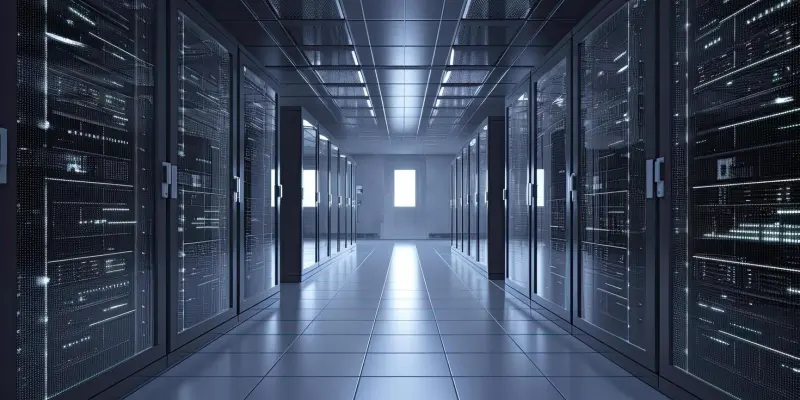
Artificial intelligence (AI) is revolutionizing numerous industries, and the transformation of data center power and cooling systems is among the most remarkable. As AI applications become more advanced and pervasive, the demand for efficient, reliable, and scalable data centers intensifies. This increasing necessity has led to significant advancements in physical infrastructure, particularly in power and cooling solutions. The surge in compute and rack densities in data centers, driven by the growing implementation of AI technologies, poses new challenges and requires innovative solutions. Notably, predictions indicate that AI will account for over 50% of global data center capacity and more than 70% of the revenue opportunity, underscoring the profound impact AI has on the functionality and potential of data centers.
Capital Expenditure and Infrastructure Investments
The data center industry is experiencing unprecedented levels of capital expenditure (CAPEX) investments, with projections suggesting a global expenditure of $1 trillion by 2030. This represents a substantial increase from less than $500 billion in 2024. The primary focus of these investments is on physical infrastructure, with a particular emphasis on power and cooling systems. The annual growth rate for these areas is an impressive 18%, highlighting their critical importance in the evolution of data centers. Experts predict a consolidation of the server count within data centers, resulting in fewer but larger systems. This consolidation strategy is expected to drive down the cost per byte and compute cycle, making data centers more efficient and cost-effective.
The expansion of AI’s influence in data centers is further evident in the increasing power capacity requirements. New installations are anticipated to add approximately 50 GW per year, potentially leading to a cumulative power capacity nearing 400 GW by 2030. Advanced rack designs are a key driver of this trend, with innovations like 120 kW racks already on the horizon and the potential development of 600 kW racks within a couple of years. However, this rapid growth presents challenges for startup data center campuses and newer cloud providers, particularly those lacking extensive business expertise. These entities are advised against relying on single providers due to potential risks and failures, emphasizing the need for a diversified and robust infrastructure approach.
Cooling Challenges and Solutions
One of the most significant challenges posed by the AI wave is effectively managing the heat generated by high-powered equipment. Air cooling, which reached its peak effectiveness around 2022, has inherent limitations, particularly for systems requiring more than 80 Watts per cm². To address these limitations, single-phase direct-to-chip (DtC) liquid cooling has become increasingly necessary. This method employs water or other fluids to dissipate heat directly through cold plates attached to the chips, efficiently handling up to 140 W/cm². By 2026, single-phase DtC cooling may prove insufficient for the most advanced racks, leading to broader adoption of two-phase liquid cooling systems. Two-phase liquid cooling enhances efficiency by utilizing fluids that vaporize upon heating, thus dissipating more significant amounts of heat. The adoption of this technology is expected to increase, with projections indicating that by 2028, approximately 80% of advanced chips requiring 600 watts or more will rely on liquid cooling, a notable rise from the current figure of 50%.
The evolution of cooling technologies is a direct response to the limitations of traditional air cooling and the increasing power demands of high-performance chips. These advancements highlight the critical role of innovative cooling solutions in maintaining the efficiency and reliability of data centers as AI continues to drive their development.
Power Self-Generation and Future Trends
The shift towards increased power self-generation is another significant trend within the data center industry, driven by the growing power demands that utilities struggle to satisfy. By 2030, it is expected that over 35 GW of power will be sourced off-grid. This move towards self-sufficiency in power generation is crucial for data centers to meet their escalating energy requirements and ensure uninterrupted operations. Innovative solutions to manage and store energy are also in development, further supporting this trend of self-generated power. The transition to more sophisticated cooling technologies is a testament to the industry’s commitment to overcoming the limitations of traditional methods. As seen with air cooling, which can handle only up to 80 W/cm², new cooling solutions like single-phase and two-phase liquid cooling are essential to support advanced chip technologies and high-density racks. These solutions are crucial to maintaining the operational efficiency of data centers and managing the immense heat generated by modern AI-driven applications.
Looking ahead, the future of data center infrastructure will likely see continued advancements in both power and cooling technologies. Enhanced self-generation capabilities and the adoption of cutting-edge cooling methods will become increasingly important as AI-driven demands continue to rise. As data centers become more complex and require greater resources, the need for efficient, reliable, and scalable infrastructure will be more critical than ever.
Transformative Impact on Data Centers
The data center industry is experiencing an unprecedented surge in capital expenditure (CAPEX) investments, with global projections suggesting a spend of $1 trillion by 2030, a significant rise from under $500 billion in 2024. These investments predominantly target physical infrastructure, especially power and cooling systems. The annual growth rate for these components is an impressive 18%, underscoring their crucial role in the evolution of data centers. Experts foresee a consolidation in server counts within data centers, leading to fewer but larger systems. This consolidation aims to reduce the cost per byte and compute cycle, enhancing efficiency and cost-effectiveness.
AI’s expanding influence also demands higher power capacities in data centers. New installations could add around 50 GW annually, with cumulative power capacity possibly reaching 400 GW by 2030. Advanced rack designs, like upcoming 120 kW racks and potential 600 kW racks, are driving this trend. However, this rapid growth poses challenges for startup data center campuses and newer cloud providers, especially those lacking extensive business expertise. These entities are advised against depending on single providers due to potential risks and failures, highlighting the importance of a diversified and robust infrastructure approach.